 Call us now:



BOI Company registration in Thailand as a legal gateway for foreign investment
BOI company registration in Thailand constitutes one of the most sophisticated legal mechanisms available to foreign investors seeking to establish and operate a business in Thailand while retaining control, legal certainty, and long-term operational stability. In a jurisdiction where foreign participation in business activities is, in principle, strictly regulated, the Thai legal system has deliberately created a derogatory regime to attract strategic investment aligned with national economic priorities.
Under the Foreign Business Act B.E. 2542 (1999), foreign-owned companies are either prohibited or subject to licensing requirements when engaging in activities listed under Schedules 1, 2 and 3 of the Act. These restrictions affect a wide range of sectors, including services, trade, and professional services. Without a specific exemption, foreign investors are generally limited to a maximum 49% shareholding and may be required to obtain a Foreign Business License, a discretionary, often uncertain administrative process.
To counterbalance these restrictions and stimulate economic growth, Thailand enacted the Investment Promotion Act B.E. 2520 (1977). This legislation establishes the legal authority of the Board of Investment (BOI) and empowers it to grant investment promotion privileges to projects that contribute to Thailand’s development objectives. Through this statutory framework, the BOI is authorised to grant both tax and non-tax incentives, including exemptions from the Foreign Business Act, corporate income tax holidays, import duty exemptions, and immigration facilitation for foreign personnel.
A BOI company registration in Thailand, therefore, does not merely concern the incorporation of a company. It is a project-based legal status that reshapes how foreign investors may operate under Thai law. When properly structured, BOI promotion allows a foreign investor to hold up to 100% of the shares in a Thai company, operate without a Foreign Business License, employ foreign specialists beyond standard quotas, and benefit from a preferential tax regime governed by the Thai Revenue Code and BOI notifications.
However, BOI promotion is not automatic. It is conditional upon strict eligibility criteria, detailed project evaluation, and continuous compliance obligations. The BOI assesses the economic substance of each project, its technological contribution, its financial feasibility, and its alignment with public policy objectives. Once granted, BOI privileges remain subject to monitoring, reporting obligations, and statutory deadlines. Failure to comply may lead to suspension or revocation of the promotion, with significant financial and legal consequences.
This article provides a comprehensive legal analysis of BOI company registration in Thailand, examining its statutory foundations, procedural requirements, benefits, and compliance risks, while highlighting the importance of structured legal support to secure and maintain BOI status.
Table of Contents
BOI Company registration in Thailand: strategic advantages for foreign investors
From a legal and strategic standpoint, BOI promotion fundamentally alters the regulatory environment in which a foreign investor operates in Thailand. The most significant advantage lies in the statutory exemption from the Foreign Business Act, expressly authorized by Section 12 of the Investment Promotion Act. Once promoted, a BOI company may conduct its approved activities without being subject to foreign shareholding limitations or licensing requirements otherwise imposed by Thai law.
In addition to ownership flexibility, BOI promotion provides access to a preferential tax regime. Corporate income tax exemptions may be granted for a defined period, typically ranging from three to eight years, depending on the promoted activity, its technological intensity, and its location. These exemptions are governed by BOI announcements and implemented through the Revenue Code, allowing promoted companies to reinvest profits during the early stages of operation.
BOI promotion also facilitates the importation of machinery and raw materials. Import duties may be fully exempted for machinery used in promoted activities, while raw materials imported for export-oriented production may benefit from duty exemptions during the authorised production period. These incentives significantly reduce initial capital expenditure and operating costs.
From an immigration perspective, BOI promotion interacts with the Immigration Act B.E. 2522 (1979) and labour regulations to streamline visa and work permit procedures. Foreign directors, executives, and specialists employed by BOI-promoted companies benefit from simplified processing through dedicated BOI service centres, reducing administrative delays and uncertainty.
Eligible activities under BOI company registration in Thailand
The granting of incentives by the Board of Investment of Thailand (BOI) is strictly reserved for activities listed in the BOI’s official lists, which are regularly updated to reflect Thailand’s national economic strategy. These eligible activities are part of a long-term development strategy, industrial upgrading and international competitiveness.
In practice, the BOI classifies promoted activities into distinct categories, each subject to specific legal, technical, and financial conditions.
The main categories of activities promoted by the BOI
The BOI structures its eligible activities around several strategic groups, including:
a) Advanced Manufacturing
These activities have historically been at the heart of BOI promotions and include:
- Manufacture of electronic components and semiconductors
- Automotive industry and electric vehicles (EV)
- Manufacture of industrial machinery, robots and automation systems
- Aeronautics and maintenance industries (MRO)
These projects generally require:
- A high level of technology
- Significant capital investment
- Know-how or technology transfers
- Commitments to training the Thai workforce
b) Digital & Technology-Based Activities
This segment is currently one of the most sought after by foreign investors, particularly because it allows 100% foreign ownership through BOI Company registration in Thailand. It includes:
- Software and digital platform development
- IT services, cloud services, data centres
- Cybersecurity activities
- Application development, fintech, AI and blockchain (subject to conditions)
- International digital service centres
These BOIs are particularly sought after by:
- International start-ups
- IT service companies
- Regional Operating Headquarters (ROH) or International Business Centre (IBC) type structures
c) Research, innovation and R&D
The BOI is placing increasing importance on activities with high intellectual value, such as:
- Research and development (R&D) centres
- Technological innovation and advanced engineering
- Industrial design and product engineering
These projects often benefit from enhanced tax privileges, provided they can demonstrate genuine research activity within Thailand.
d) Biotechnology, medical industries and healthcare
This sector is actively supported by the Thai government and includes:
- Manufacture of medical devices
- Biotechnology and pharmaceuticals
- Specialised medical services and international clinics (subject to conditions)
- Laboratories and medical analysis centres
These BOIs are subject to strict regulatory standards, particularly regarding sectoral licensing and health compliance.
e) Renewable energy and environmental activities
As part of the energy transition, the BOI promotes:
- Solar, wind and biomass energy production
- Waste recycling and treatment
- Environmental services and green technologies
- Carbon footprint reduction solutions
These projects often benefit from significant tax incentives and strong institutional support.
f) International services and regional structures
Among the most sought-after BOIs are:
- International Business Centres (IBCs)
- Regional Headquarters (RHQs)
- Shared Service Centres
- Management, finance, compliance, IT or marketing activities for foreign subsidiaries
These structures allow for:
- 100% foreign ownership
- Corporate tax advantages
- Facilities in terms of visas and work permits for foreign executives.
BOIs are most in demand by foreign investors
In practice, the BOIs most frequently requested today are:
- Software development and IT services
- International Business Centre (IBC)
- Digital service centres and data centres
- Technical consulting or advanced engineering activities
- R&D and innovation
- Renewable energies
These categories are preferred because they provide a stable legal structure compatible with the rules of the Foreign Business Act while offering operational and tax flexibility through BOI Company registration in Thailand.
Excluded or rarely promoted activities
It is essential to note that the BOI does not promote:
- Simple trading activities with no added value
- Purely domestic services
- Catering, bars, and traditional retail businesses
- Activities without demonstrable innovation, technology or international dimension
Each application is analysed individually, based on a detailed business plan, the project’s economic coherence, and its alignment with national priorities.
Importance of prior legal structuring
The BOI qualification of an activity is based not only on its description, but also on:
- The precise wording of the corporate purpose
- The structuring of capital
- Contractual and operational commitments
- Compliance with tax and social security requirements
Incorrect qualification of the activity may result in refusal of promotion or subsequent questioning of the privileges granted.
Get expert legal guidance.
BOI Company registration in Thailand: Application and Approval Process
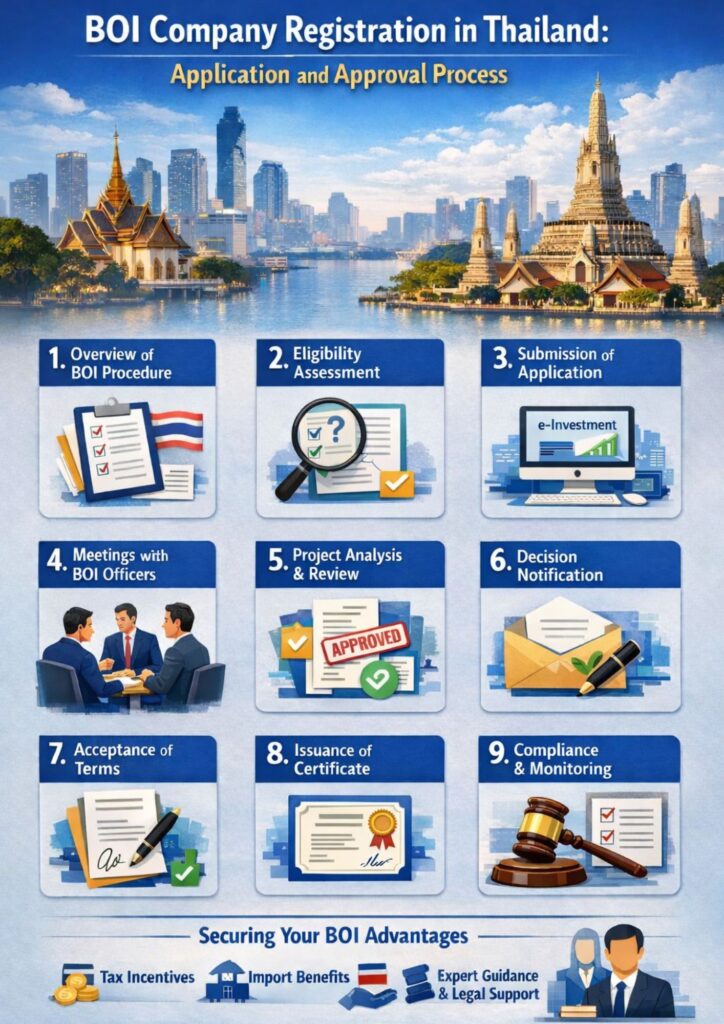
Step 1: Overview of the BOI application procedure
Applications for promotion to the Thailand Board of Investment (BOI) follow a formal and strictly regulated administrative procedure. The aim is to ensure that projects benefiting from specific advantages align with Thailand’s economic, technological, and industrial priorities. The entire procedure is managed by the BOI according to a precise sequence of eight steps, from the initial project review to the issuance of the promotion certificate, which determines effective access to the privileges granted through BOI Company registration in Thailand.
Step 2: Preliminary assessment of project eligibility
The first step is to verify that the proposed activity is among those eligible for BOI promotion. This preliminary analysis is based on a review of current announcements and regulations, as well as the identification of the BOI category applicable to the project. At this stage, the investor must also anticipate future requirements for minimum capital, technology, job creation, and regulatory compliance. An imprecise or overly broad classification of the activity may result in the rejection of the application or a limitation of the benefits granted.
Step 3: Submission of the BOI promotion application
Once eligibility has been confirmed, the promotion application must be submitted exclusively via the BOI’s official e-Investment Promotion Service platform. The submitted file must present the investment project in detail, including an exact description of the activities, the investment amount, the technologies used, the capital structure, the operational organisation, and the implementation schedule. The BOI attaches particular importance to the consistency between these elements and the State’s strategic objectives.
Step 4: Project clarification and meetings with BOI officers
After the application has been submitted, the BOI may invite the applicant to a clarification meeting, usually within approximately ten working days. This exchange allows BOI officers to better understand the project, obtain clarification on certain technical or financial aspects, and assess the investor’s ability to execute the project in accordance with the stated commitments. This step is particularly common for technological or innovative projects, or those involving 100% foreign ownership through BOI Company registration in Thailand.
Step 5: BOI project analysis and consideration timeline
The file then enters a formal analysis phase by the BOI. The duration of this analysis depends mainly on the total amount of the declared investment. Smaller projects benefit from a shorter review period, while larger investments are subject to a more in-depth assessment. During this phase, the BOI examines the project’s legal compliance, economic viability, technological contribution, and impact on Thailand’s economy and employment.
Step 6: Notification of BOI decision
At the end of the analysis, the BOI officially notifies the applicant of its decision. If approved, this notification specifies the authorised activities, the benefits granted and the mandatory conditions to be met. This decision constitutes a binding administrative act, which strictly defines the scope of the promotion and the obligations attached to the project.
Step 7: Acceptance of the BOI promotion resolution
The investor then has one month from receipt of the notification to formally accept the promotion through BOI Company registration in Thailand. This acceptance must be made via the BOI’s online system and confirmed by submitting the Promotion Acceptance Form (F GA CT 07). If acceptance is not received within the specified time limit, the promotion is automatically cancelled, with no appeal possible.
Step 8: Application for and issuance of the promotion certificate
Once the promotion has been accepted, the investor must submit an application for a Promotion Certificate within 6 months. This application must be accompanied by documents demonstrating that the prerequisites have been met, particularly regarding legal structure, capital, and operational establishment. After verification, the BOI issues the promotion certificate, usually within approximately ten working days. This document serves as the legal basis for the company to effectively benefit from BOI advantages, particularly in taxation, customs, foreign ownership, and professional immigration.
Step 9: Importance of legal compliance throughout the process
The BOI procedure is strictly formalistic and is based on consistency between the declared project and the activity actually carried out. Any discrepancy may result in the suspension or withdrawal of the privileges granted. In this context, support from an experienced firm such as Benoit & Partners, with recognised expertise in BOI procedures, company law, and Thai taxation, is a key factor in ensuring the project’s security and success.
Company incorporation and implementation after BOI Company registration in Thailand approval
Legal incorporation of the BOI-promoted company
In many projects, the company is incorporated after obtaining BOI approval. This sequence is legally permissible and commonly used, particularly when the shareholding structure, share capital, or corporate purpose must be strictly aligned with the conditions set out in the promotion decision.
The promoted company must be registered with the Department of Business Development (DBD) in accordance with the provisions of the Civil and Commercial Code. At this stage, the corporate purpose must accurately reflect the activities authorised by the BOI, without any unapproved extensions, and the capital structure must reflect the foreign ownership rights as granted. Any discrepancy between the company’s articles of association and the BOI resolution may block further steps or call into question the benefits granted.
Alignment of shareholding and capital structure with BOI conditions
The company’s shareholding structure must comply with the specific terms of the BOI Company registration in Thailand, particularly regarding foreign ownership, voting rights, and minimum capital requirements. Under a BOI promotion, the company may benefit from an exemption from the Foreign Business Act, allowing majority or full foreign ownership, subject to strict compliance with the approved activities.
The share capital declared at the time of registration must be consistent with the investment plan approved by the BOI. In practice, the BOI requires capital contributions to be made progressively in accordance with a specific schedule and to be justified by banking and accounting documents. Under-capitalisation or a delay in funding may result in the suspension of the project’s implementation.
Implementation of the promoted project and BOI Company registration in Thailand compliance obligations
After the company is registered, the investor must proceed with the effective implementation of the project within the time limits imposed by the BOI. This phase includes, in particular, the injection of the approved capital, the acquisition or import of machinery and equipment, the installation of premises, and the operational start-up of activities.
Imports of machinery benefiting from customs exemptions must be carried out in accordance with BOI procedures and declared via the dedicated electronic systems. Any import that does not comply with these procedures or is made outside the authorised scope may result in the loss of the corresponding tax privileges.
Monitoring, reporting, and compliance with BOI timelines
During the implementation phase, the promoted company is subject to strict reporting requirements. The BOI requires regular progress reports demonstrating compliance with the investment schedule, job creation, and effective use of declared assets. These reports are a central element of the BOI’s administrative control.
In the event of a justified delay, a formal request for an extension may be submitted, subject to the BOI’s express acceptance. Otherwise, failure to meet the deadlines may lead to a reduction, suspension, or withdrawal of the benefits granted.
Issuance of the BOI promotion certificate and activation of incentives
Only after full verification of the project’s legal and operational compliance does the BOI issue the Promotion Certificate through BOI Company registration in Thailand. This document marks the effective activation of the incentives granted, including tax exemptions, customs facilities, and specific visa and work permit rights for foreign executives and employees.
The BOI certificate is therefore a fundamental administrative act, the validity of which is conditional on the continued compliance of the actual activity carried out with the approved commitments.
Strategic importance of legal and operational coordination
The post-BOI approval phase is often the most sensitive from a legal and operational standpoint. It requires close coordination between corporate law, taxation, customs procedures, and BOI Company registration in Thailand obligations. Poor execution at this stage can negate the benefits of the promotion obtained.
In this context, the support provided by Benoit & Partners, with its integrated expertise in BOI company formation, capital structuring, regulatory compliance, and post-registration monitoring, helps to secure the implementation of the project and ensure the long-term sustainability of BOI benefits.
Company Incorporation and Implementation After BOI Approval
In many cases, company incorporation occurs after BOI Company registration in Thailand approval. The promoted company must be registered with the Department of Business Development in compliance with the Civil and Commercial Code, and its shareholding structure must reflect the approved BOI conditions.
The company must then implement the project within the deadlines set by the BOI, including capital injection, machinery importation, and commencement of operations. Only after these conditions are met does the BOI issue the Promotion Certificate, activating the granted incentives.
Conclusion
BOI company registration in Thailand offers foreign investors a legally secure and economically attractive framework to operate in Thailand. However, its benefits are inseparable from strict statutory obligations and regulatory oversight. A properly structured BOI project, supported by experienced legal counsel, allows investors to leverage Thailand’s investment promotion regime while maintaining full compliance with Thai law.
If you wish to secure your BOI project and ensure full compliance at every stage, you may book a free initial consultation with our team to assess your project and receive tailored legal guidance throughout the BOI process.
FAQ
A BOI company registration in Thailand refers to a company that benefits from investment promotion granted by the Board of Investment under the Investment Promotion Act. This status allows foreign investors to operate under a specific legal regime with tax and non-tax incentives.
Yes. One of the main advantages of a BOI company registration in Thailand is the possibility of 100% foreign ownership for the activities expressly approved by the BOI, without the need for a Foreign Business License.
Only activities listed by the BOI are eligible. These generally include advanced manufacturing, digital and technology services, R&D, renewable energy, medical industries and international business services with high added value.
The duration depends on the nature and size of the project. Simple projects may be processed within a few months, while larger or more complex investments require longer review periods due to technical and economic analysis.
BOI incentives become effective only after the issuance of the Promotion Certificate. Prior to this, the investor must comply with post-approval conditions such as company incorporation.