 Call us now:



BOI tax incentives as a cornerstone of investment structuring in Thailand
BOI tax incentives play a decisive role in the way both foreign and Thai investors design, finance and structure their business operations in Thailand. In a jurisdiction characterised by strict foreign ownership rules, controlled business activities and a highly formalised tax system, fiscal advantages cannot be considered in isolation. They must be analysed as an integral component of a broader legal, corporate and regulatory architecture.
Thailand’s investment framework is not designed to provide blanket tax relief. Instead, it relies on a selective incentive mechanism, administered by the Thailand Board of Investment (BOI), to channel capital, technology and know-how into sectors considered essential to the country’s economic strategy. BOI tax incentives are therefore a policy instrument as much as a fiscal one.
Under Thai law, tax incentives from BOI are granted pursuant to the Investment Promotion Act B.E. 2520 (1977), together with an extensive body of BOI notifications, announcements and internal regulations. These instruments define eligible activities, applicable incentive categories, investment thresholds and compliance obligations. The resulting legal framework is complex, technical and highly conditional.
A recurring misconception among investors is that BOI promotion automatically results in a tax-free company. In reality, BOI tax incentives apply only to income derived from approved activities, only for a limited duration, and only if the promoted company complies continuously with BOI conditions. All other income remains subject to ordinary Thai taxation, and all promoted companies remain subject to accounting, reporting and audit obligations.
From a legal structuring perspective, tax incentives from BOI affect several layers of a company’s existence: corporate income tax exposure, customs duties, capital investment planning, cash flow projections, foreign shareholding ratios and, in some cases, the right to operate otherwise restricted businesses. When correctly structured, these incentives materially improve the financial viability and predictability of an investment. When misunderstood or misapplied, they expose investors to tax reassessments, penalties, loss of privileges and regulatory sanctions.
For this reason, BOI tax incentives must be analysed at the very beginning of any investment project in Thailand. A precise understanding of their legal basis, scope, categories and operational constraints is indispensable to securing tax benefits in a lawful, sustainable and defensible manner.
Table of Contents
The legal basis of BOI tax incentives in Thailand
The Investment Promotion Act as the foundation of BOI tax incentives
The Investment Promotion Act B.E. 2520 constitutes the cornerstone of Thailand’s investment incentive regime. It establishes the BOI as the competent authority empowered to promote investment and to grant fiscal and non-fiscal incentives to qualifying projects.
Sections 28 to 36 of the Act expressly authorise the BOI to grant exemptions or reductions relating to corporate income tax, import duties, export duties and other fiscal charges. The Act deliberately refrains from defining exhaustive lists of incentives or activities, instead delegating broad discretionary powers to the BOI to adapt policy in response to economic priorities.
This legislative architecture allows Thailand to update its incentive framework dynamically, without requiring frequent statutory amendments. In practice, the real substance of BOI tax incentives is defined through BOI announcements, notifications and sector-specific criteria, which have binding legal force.
BOI promotion as an administrative contract with the State
From a legal standpoint, BOI promotion is not a unilateral tax exemption. It constitutes an administrative approval with contractual characteristics, whereby the promoted company undertakes to implement a specific project in accordance with approved parameters, in exchange for tax and regulatory privileges.
Once a project is approved and a promotion certificate issued, the company is legally bound by:
- The scope of approved activities
- The investment amount and timeline
- The capital structure and shareholding conditions
- Reporting and compliance obligations
Failure to comply may result in partial or total revocation of BOI tax incentives, including retroactive reassessment. This contractual dimension explains why BOI tax incentives are legally binding, conditional and subject to ongoing scrutiny.
What BOI tax incentives are available to promoted companies?
Corporate income tax exemptions as the primary BOI tax incentive
The most significant BOI tax incentive is the exemption from corporate income tax (CIT). Depending on the activity and incentive category, promoted companies may benefit from a full CIT exemption for a period ranging from 3 to 8 years.
This exemption applies exclusively to net profits generated from BOI-approved activities. Income derived from non-promoted activities, ancillary services or unrelated operations remains taxable at the standard corporate income tax rate.
From a compliance perspective, this requires strict segregation of accounting records, cost allocation and revenue tracking. The Thai Revenue Department and the BOI frequently scrutinise whether income claimed as exempt genuinely arises from promoted activities.
Reduced corporate income tax after the exemption period
In certain categories, BOI promotion includes a subsequent 50% reduction of corporate income tax for an additional period, typically up to five years, after the full exemption phase expires.
This reduced-rate period is subject to continued compliance with BOI conditions and is often overlooked in initial structuring. When properly integrated into financial planning, it provides a smoother transition from tax exemption to full taxation.
Import duty exemptions as a core BOI tax incentive
Import duty exemptions constitute a major financial benefit, particularly for capital-intensive projects. BOI promotion may grant:
- Full exemption of import duties on machinery
- Exemption or reduction on raw materials used for export production
These exemptions are strictly regulated. Imported machinery must be used exclusively for approved activities, within approved timelines. Any deviation may trigger reassessment, penalties or withdrawal of privileges.
From a legal risk perspective, import duty exemptions require meticulous coordination between BOI compliance, customs procedures and internal asset management.
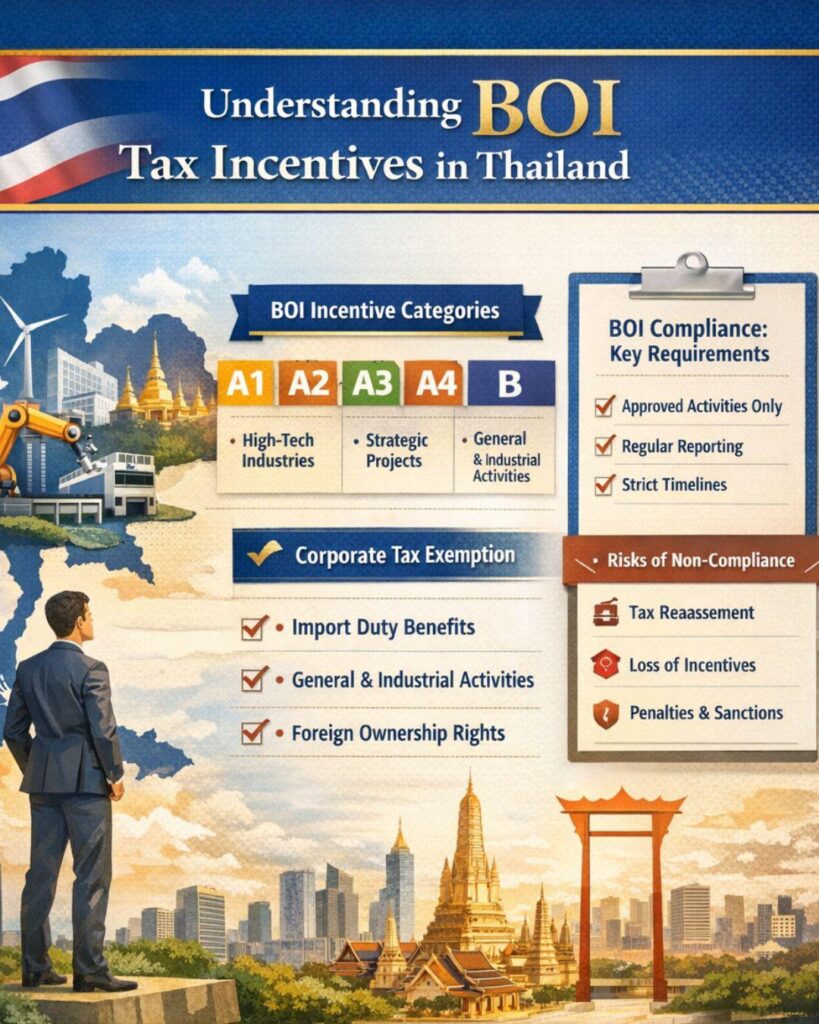
BOI tax incentive categories: A1, A2, A3, A4 and B explained
One of the most critical aspects of BOI tax incentives is the categorisation system, which determines the level and duration of incentives granted. Understanding these categories is essential for accurate investment structuring.
Category A1 – Maximum BOI tax incentives for strategic activities
Category A1 is reserved for activities deemed highly strategic for Thailand’s long-term economic development. These projects typically involve advanced technology, innovation, research and development or activities aligned with national priority sectors.
Key characteristics of A1 projects include:
- Full corporate income tax exemption for up to 8 years, with no cap on the exemption amount
- Import duty exemption on machinery
- Import duty exemption on raw materials used for export
- Permission for 100% foreign ownership, where applicable
Examples of A1 activities often include advanced manufacturing, biotechnology, digital innovation, R&D centres and certain environmental technologies.
From a legal standpoint, A1 projects are subject to heightened scrutiny and often require detailed technical documentation, technology descriptions and implementation plans.
Category A2 – High-value activities with strong economic impact
Category A2 applies to activities with significant economic impact but slightly lower strategic sensitivity than A1. These projects still benefit from robust incentives but may be subject to additional conditions.
Typical A2 incentives include:
- Corporate income tax exemption for up to 8 years, sometimes subject to a monetary cap
- Import duty exemption on machinery
- Possible reduction of corporate income tax after the exemption period
Foreign ownership may be permitted depending on the activity and BOI approval.
Category A3 – Medium-level incentives for established industries
Category A3 covers a broad range of manufacturing and service activities that contribute to Thailand’s economy but do not involve cutting-edge technology.
Incentives under A3 typically include:
- Corporate income tax exemption for 5 years
- Import duty exemption on machinery
- Possible tax reductions after the exemption period
These projects are often easier to implement but offer more limited tax benefits compared to A1 and A2.
Category A4 – Entry-level incentives for general activities
Category A4 applies to standard industrial activities with limited strategic priority. Incentives are more modest and typically include:
- Corporate income tax exemption for 3 years
- Import duty exemption on machinery
A4 projects often serve as entry points for investors seeking moderate tax relief combined with regulatory facilitation.
Category B – Non-tax incentives only
Category B projects do not receive corporate income tax exemptions. However, they may still benefit from:
- Import duty exemptions on machinery
- Non-tax incentives such as foreign ownership permissions or land ownership rights
Category B promotion is often used to overcome regulatory restrictions rather than for tax optimisation.
Get expert legal guidance.
Business activities eligible for BOI tax incentives
Eligibility for BOI tax incentives depends entirely on whether the proposed activity appears on the BOI’s promoted activity list. This list is periodically updated to reflect Thailand’s economic policy.
Common eligible sectors include:
- Advanced manufacturing and automation
- Digital services, software development and data centres
- Renewable energy and environmental management
- Logistics, smart warehouses and distribution centres
- International business centres and regional headquarters
Legal due diligence is essential to confirm eligibility and incentive category before application.
BOI tax incentives and foreign ownership structuring
BOI tax incentives often interact directly with Thailand’s Foreign Business Act B.E. 2542, which restricts foreign ownership in many sectors.
In certain promoted activities, BOI approval may allow:
- 100% foreign ownership
- Majority foreign shareholding
- Waivers from specific licensing requirements
However, such permissions are not automatic and must be expressly granted in the BOI approval. Corporate documents must be drafted in strict alignment with BOI conditions to avoid regulatory exposure.
Compliance, risks and strategic tax planning under BOI tax incentives
Ongoing reporting and audit obligations
BOI-promoted companies must submit regular reports to the BOI, including:
- Project implementation reports
- Operational updates
- Financial and compliance confirmations
These obligations are enforceable and failure to comply may jeopardise tax incentives.
Legal and tax risks of non-compliance
The most frequent risks include:
- Improper allocation of exempt income
- Exceeding the scope of approved activities
- Non-compliance with investment timelines
Such breaches may result in retroactive tax assessments and penalties.
Interaction with VAT, withholding tax and tax treaties
BOI tax incentives do not generally exempt companies from VAT, withholding tax or international tax obligations. Cross-border transactions must still comply with Thailand’s double tax treaties and transfer pricing rules.
Securing BOI tax incentives through proper legal structuring
BOI tax incentives are not obtained through administrative filing alone. They require careful legal engineering that integrates corporate law, tax law, regulatory compliance and the investor’s broader business strategy from the outset. Each element of the project must be legally consistent with the BOI approval, from the company’s objects and shareholding structure to its financing model, accounting treatment and operational scope.
Effective structuring also anticipates long-term compliance. This includes clear separation between promoted and non-promoted activities, robust internal reporting systems, and documentation capable of withstanding scrutiny by both the BOI and the Thai Revenue Department. BOI tax incentives only remain secure when the legal structure reflects the economic reality of the project throughout its lifecycle.
At Benoit & Partners, BOI structuring is handled holistically. We align the BOI application, corporate documentation and tax planning to ensure that incentives are not only granted, but remain operationally viable and legally defensible in the event of audit, reassessment or regulatory dispute.
Conclusion
BOI tax incentives are a powerful instrument within Thailand’s investment framework, but they are neither automatic nor risk-free. They operate as conditional legal privileges, granted in exchange for strict compliance with approved activities, timelines and reporting obligations. When correctly structured, BOI tax incentives can substantially improve cash flow, reduce investment costs and, in some cases, facilitate foreign ownership in otherwise restricted sectors.
However, these benefits only remain effective if the company’s legal structure, accounting treatment and operations remain fully aligned with BOI conditions. Poor structuring or weak compliance frequently leads to tax reassessments, loss of incentives and regulatory exposure. BOI tax incentives must therefore be treated as a long-term legal commitment, not a simple tax optimisation tool.
Before filing a BOI application or launching operations, professional structuring is essential. Benoit & Partners assists investors in securing BOI tax incentives in a lawful, sustainable and defensible manner. You may book a free initial consultation to assess your eligibility and structure your project safely from the outset.
FAQ
No. BOI tax incentives vary significantly depending on whether the project falls under categories A1, A2, A3, A4 or B, with major differences in tax exemption duration and scope.
Yes. Failure to comply with BOI conditions may lead to suspension or revocation of incentives, including retroactive tax reassessments.
In many cases, yes. However, full foreign ownership is only permitted if expressly granted in the BOI approval and limited to the approved activity.
Yes. BOI tax incentives generally do not exempt companies from VAT, withholding tax or other indirect taxes, unless explicitly stated.
BOI tax incentives apply only to income derived from BOI-approved activities. Non-promoted activities remain fully taxable.
Corporate income tax exemptions usually range from 3 to 8 years, depending on the incentive category, and may be followed by a reduced tax period.
Yes, but any new activity requires prior BOI approval. Operating outside the approved scope may jeopardise existing incentives.
No. Incentives only apply after formal BOI approval and issuance of the promotion certificate, and only once implementation conditions are met.
Yes. BOI tax incentives are available for both manufacturing and service activities, provided the activity appears on the BOI promoted list.
Given the legal, tax and regulatory consequences of BOI promotion, professional legal structuring and ongoing compliance support are strongly recommended.