 Call us now:



Labour dispute in Thailand
Here is your text rewritten to remove the passive voice:
In an employment relationship, the parties place their working capacity at the company’s disposal. The personal nature of the worker characterizes this contract. The technological process requires performance, and the worker cannot freely place his working capacity at the company’s disposal to perform the work. Thai labour law protects employees’ rights and interests and establishes minimum standards for concluding employment contracts to prevent employers from infringing employees’ rights during labour disputes. Therefore, even by mutual agreement, an employer cannot grant an employee fewer rights and privileges than those provided by law.
Table of Contents
What is an employee’s status in Thailand?
Here is your text rewritten to remove the passive voice:
A worker is a person who performs any type of work. In Thailand, people recognize paid work as the characteristic form of employment. Thai labour law grants protected status to employees. The payment of wages creates a legal relationship of subordination between the worker and the employer.
A company must implement an employee profit-sharing system if it employs at least 50 employees. To finance the national social security system (SSO in Thailand), both employees and employers must pay social contributions. Companies record wages and social contributions as business expenses. Businesses regard wages as fixed costs because the payment of wages and salaries does not depend on business output.
Get expert legal guidance.
What is an employer under Thai labour law ?
Here is your text rewritten to remove the passive voice:
In Thailand, the law defines an employer as a legal person who employs another person. An employer may carry out employment directly or appoint an agent to act on behalf of the company. The Labour Protection Act B.E. 2541 (1998) interprets the term “employer” broadly.
In contractual arrangements, a contractor may engage a subcontractor or appoint additional subcontractors and delegate certain tasks to them. In such circumstances, the law may impose joint and several liability on both the contractor and the subcontractor for compensation, wages, or other employment-related expenses payable to employees. The law may also hold the contractor liable for social security contributions, salaries, notice pay, and additional compensation in cases of dismissal. Consequently, companies must anticipate the financial risks associated with subcontracting arrangements when they engage such services.
Pursuant to Section 13 of the Labour Protection Act B.E. 2541 (1998), if a company merges, transfers its business, undergoes succession, or makes a similar structural change, the employer may transfer employment relationships to a new legal entity only if the affected employees provide written consent. In such cases, the new employer automatically assumes all rights and obligations of the former employer.
Furthermore, entrepreneurs who assign individuals to perform work within their business operations, as well as business operators or managers, must fulfil their statutory responsibilities toward those workers. If they fail to comply with these obligations, authorities may prosecute them under Section 158 of the Labour Protection Act B.E. 2541 (1998).
Get expert legal guidance.
What are the legal provisions of labour law and labour dispute in Thailand ?
The most relevant Thailand’s labour laws’ provisions are listed below:
- Labour Protection Act B.E. 2541 (1998), as amended.
- Workers’ Compensation Act B.E. 2537.
- Civil and Commercial Code B.E. 2535.
- Social Security Act B.E. 2533.
- An Act Concerning the Establishment of Labour Courts and Labour Court Procedures B.E. 2522 (1979).
- Labour Relations Act B.E. 2518 (1975).
- Minimum Wage Regulations.
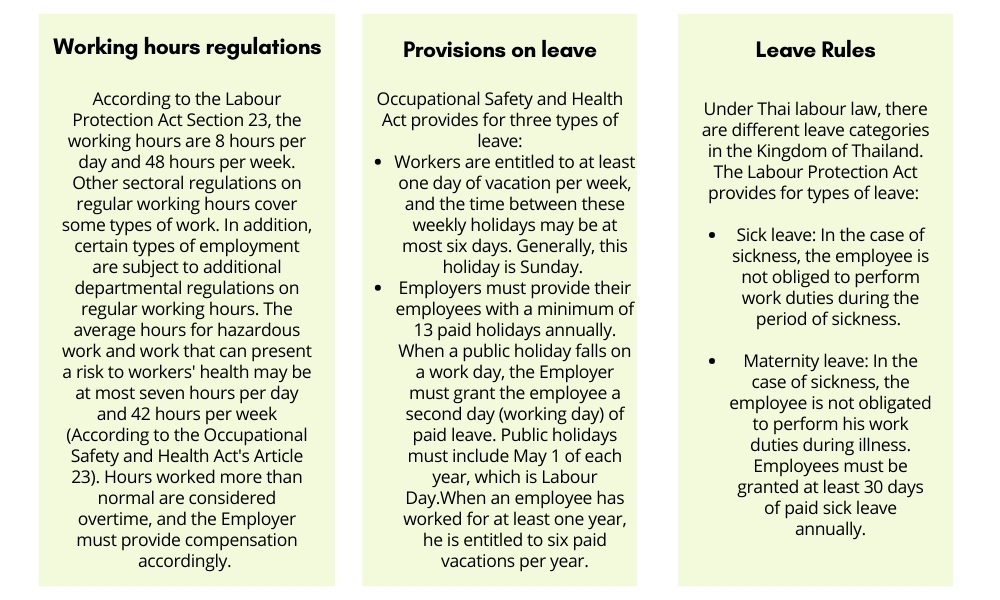
What are the rules for working hours and holidays in Thailand ?
Conclusion
Labour disputes in Thailand are governed by a comprehensive legal framework that balances the interests of employers and employees while ensuring minimum standards of protection. Key legislation, including the Labour Protection Act B.E. 2541 (1998), the Labour Relations Act B.E. 2518 (1975), and the Social Security Act B.E. 2533 (1990), establishes clear rules on wages, working conditions, termination, collective bargaining, and dispute resolution mechanisms.
Thai labour law emphasizes the subordinate nature of the employment relationship and grants employees protected legal status. The law imposes broad statutory obligations on employers, including wage payment, social security contributions, and liability in subcontracting or business transfer situations. Importantly, the law does not permit employers or employees to waive statutory protections if such a waiver reduces employee rights below legal standards.
In labour disputes, specialized labour courts apply formal procedures to resolve conflicts efficiently and in accordance with statutory protections. Ultimately, Thailand’s labour law system reflects a policy objective to safeguard workers’ rights while maintaining legal certainty for employers operating within the country.
If you need further information, you may schedule an appointment with one of our lawyers.
A labour dispute generally arises when there is disagreement between an employer and employees regarding employment conditions, wages, benefits, dismissal, or collective bargaining matters. Disputes may be individual or collective and are governed primarily by the Labour Relations Act B.E. 2518.
No. Under the Labour Protection Act B.E. 2541, any agreement that provides fewer rights or benefits than those guaranteed by law is invalid. Minimum legal standards must always be respected.
Yes. In certain cases, joint and several liability may apply to both contractors and subcontractors for wages, compensation, and social security obligations. Employers engaging subcontractors must carefully assess potential financial risks.
Employment relationships may only be transferred to a new employer with the written consent of the employees. The new employer assumes all rights and obligations of the former employer under Section 13 of the Labour Protection Act B.E. 2541.
Yes. Under the Social Security Act B.E. 2533, both employers and employees must contribute to the national social security system. Contributions are mandatory and form part of statutory employment obligations.