
Accommodation Agreement Template for Thailand
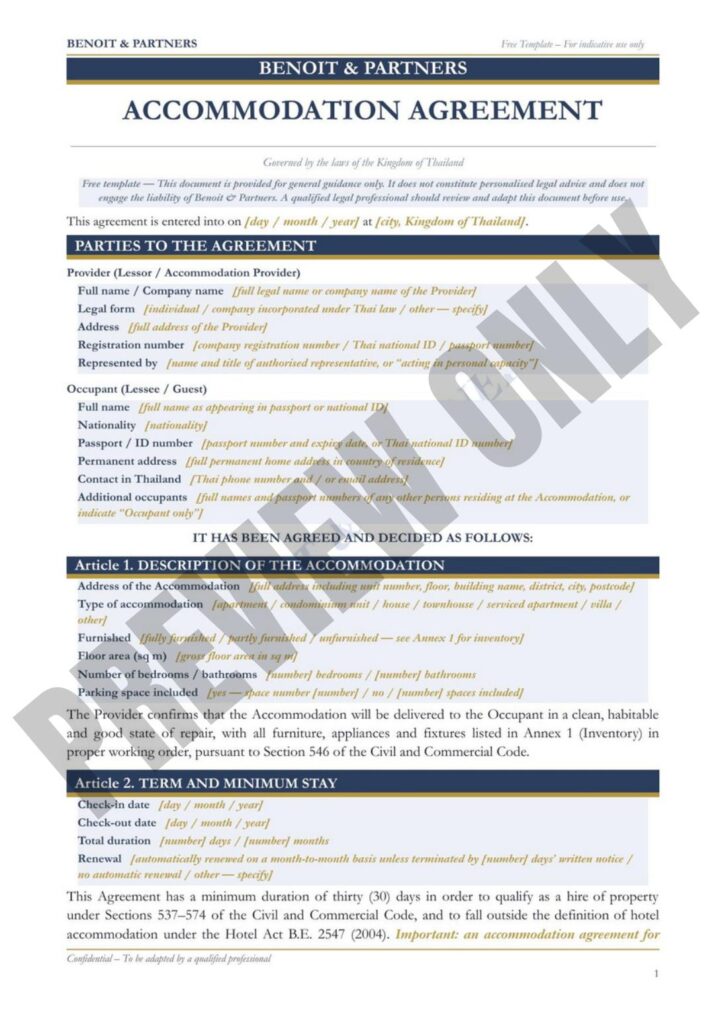
Our Accommodation Agreement template for Thailand has been drafted and reviewed by qualified lawyers to ensure full compliance with Thai law. It offers a solid legal framework for formalising the rental of a residential property between a landlord and a tenant, whether for a condominium unit, a house, a villa, or a serviced apartment.
Designed to serve both providers and occupants, this template addresses all essential aspects of a residential arrangement: identification of the parties, description of the accommodation, rental fee and payment terms, security deposit, obligations of each party, immigration reporting requirements, and early termination conditions, in accordance with the Civil and Commercial Code.
For arrangements involving specific circumstances or non-standard clauses, our legal team can prepare a fully tailored agreement to match your situation.
Disclaimer : This template is provided for general informational purposes only and does not constitute legal advice. For complex arrangements, professional legal advice should be sought to ensure compliance with applicable Thai legislation.
Need a Contract Tailored to Your Needs ? Get a Free Consultation.
When should you use an Accommodation Agreement in Thailand?
An Accommodation Agreement in Thailand is the appropriate document to use whenever a residential property is made available for occupation in Thailand, whether between private individuals or involving a corporate entity as landlord. It formally sets out the agreed conditions of the arrangement and protects both parties in the event of a later disagreement.
Under Thai law, property hire arrangements are primarily governed by the Civil and Commercial Code, in particular Sections 537 to 574 relating to hire of property, and the provisions on the landlord’s obligation to maintain the property in a suitable condition. Arrangements exceeding thirty (30) days fall outside the scope of the Hotel Act B.E. 2547 (2004) and are subject to a different legal regime, which this template is designed to reflect.
This document is especially relevant where the accommodation fee represents a substantial financial commitment, where the occupant is a foreign national subject to immigration reporting obligations, or where the property is furnished and the condition of its contents needs to be formally documented. It enables both parties to record the agreed terms, allocate responsibilities, and establish a clear framework for managing the arrangement throughout its duration.
For more complex situations, such as long-term stays, arrangements with instalment payments, or properties held through a corporate structure, additional provisions may be required. Our legal team assists clients with customised agreements adapted to their specific needs.
Without a properly drafted Accommodation Agreement, both landlord and tenant are exposed to disputes over the condition of the property, the handling of the security deposit, and the allocation of responsibilities for utilities, maintenance, and early departure.

1. Identification of the parties and description of the accommodation
The agreement must clearly identify the provider and the occupant, and include a precise description of the property, covering its address, type, floor area, number of rooms, and furnished status, so that the subject matter of the arrangement is unambiguous from the outset.
2. Rental fee, payment schedule, and included services
The document must set out the monthly accommodation fee, the services and utilities covered, the payment due date, the accepted payment method, and the applicable late payment charge, in accordance with the Civil and Commercial Code.
3. Security deposit and conditions of return
The agreement must specify the deposit amount, the deadline for payment, the permitted grounds for deduction, and the timeframe within which the balance must be returned to the occupant after check-out, along with the obligation to provide an itemised statement of any amounts retained.
4. Obligations of the occupant and house rules
The occupant's obligations must be clearly set out, covering use of the property for residential purposes only, maintenance standards, restrictions on alterations and subletting, compliance with building regulations, and the conditions applying to pets, smoking, and the return of the property at the end of the term.
5. Provider's obligations and right of access
The provider's obligations regarding delivery of the property, ongoing maintenance, and the occupant's right to peaceful enjoyment must be clearly defined, together with the conditions under which the provider or their representative may access the accommodation for inspection or repair.
6. Immigration obligations, early termination, and governing law
The Accommodation Agreement in Thailand must address the TM30 notification requirement applicable to foreign occupants, the notice period and consequences of early termination by either party, and the governing law and jurisdiction applicable to any dispute arising from the arrangement.
Key clauses and additional protections in an Accommodation Agreement
An Accommodation Agreement in Thailand is a fundamental legal document governing the occupation of a residential property in Thailand. It defines the terms of the arrangement, records the condition of the property and its contents at the time of check-in, and provides a clear legal basis for resolving any disagreement that may arise during or after the occupancy.
Under the Civil and Commercial Code, a provider is required to maintain the property in a condition fit for the purpose for which it was hired throughout the entire term of the agreement, regardless of any general disclaimer included in the document. A well-drafted contract helps clarify each party’s responsibilities and manage this exposure effectively.
This type of document is commonly used for residential arrangements between private individuals, as well as for situations involving corporate landlords, furnished properties, or expatriate tenants. While a standard arrangement may be adequately covered by a general template, occupancies involving long-term stays, subleasing, shared accommodation, or foreign nationals with specific visa conditions often require additional legal provisions and tailored drafting.
A properly customised Accommodation Agreement helps secure the arrangement and better protect the legitimate interests of both the provider and the occupant.
Why customise an Accommodation Agreement with a lawyer in Thailand?
While a standard template may be sufficient for a straightforward residential arrangement between individuals, many accommodation situations involve legal or practical considerations that require more specific drafting.
In practice, arrangements involving furnished properties with a detailed inventory, foreign nationals subject to immigration reporting, long-term stays with renewal clauses, or properties owned through a corporate structure may require tailored provisions on deposit management and deduction procedures, TM30 compliance and immigration obligations, maintenance responsibilities and cost allocation, subletting restrictions and consent procedures, or the tax treatment of rental income under the Thai Revenue Code.
Our legal team assists landlords, tenants, and companies with customised agreements adapted to their specific situation, ensuring full compliance with applicable Thai legislation, in most cases within a short timeframe.
A properly drafted agreement reduces the risk of future disputes, regulatory complications, and unexpected financial exposure for both parties.
Accommodation Agreement template
Instant Download
Easy to Customize
Ready to Sign
Crafted by Lawyers
FAQ
What is an Accommodation Agreement in Thailand?
An Accommodation Agreement is a contract formalising the occupation of a residential property between a provider and an occupant. It records the agreed terms, including the rental fee, the security deposit, the condition of the property, and the obligations of each party, and is governed by the Civil and Commercial Code of Thailand.
When should it be used?
It should be used whenever a residential property is made available for occupation in Thailand for a period of thirty (30) days or more, whether between private individuals or involving a company, to document the agreed terms and protect both parties in the event of a later disagreement.
Does the agreement need to be registered?
An Accommodation Agreement for a term not exceeding three years does not require registration at the Land Department. However, agreements intended to run for more than three years must be registered in order to be enforceable beyond that period under Section 538 of the Civil and Commercial Code.
What are the tax implications?
Rental income received by the provider is subject to personal income tax or corporate income tax under the Thai Revenue Code, depending on the nature of the provider. Where the occupant is a company, withholding tax may apply to rental payments. Each party is responsible for their own tax position, and professional advice is recommended.
Can a foreign national rent a property in Thailand?
Yes. Foreign nationals may legally rent residential property in Thailand. The provider is required to file a TM30 notification with the Immigration Bureau within twenty-four hours of the foreign occupant’s arrival. The occupant remains solely responsible for maintaining a valid visa or authorisation to remain in Thailand throughout the term of the agreement.
Do I need a lawyer?
For a straightforward arrangement between individuals, a standard template may be adequate. For arrangements involving significant rental amounts, furnished properties, corporate providers, or foreign nationals, legal assistance is strongly recommended to ensure compliance with Thai law and to protect your interests effectively.
What happens if no written agreement is signed?
Without a written contract, the parties have no reliable evidence of the agreed terms, which significantly increases the risk of disputes over the rental conditions, the handling of the deposit, or the allocation of maintenance responsibilities.
How does the PDPA apply?
Where the arrangement involves the exchange of personal data, including copies of identification documents or passport details collected for TM30 purposes, both parties must comply with the Personal Data Protection Act B.E. 2562 (2019), including appropriate data processing and confidentiality obligations.