
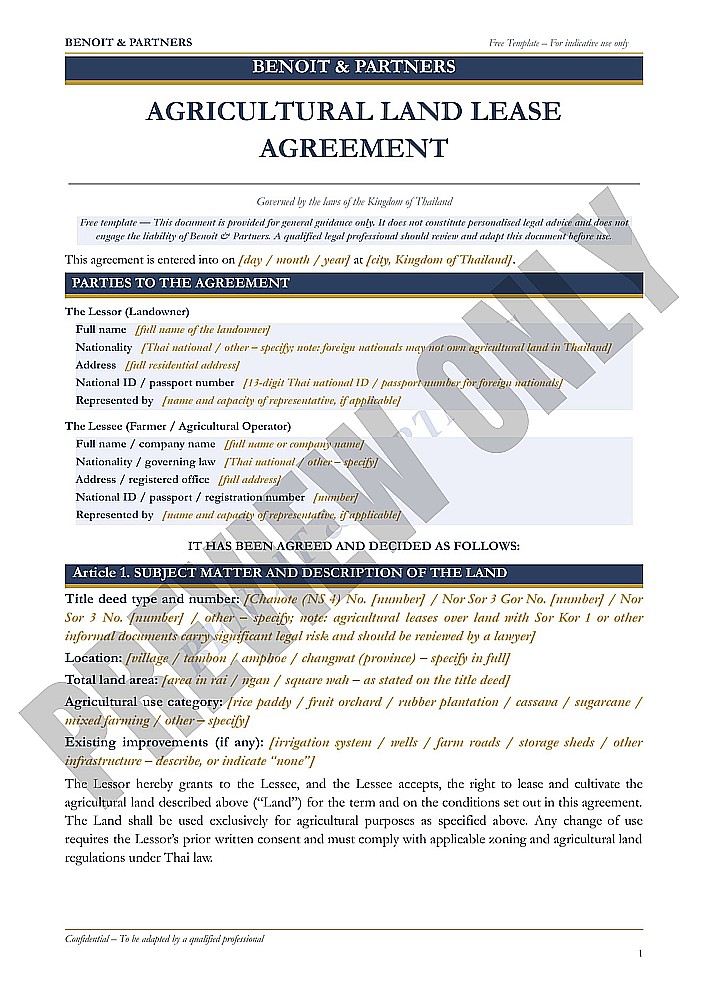
Agricultural Land Lease Agreement Template for Thailand
Our Agricultural Land Lease Agreement in Thailand template is drafted and reviewed by experienced lawyers to ensure compliance with Thai law and practical business use. It provides a reliable legal framework for standard agricultural land rental transactions in Thailand.
Designed for landowners, farmers, and companies involved in the leasing of agricultural land, this template covers key legal aspects such as description of the leased land, rental terms, permitted agricultural use, obligations of the parties, security deposit, and regulatory compliance under Thai law.
However, some transactions may require additional clauses or tailored structuring depending on the nature of the agricultural activity, foreign ownership restrictions, or commercial risks. Our legal team can assist clients with customised Agricultural Land Lease Agreements within a short timeframe.
Disclaimer: This template is provided for general informational purposes only and does not constitute legal advice. While it has been prepared by legal professionals, it may not reflect your specific situation or regulatory constraints. For complex or high-value transactions, legal advice should be sought to ensure compliance under Thai law.
Need a Contract Tailored to Your Needs ? Get a Free Consultation.
When should you use a Agricultural Land Lease Agreement in Thailand?
An Agricultural Land Lease Agreement is used whenever a landowner grants a tenant the right to occupy and use agricultural land in Thailand for farming or related purposes. This situation commonly arises in crop farming, livestock breeding, plantation activities, agribusiness operations, and any arrangement involving the long-term use of agricultural land.
Under Thai law, agricultural land leases are governed by the Civil and Commercial Code (Sections 537 to 571) and the Agricultural Land Reform Act B.E. 2518 (1975), which imposes specific restrictions on the use and transfer of certain categories of agricultural land. Leases exceeding three years must be registered with the Land Department to be enforceable against third parties.
This agreement becomes particularly important when the transaction involves significant land area, long-term occupation, regulated agricultural activities, or foreign tenants. It allows the parties to clearly define the permitted use of the land, rental conditions, maintenance obligations, and risk allocation mechanisms.
In more complex transactions, additional clauses may be required regarding permitted crops or activities, land improvement works, water and irrigation rights, tax liabilities, stamp duty, or compliance with foreign ownership restrictions. Our legal team assists clients with customised Agricultural Land Lease Agreements to ensure compliance with Thai law.
Without a properly drafted Agricultural Land Lease Agreement, parties expose themselves to disputes over permitted use, maintenance obligations, deposit refund, and potential unenforceability under Thai property law.

1. Identification of the parties and company
A Share Purchase Agreement must clearly identify the transferor, the transferee, and the target company. This includes full legal names, registration details, and alignment with the records held by the Department of Business Development.
2. Description of the transferred shares
The agreement must specify the number of shares transferred, their class, par value, and confirm that they are free from encumbrances, pledges, or third-party rights.
3. Purchase price and payment terms
The agreement must clearly define the purchase price, payment method, currency, and payment schedule. It should also address late payment consequences in accordance with Thai law.
4. Representations and warranties
Representations and warranties protect both parties by confirming ownership of the shares, absence of disputes, and the legal and financial standing of the company.
5. Transfer and registration of ownership
Ownership may transfer upon signing, but enforceability requires registration in the shareholders register in compliance with Thai legal requirements.
6. Tax and regulatory compliance
The agreement must address stamp duty obligations under the Thai Revenue Code and ensure compliance with the Foreign Business Act where foreign ownership is involved.
Key clauses and additional protections in a Agricultural Land Lease Agreement
An Agricultural Land Lease Agreement is a key legal document governing the use of agricultural land in Thailand. It defines the rights and obligations of the landowner and tenant while ensuring compliance with Thai property and agricultural law.
Under the Civil and Commercial Code, leases exceeding three years must be registered with the Land Department to be enforceable against third parties. A properly drafted agreement helps secure the transaction and reduce legal risks for both parties.
This type of agreement is commonly used in crop farming, plantation activities, livestock operations, and agribusiness arrangements. While standard transactions may rely on a general template, more complex arrangements often require additional legal protections and customised clauses depending on the nature of the agricultural activity and the risks involved.
A properly customised Agricultural Land Lease Agreement helps secure the transaction and better protect the interests of the parties involved.
Why customise a Agricultural Land Lease Agreement with a lawyer in Thailand?
While a standard Agricultural Land Lease Agreement template may be sufficient for simple farming arrangements, many leases involve legal, financial, and regulatory considerations requiring more advanced drafting and tailored protections.
In practice, each transaction has its own structure and level of risk. Foreign tenant involvement, regulated agricultural activities, land improvement works, water and irrigation rights, or long-term occupation may require provisions not included in a standard template.
Depending on the transaction, specific clauses may be added relating to permitted crops and agricultural activities, land improvement and reinstatement obligations, water and irrigation rights, subletting and assignment restrictions, rent review mechanisms, stamp duty under the Thai Revenue Code, VAT and withholding tax on rental income, Land Department registration requirements, PDPA compliance, or compliance with the Agricultural Land Reform Act and foreign ownership restrictions.
Tailoring an Agricultural Land Lease Agreement allows the parties to better allocate responsibilities and anticipate risks. This is particularly important for large agricultural plots, long-term arrangements, regulated crops, or transactions involving foreign nationals or agribusiness companies.
Our legal team assists landowners, farmers, and companies with customised Agricultural Land Lease Agreements adapted to their specific situation. In many cases, tailored agreements can be prepared within a short timeframe while ensuring compliance with Thai property and agricultural laws.
A properly drafted agreement reduces the risk of future disputes, regulatory issues, and unexpected liabilities.
Agricultural Land Lease Agreement template
Instant Download
Easy to Customize
Ready to Sign
Crafted by Lawyers
FAQ
What is an Agricultural Land Lease Agreement in Thailand?
An Agricultural Land Lease Agreement is a contract by which a landowner grants a tenant the right to use agricultural land for farming or related purposes in exchange for rental payments. In Thailand, it is governed by the Civil and Commercial Code and the Agricultural Land Reform Act B.E. 2518 (1975).
Does an Agricultural Land Lease Agreement need to be registered?
Leases exceeding three years must be registered with the Land Department to be enforceable against third parties. Shorter leases are binding between the parties without registration, though registration is recommended for greater legal protection.
Can a foreigner lease agricultural land in Thailand?
Foreign nationals cannot own land in Thailand but may lease agricultural land. However, certain categories of agricultural land are subject to restrictions under the Agricultural Land Reform Act. Legal advice should be sought before entering into any agricultural land lease involving a foreign party.
What are the stamp duty obligations?
Agricultural land lease agreements are subject to stamp duty at 0.1% of the total rental value over the lease term under the Thai Revenue Code. Stamp duty must be paid within 15 days of execution to avoid penalties.
What permitted uses should be specified in the agreement?
The agreement should clearly define the authorised agricultural activities, such as crop farming, livestock breeding, or plantation use, to avoid disputes over land use and ensure compliance with applicable agricultural regulations.
Do I need a lawyer?
For simple short-term arrangements, a standard template may be sufficient. For long-term leases, regulated crops, large agricultural plots, or transactions involving foreign parties, legal assistance is strongly recommended.
What happens if the tenant fails to pay rent?
The landowner may terminate the lease and seek compensation under the Civil and Commercial Code. The agreement should include penalty clauses, notice periods, and termination rights in case of persistent default.
How does the PDPA apply?
If the agreement involves the exchange of personal data, both parties must comply with the Personal Data Protection Act B.E. 2562 (2019), including appropriate confidentiality and data processing provisions.