
Airline Complaint Letter Thailand
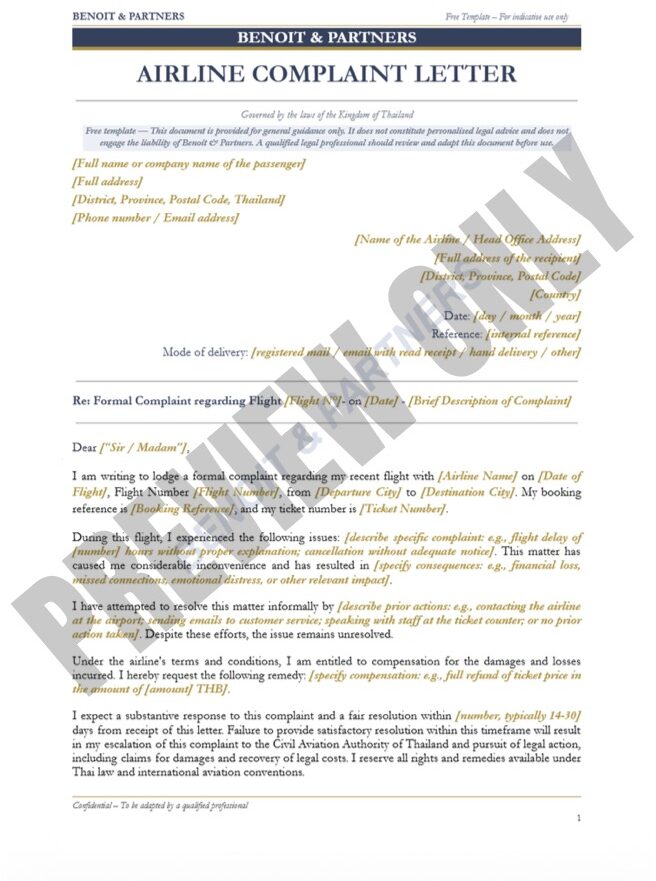
Our Airline Complaint Letter Thailand is drafted and reviewed by experienced lawyers to ensure compliance with Thai law and practical business use. It provides a reliable legal framework for formally raising a complaint against an airline operating in Thailand and seeking an appropriate remedy for a flight disruption, service failure, or passenger rights violation.
Designed for passengers and travel professionals seeking to formally pursue a complaint against an airline in Thailand, this template covers key legal aspects such as identification of the parties and the relevant flight details, a clear description of the incident or failure giving rise to the complaint, the applicable passenger rights framework, the specific remedy or compensation sought, and a defined timeframe for the airline’s response.
However, some situations may require additional clauses or tailored structuring depending on the nature of the disruption, the terms and conditions of the ticket purchased, the airline’s nationality and applicable international conventions, or the specific compensation regime that governs the claim. Our legal team can assist clients with customised Airline Complaint Letters adapted to their specific situation within a short timeframe.
Disclaimer: This template is provided for general informational purposes only and does not constitute legal advice. While it has been prepared by legal professionals, it may not reflect your specific situation or regulatory constraints. For complex claims or disputes involving significant compensation amounts, legal advice should be sought to ensure proper structuring and compliance under Thai and applicable international aviation law.
Need a Contract Tailored to Your Needs? Get a Free Consultation.
When should you use an Airline Complaint Letter in Thailand?
An Airline Complaint Letter Thailand is the right tool when a passenger wishes to formally assert their rights and seek a remedy from an airline following an unsatisfactory experience connected with a flight departing from or arriving in Thailand. Common grounds for a formal complaint include a significant flight delay or cancellation, denied boarding due to overbooking, loss or damage to checked baggage, a substantial downgrade from the class of travel booked, inadequate care during a prolonged disruption, or a serious failure of in-flight service.
Passenger rights in Thailand are addressed through a combination of domestic consumer protection legislation principally the Consumer Protection Act B.E. 2522 (1979) and international frameworks, including the Warsaw Convention and the Montreal Convention, which apply to international carriage by air and set out the liability of airlines for delay, damage, and loss. For domestic flights, the Civil Aviation Authority of Thailand also issues passenger protection notifications that establish minimum standards and entitlements.
Committing the complaint to a formal written letter carries clear practical benefits. It places the claim on official record, demonstrates that the passenger is pursuing the matter seriously, and gives the airline a specific and documented basis on which to assess and respond to the claim. A well-presented letter that references the applicable legal framework is considerably harder for an airline to dismiss with a standard customer service response than an informal verbal complaint.
More involved cases may raise additional considerations, such as the interaction between the Montreal Convention’s liability limits and the actual losses sustained, the airline’s assertion of extraordinary circumstances as a defence to a delay or cancellation claim, the loss or destruction of high-value items in checked baggage, or the cumulative impact of successive disruptions on a multi-leg itinerary. Our legal team is available to assist with tailored complaint letters that address these dimensions precisely and compellingly.
A formal written complaint also creates a clear record of the passenger’s position and the date on which the claim was formally asserted, which is relevant to applicable limitation periods under international aviation law and to any subsequent escalation of the claim.
Submitting a general online feedback form or relying on an informal telephone complaint, rather than a properly structured written letter, significantly reduces the likelihood of a substantive response and weakens the passenger’s position if the matter needs to be escalated to a regulatory authority or pursued through the courts.

1. Passenger and Flight Details
The letter should open by identifying the complainant by full name, providing the booking reference or ticket number, and setting out the specific flight details — including the flight number, the scheduled departure date and time, the departure airport, and the destination. This information allows the airline to locate the relevant booking and verify the claim efficiently.
2. Clear Account of the Incident or Failure
The complaint should set out a precise and chronological account of what occurred, identifying the nature of the disruption or failure, when it occurred, and how the passenger was affected. Factual specificity is critical — vague or emotive accounts are easier for airlines to deflect.
3. Reference to Applicable Passenger Rights
The relevant legal basis for the claim should be identified, whether that is a provision of the Montreal Convention, the Warsaw Convention, a Civil Aviation Authority of Thailand notification, or the Consumer Protection Act. Referencing the applicable framework demonstrates that the claim has a recognised legal foundation.
4. Quantification of the Claim
The letter should specify the remedy or compensation being sought, setting out the amount claimed and the basis on which it has been calculated. Where baggage loss or damage is in issue, a list of the affected items and their approximate values should be included.
5. Supporting Documentation
Relevant documents including the boarding pass, baggage receipts, receipts for expenses incurred as a result of the disruption, and any correspondence from the airline should be referenced and attached. A well-documented claim is harder to dispute and demonstrates that the passenger has kept a careful record.
6. Response Deadline
A clear and reasonable deadline by which the airline is expected to provide a substantive response should be stated. This creates a defined escalation trigger and signals that the passenger is monitoring the airline's response actively.
Key Clauses and Essential Elements in an Airline Complaint Letter
A well-constructedAirline Complaint Letter Thailand gives the airline a precise account of what occurred, identifies the applicable rights that have been engaged, and sets out clearly what the passenger expects in response. It presents the claim in factual and measured terms and signals that the passenger is informed of their legal entitlements and prepared to pursue them through the appropriate channels.
Airlines receive large volumes of complaints, and a letter that is specific, well-structured, and grounded in the applicable legal framework is far more likely to receive a substantive response and a fair assessment than a general expression of dissatisfaction.
This document is applicable to a wide range of flight disruption scenarios and service failures, whether the journey involved a domestic Thai flight or an international route.
The core structure remains consistent, though the applicable legal framework and the compensation entitlements that can properly be claimed will vary depending on the route and the international conventions that apply.
Why customise an Airline Complaint Letter with a lawyer in Thailand?
A Airline Complaint Letter Thailand is a reasonable starting point for straightforward flight disruption claims, but a number of situations call for a more carefully constructed approach before the letter is submitted to the airline.
The specific facts of the incident and the legal framework applicable to the route significantly shape what the letter needs to achieve and what can realistically be claimed. A high-value baggage loss, a claim arising from a significant delay on a long-haul international route, or a complaint connected to a denied boarding incident involving multiple passengers each requires a level of legal precision that a generic template cannot deliver.
Depending on the situation, the letter may need to address: the specific liability limits applicable under the Montreal or Warsaw Convention and the basis for any claim that those limits should not apply; the airline’s likely assertion of extraordinary circumstances and the factual and legal response to that defence; the calculation of the actual losses sustained and the documentation required to substantiate them; the limitation periods applicable under international aviation law and the risk of a claim becoming time-barred; the interaction between the complaint and any travel insurance claim the passenger intends to pursue; or the procedural requirements of the regulatory body to which the complaint may need to be escalated.
Getting the legal basis and the quantification of the claim right from the outset places the passenger in the strongest possible negotiating position and reduces the risk of the claim being undervalued or dismissed on a technical basis.
Our legal team works with passengers and travel professionals to prepare airline complaint letters that are factually precise, legally grounded, and calibrated to the specific circumstances of the claim. The result is a letter that the airline cannot reasonably ignore and that positions the passenger effectively for a fair resolution.
A professionally drafted airline complaint letter does more than express dissatisfaction, it asserts the passenger’s rights clearly and specifically, creates a formal record of the claim, and signals that the matter will be pursued through all available channels if a fair remedy is not offered.
Airline Complaint Letter Thailand
Instant Download
Easy to Customize
Ready to Sign
Crafted by Lawyers
FAQ
What is an Airline Complaint Letter in Thailand?
A formal written communication through which a passenger asserts their rights following a flight disruption, service failure, or passenger rights violation, setting out the factual basis for the claim, the applicable legal framework, the specific remedy sought, and a deadline for the airline’s response.
What passenger rights apply to flights in Thailand?
For international flights, the Montreal Convention and the Warsaw Convention govern airline liability for delay, baggage loss or damage, and personal injury. For domestic flights and consumer protection matters, the Consumer Protection Act and Civil Aviation Authority of Thailand notifications set out applicable standards and entitlements.
How long does a passenger have to make a claim against an airline in Thailand?
Under the Montreal Convention, claims for baggage damage or loss must be notified to the airline within seven and twenty-one days respectively. Claims for delay must be brought within two years. Domestic claims may be subject to different limitation periods, and legal advice should be sought promptly if there is any risk that a claim may be approaching its time limit.
Is written notification required before pursuing a claim against an airline in Thailand?
For baggage damage and loss claims under the Montreal Convention, written notification within the prescribed periods is a condition of the right to claim. For other types of complaint, a formal written letter is strongly advisable as the first step in any escalation process.
Can a passenger claim both a refund and additional compensation from an airline in Thailand?
Yes, depending on the applicable legal framework and the nature of the disruption. The Montreal Convention provides for compensation for actual loss, while consumer protection frameworks may support additional remedies. The appropriate combination of claims will depend on the specific facts of the case.
What should a passenger do if the airline does not respond to their complaint in Thailand?
If the airline fails to provide a satisfactory response within the stated period, the passenger may refer the complaint to the Civil Aviation Authority of Thailand, submit a complaint to the Office of the Consumer Protection Board, or initiate legal proceedings in the Thai courts. The formal complaint letter serves as a key piece of evidence in any subsequent process.
How does the PDPA apply to an Airline Complaint Letter in Thailand?
The letter will contain personal data, including the passenger’s name, contact details, and booking information. The airline, as the data controller, is required under the Personal Data Protection Act B.E. 2562 (2019) to handle this data securely and to use it only for the purpose of addressing the complaint.
What evidence should a passenger include with an Airline Complaint Letter in Thailand?
A passenger should include all relevant supporting documents such as the booking confirmation, boarding pass, baggage tags, receipts for additional expenses caused by the disruption, correspondence with the airline, and any proof of delay, cancellation, or service failure. Providing clear and organized evidence strengthens the claim and helps the airline assess liability and determine appropriate compensation.