
Amend Lease Agreement Template for Thailand
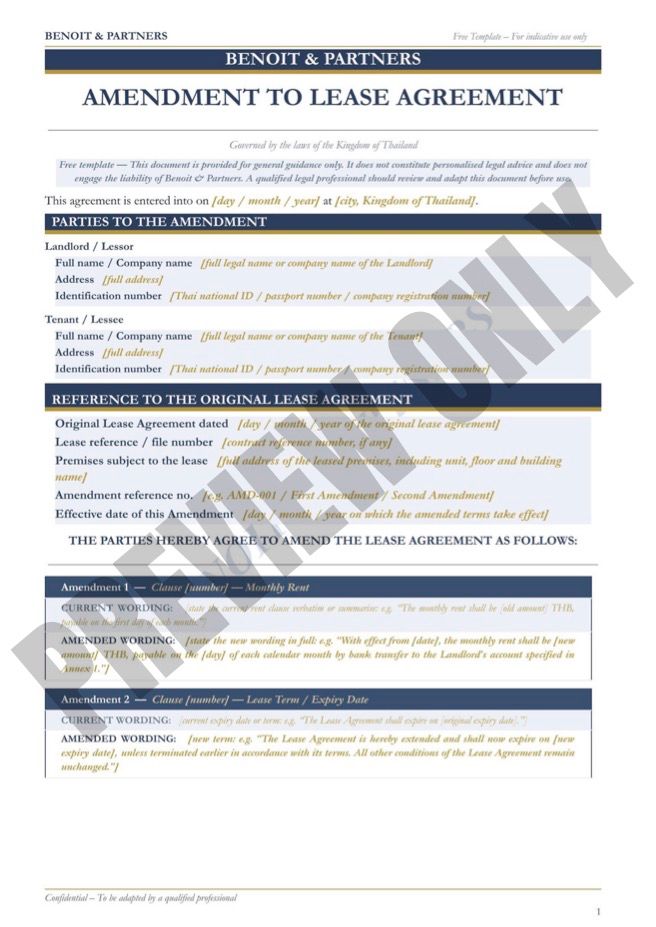
Our Amend to Lease Agreement Thailand template is drafted and reviewed by experienced lawyers to ensure compliance with Thai law and practical business use. It provides a reliable legal framework for modifying existing lease agreements in Thailand.
Designed for landlords, tenants, and companies seeking to amend the terms of an existing lease, this template covers key legal aspects such as identification of the original agreement, description of the amendments, revised rental terms, and regulatory compliance under Thai law.
However, some amendments may require additional clauses or tailored structuring depending on the nature of the modifications, registration requirements, or commercial risks. Our legal team can assist clients with customised Amendments to Lease Agreements within a short timeframe.
Disclaimer: This template is provided for general informational purposes only and does not constitute legal advice. While it has been prepared by legal professionals, it may not reflect your specific situation or regulatory constraints. For complex transactions, legal advice should be sought to ensure proper compliance under Thai law.
Need a Contract Tailored to Your Needs ? Get a Free Consultation.
When should you use an Amend Lease Agreement in Thailand?
An Amendment to Lease Agreement is used whenever the parties to an existing lease wish to modify one or more terms without terminating and replacing it entirely. This situation commonly arises when renegotiating rental amounts, extending or reducing the lease term, changing the permitted use of the premises, or updating the obligations of either party.
Under Thai law, lease agreements are governed by the Civil and Commercial Code, notably Sections 537 to 571. Any amendment to a registered lease must also be registered with the Land Department to be enforceable against third parties.
This document becomes particularly important when the modification involves a change in rental amount, an extension of the lease term, or the addition of new obligations. It allows the parties to clearly document the agreed modifications while preserving the validity of the original agreement.
In more complex transactions, additional clauses may be required regarding stamp duty obligations, VAT adjustments, subletting rights, or compliance with foreign business regulations. Our legal team assists clients with customised Amendments tailored to their situation to ensure compliance with Thai law.
Without a properly drafted Amendment to Lease Agreement, parties expose themselves to disputes over modified terms, regulatory issues, and potential unenforceability under Thai property law.

1. Identification of the parties and original agreement
The amendment must clearly identify the landlord and the tenant, and refer precisely to the original lease being amended, including its execution date and any prior amendments already in force.
2. Description of the amendments
The document must specify each clause being modified, setting out the original wording and the revised terms agreed between the parties to avoid any ambiguity as to the scope of the amendment.
3. Revised rental amount and payment terms
Where the rental amount is modified, the amendment must define the new rent, applicable VAT, effective date, payment method, and late payment consequences in accordance with the Civil and Commercial Code.
4. Representations and confirmations
Both parties must confirm their continued agreement to the original lease as amended, their legal capacity to execute the amendment, and the absence of disputes arising from the original agreement.
5. Duration and registration requirements
The amendment must specify its effective date and, where the lease term is extended beyond three years, confirm the obligation to register with the Land Department for enforceability against third parties.
6. Tax, stamp duty and regulatory compliance
The amendment must address additional stamp duty at 0.1% of the revised rental value, VAT and withholding tax implications, and compliance with Land Department registration requirements under Thai law.
Key clauses and additional protections in Amend Lease Agreement
An Amendment to Lease Agreement is a key legal document governing the modification of an existing lease in Thailand. It defines the specific terms being amended, confirms the continued validity of the original agreement, and ensures compliance with Thai property and commercial law.
Under the Civil and Commercial Code, any material modification to a registered lease must be registered with the Land Department to be enforceable against third parties. A properly drafted amendment helps secure the modification and reduce legal risks for both parties.
This type of document is commonly used in residential and commercial leases where circumstances have changed since the original agreement was executed. While straightforward amendments may rely on a general template, more complex modifications often require additional legal protections and customised clauses.
A properly customised Amendment to Lease Agreement helps secure the modification and better protect the interests of the parties involved.
Why customise an Amend Lease Agreement with a lawyer in Thailand?
While a standard Amendment to Lease Agreement template may be sufficient for simple modifications, many amendments involve legal, financial, and regulatory considerations requiring more advanced drafting and tailored protections.
In practice, each amendment has its own structure and level of risk. Changes to rental amounts, lease duration, permitted use, or the involvement of foreign parties may require provisions not included in a standard template.
Depending on the amendment, specific clauses may be added relating to revised rent and indexation, updated subletting rights, additional fit-out and reinstatement obligations, revised security deposit terms, stamp duty adjustments, VAT and withholding tax implications, Land Department registration requirements, or dispute resolution procedures.
Tailoring an Amendment to Lease Agreement allows the parties to better allocate responsibilities and anticipate risks arising from the modified terms. This is particularly important for high-value commercial leases, long-term agreements, or transactions involving foreign nationals.
Our legal team assists landlords, tenants, and companies with the preparation of customised Amendments adapted to their specific situation. In many cases, tailored amendments can be prepared within a short timeframe while ensuring compliance with Thai property and commercial laws.
A properly drafted amendment reduces the risk of future disputes, regulatory issues, and unexpected liabilities arising from the changed terms.
Amend Lease Agreement template
Instant Download
Easy to Customize
Ready to Sign
Crafted by Lawyers
FAQ
What is an Amendment to Lease Agreement in Thailand?
An Amendment to Lease Agreement modifies one or more terms of an existing lease without terminating it. In Thailand, it is governed by the Civil and Commercial Code and must be registered with the Land Department if it affects a registered lease.
When should it be used?
It should be used whenever the parties agree to change the rental amount, extend or reduce the lease term, modify the permitted use, or update any other material term of the original agreement.
Does it need to be registered in Thailand?
If the original lease was registered, any material amendment — particularly one affecting the lease term or rental amount — should also be registered with the Land Department to be enforceable against third parties.
What are the stamp duty implications?
An amendment may trigger additional stamp duty under the Thai Revenue Code. Where the rental amount or lease term is increased, additional stamp duty at 0.1% of the additional rental value may be payable.
Can a foreign national amend a lease agreement in Thailand?
Yes. Foreign nationals can amend existing lease agreements, provided the total lease term does not exceed 30 years. Registration with the Land Department is required for enforceability against third parties.
Do I need a lawyer?
For simple modifications, a standard template may be sufficient. For commercial leases, material changes, or transactions involving foreign parties, legal assistance is strongly recommended to ensure compliance with Thai law.
What happens if the amendment is not properly documented?
Without a properly drafted amendment, the modified terms may be unenforceable and the original lease terms may continue to apply, potentially to the detriment of one or both parties.
How does the PDPA apply?
If the amendment involves the exchange of personal data, both parties must comply with the Personal Data Protection Act B.E. 2562 (2019), including appropriate confidentiality and data processing provisions.