
Annual General Meeting Invitation Letter in Thailand
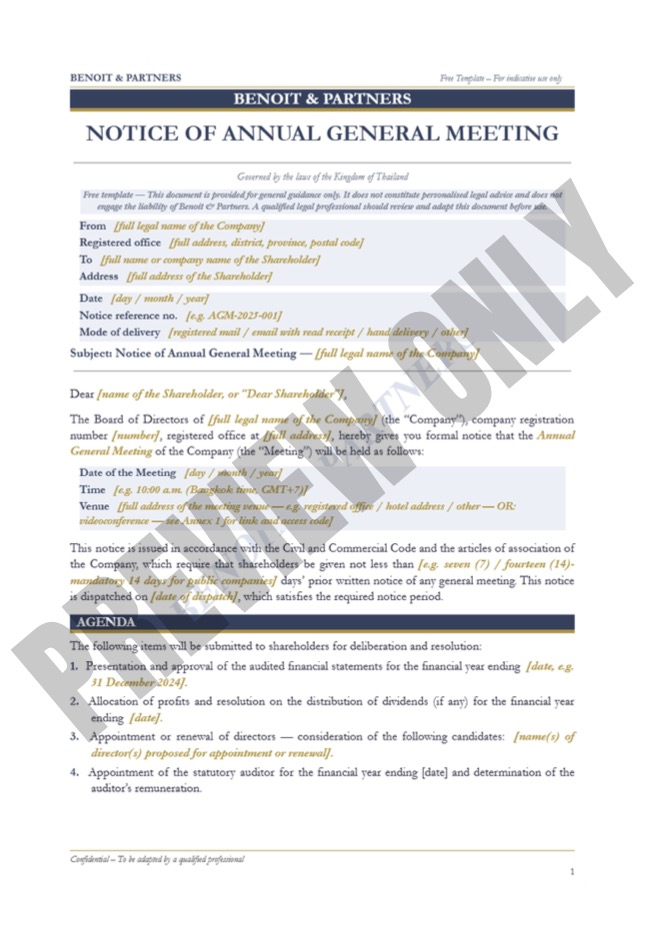
Our Annual General Meeting Invitation Letter in Thailand is drafted and reviewed by experienced lawyers to ensure compliance with Thai law and practical business use. It provides a reliable legal framework for formally notifying shareholders of an upcoming annual general meeting and the matters to be considered at that meeting.
Designed for companies, directors, and corporate secretaries seeking to issue a legally compliant notice of annual general meeting to their shareholders in Thailand, this template covers key legal aspects such as identification of the company and meeting details, the agenda items to be considered, the required notice period, and compliance with the notification requirements set out in the Civil and Commercial Code and, where applicable, the Public Limited Companies Act.
However, some situations may require additional clauses or tailored structuring depending on whether the company is a private limited company or a public limited company, the specific resolutions to be considered, and any specific notice provisions contained in the company’s articles of association. Our legal team can assist clients with customised invitation letters adapted to their specific situation within a short timeframe.
Disclaimer: This template is provided for general informational purposes only and does not constitute legal advice. While it has been prepared by legal professionals, it may not reflect your specific situation or regulatory constraints. For meetings involving significant resolutions or public company requirements, legal advice should be sought to ensure proper structuring and compliance under Thai corporate law.
Need a Contract Tailored to Your Needs? Get a Free Consultation.
When should you use an Annual General Meeting Invitation Letter in Thailand?
An Annual General Meeting Invitation Letter in Thailand is required whenever a Thai company convenes its annual general meeting, which the Civil and Commercial Code requires to be held within a specified period following incorporation and, thereafter, at least once every year. The letter formally notifies shareholders of the date, time, location, and agenda of the meeting, giving them the opportunity to attend, participate, and vote on the matters to be considered.
Under the Civil and Commercial Code, private limited companies must provide shareholders with at least seven days’ notice of a general meeting, while public limited companies are subject to longer notice periods under the Public Limited Companies Act, particularly where the agenda includes matters such as the approval of financial statements, dividend declarations, or the election of directors. Failure to observe the required notice period can render resolutions passed at the meeting voidable.
A properly issued invitation letter ensures that shareholders are given fair and timely opportunity to exercise their rights, protects the company against challenges to the validity of the meeting on procedural grounds, and provides a clear documentary record that the statutory notification requirements have been satisfied.
Issuing an inadequate or improperly timed notice exposes the company to the risk that resolutions passed at the meeting may later be challenged by shareholders who did not receive proper notice, potentially unwinding decisions that the company has already acted upon.

1. Company Identification
The letter should state the company's full registered name, registration number, and registered address, establishing clearly which entity is convening the meeting.
2. Meeting Details
The date, time, and venue of the meeting should be stated precisely, together with confirmation of whether the meeting will be held in person, electronically, or in a hybrid format.
3. Agenda Items
Each matter to be considered at the meeting should be listed clearly and in the order in which it will be addressed, including any resolutions requiring shareholder approval.
4. Supporting Documentation
Where relevant documents such as financial statements, the auditor's report, or proposed amendments to the articles of association are to be considered at the meeting, the letter should reference how shareholders can obtain copies in advance.
5. Proxy Appointment Information
The letter should explain the shareholder's right to appoint a proxy to attend and vote on their behalf, and should include or reference the proxy form and the deadline for its submission.
6. Quorum Requirements
A statement of the quorum required for the meeting to validly proceed should be included, giving shareholders an understanding of the attendance threshold that must be met.
Key Clauses and Essential Elements in an Annual General Meeting Invitation Letter
A well-prepared Annual General Meeting Invitation Letter in Thailand gives shareholders complete and accurate information about the meeting, enabling them to decide whether to attend in person, appoint a proxy, or otherwise participate in accordance with their rights as shareholders.
The Civil and Commercial Code and, for public companies, the Public Limited Companies Act, prescribe specific content and notice period requirements for meeting invitations. Compliance with these requirements is essential to the legal validity of the meeting and any resolutions passed at it.
This document is used by companies of all sizes across Thailand, and its specific content will vary depending on whether the company is privately or publicly held and the nature of the resolutions to be considered at the meeting.
Why customise an Annual General Meeting Invitation Letter with a lawyer in Thailand?
A standard Annual General Meeting Invitation Letter template in Thailand is generally suitable for routine annual general meetings of private companies, but more complex situations call for a carefully tailored approach to ensure full compliance and to avoid procedural challenges.
Public limited companies, meetings considering significant resolutions such as capital increases or director removals, and companies with a history of shareholder disputes each require particular attention to the content and timing of the invitation letter.
Depending on the situation, the letter may need to address specific public company notice period requirements, the inclusion of detailed explanatory notes for complex resolutions, electronic meeting participation arrangements, or coordination with simultaneous regulatory filings.
Our legal team works with companies and corporate secretaries to prepare invitation letters that are fully compliant with the applicable notice period and content requirements, reducing the risk of procedural challenges to the meeting or its resolutions.
Annual General Meeting Invitation Letter Thailand
Instant Download
Easy to Customize
Ready to Sign
Crafted by Lawyers
FAQ
What is an Annual General Meeting Invitation Letter in Thailand?
A formal written notice issued by a company to its shareholders, informing them of the date, time, location, and agenda of the company’s annual general meeting, in compliance with the requirements of Thai corporate law.
How much notice must be given for an Annual General Meeting in Thailand?
Private limited companies must generally provide at least seven days’ notice under the Civil and Commercial Code. Public limited companies are subject to longer notice periods, which vary depending on the nature of the resolutions to be considered.
What happens if a company fails to give proper notice of its Annual General Meeting in Thailand?
Resolutions passed at a meeting convened without proper notice may be voidable, exposing the company to the risk that affected shareholders could successfully challenge the validity of decisions taken at the meeting.
Can shareholders appoint a proxy to attend an Annual General Meeting in Thailand on their behalf?
Yes. Thai law permits shareholders to appoint a proxy to attend and vote at general meetings, and the invitation letter should provide the necessary proxy form and submission instructions.
Is it mandatory for a Thai company to hold an Annual General Meeting every year?
Yes. The Civil and Commercial Code requires companies to hold an annual general meeting at least once every twelve months following the first meeting held after incorporation.
Can an Annual General Meeting be held electronically in Thailand?
Yes, subject to compliance with applicable electronic meeting regulations and, where relevant, provisions in the company’s articles of association permitting electronic or hybrid participation.
What matters are typically considered at an Annual General Meeting in Thailand?
Common agenda items include the approval of annual financial statements, consideration of dividend payments, the election or re-election of directors, and the appointment of the company’s auditor.
How does the PDPA apply to an Annual General Meeting Invitation Letter in Thailand?
The letter and any accompanying shareholder list contain personal data of the company’s shareholders. The company must ensure that this data is handled in accordance with the Personal Data Protection Act B.E. 2562 (2019), particularly where the letter is distributed by email or another electronic channel.