
Arbitration Agreement in Thailand
Our Arbitration Agreement in Thailand is drafted and reviewed by experienced lawyers to ensure compliance with Thai law and practical business use. It provides a reliable legal framework for formally committing parties to resolve disputes through arbitration rather than through the Thai courts.
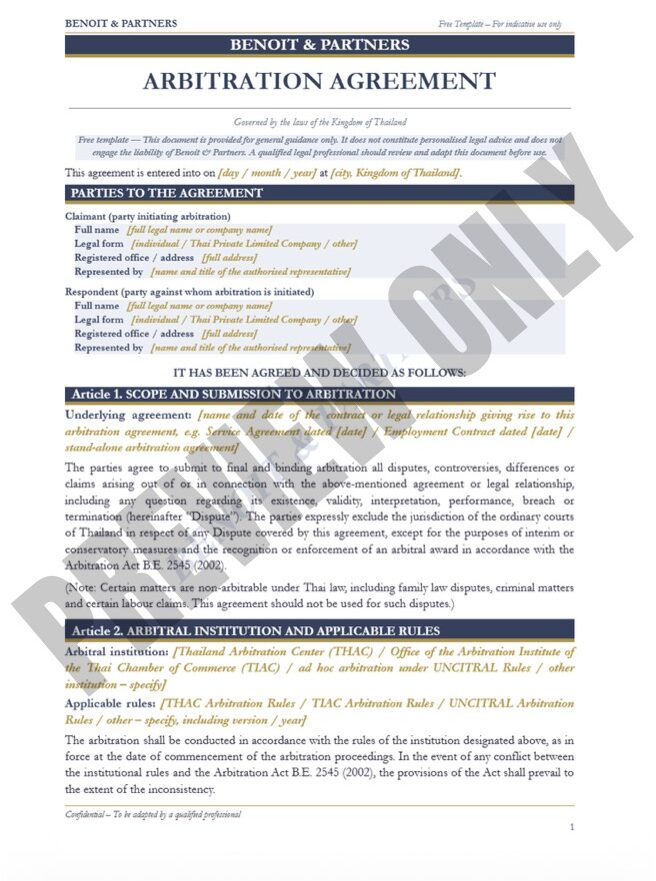
Designed for businesses, commercial partners, and individuals seeking to establish a binding arbitration mechanism for the resolution of disputes arising from their relationship in Thailand, this template covers key legal aspects such as identification of the parties, the scope of disputes covered by the agreement, the seat and language of arbitration, the applicable procedural rules, the number and appointment of arbitrators, and compliance with the Thai Arbitration Act B.E. 2545 (2002) and international arbitration standards.
However, some situations may require additional clauses or tailored structuring depending on the nature of the underlying commercial relationship, the nationalities of the parties, the value and complexity of potential disputes, or the desired interaction between the arbitration clause and other dispute resolution mechanisms. Our legal team can assist clients with customised Arbitration Agreements adapted to their specific situation within a short timeframe.
Disclaimer: This template is provided for general informational purposes only and does not constitute legal advice. While it has been prepared by legal professionals, it may not reflect your specific situation or regulatory constraints. For high-value commercial transactions or cross-border disputes, legal advice should be sought to ensure proper structuring and compliance under Thai and applicable international arbitration law.
Need a Contract Tailored to Your Needs? Get a Free Consultation.
When should you use an Arbitration Agreement in Thailand?
An Arbitration Agreement in Thailand becomes the appropriate instrument when two or more parties wish to commit in advance to resolving any disputes that arise between them through arbitration rather than through litigation in the Thai courts. It is particularly well-suited to commercial contracts, joint venture arrangements, construction projects, technology agreements, and any relationship where the parties value confidentiality, speed, or the ability to appoint decision-makers with specialist expertise.
Thai arbitration law is governed primarily by the Arbitration Act B.E. 2545 (2002), which is modelled on the UNCITRAL Model Law and provides a well-established framework for both domestic and international arbitration. An arbitration agreement that complies with the Act is binding on the parties and enforceable before the Thai courts, which are required to stay any court proceedings brought in breach of a valid arbitration clause.
Choosing Arbitration Agreement Thailand over litigation offers meaningful advantages in the right circumstances. Proceedings are confidential, the timetable is more predictable, the parties have greater control over the process and the composition of the tribunal, and an arbitral award made in Thailand is enforceable in over 170 countries under the New York Convention.
More complex arrangements may require additional provisions covering emergency arbitrator procedures, interim relief, multi-party arbitration, or the interaction between the arbitration clause and any expert determination or mediation mechanism. Our legal team is available to assist with tailored agreements that address these dimensions with precision.
Without a clearly drafted arbitration agreement, parties may find themselves in dispute about whether their disagreement is subject to arbitration at all, potentially leading to costly parallel proceedings before both an arbitral tribunal and the Thai courts.

1. Identification of the Parties
The agreement should clearly identify all parties bound by the arbitration commitment, including their full legal names and, where applicable, their registered addresses and company registration numbers.
2. Scope of the Arbitration Clause
The agreement should define precisely which disputes are subject to arbitration typically all disputes arising out of or in connection with the underlying contract or relationship. Any carve-outs, such as applications for urgent interim relief, should be clearly identified.
3. Seat of Arbitration
The seat determines the arbitration’s legal framework and court supervision. Bangkok is commonly used, but parties may choose another seat.
4. Institutional or Ad Hoc Rules
The agreement should specify whether the arbitration will be administered by an institution such as the Thai Arbitration Institute, the SIAC, or the ICC or conducted on an ad hoc basis under a set of procedural rules such as the UNCITRAL Arbitration Rules.
5. Number and Appointment of Arbitrators
The parties should decide whether the tribunal will have one arbitrator or three, and how they will be appointed. In three-member tribunals, each party usually appoints one arbitrator, and the third is agreed or appointed by the institution.
6. Language of the Arbitration
The language in which the proceedings will be conducted including written submissions, oral hearings, and the award should be specified. English, Thai, or a combination are the most common choices for Thailand-related arbitrations.
Key Clauses and Essential Elements in an Arbitration Agreement
A well-drafted Arbitration Agreement in Thailand gives the parties a clear, workable, and enforceable framework for the resolution of any disputes that may arise between them. It eliminates ambiguity about the scope of the arbitration commitment, the procedural rules that will govern the proceedings, and the composition and powers of the tribunal.
Under the Thai Arbitration Act, an arbitration agreement must be in writing to be valid and enforceable. A properly structured agreement that satisfies the formal requirements of the Act and clearly defines the scope of arbitrable disputes is the foundation on which an effective dispute resolution mechanism is built.
This document is relevant across all categories of commercial relationship from bilateral supply agreements to complex multi-party joint ventures and is applicable whether both parties are Thai entities, both are foreign, or the arrangement involves a combination of domestic and international participants.
Why customise an Arbitration Agreement with a lawyer in Thailand?
A standard Arbitration Agreement Thailand clause is adequate for straightforward commercial relationships, but many transactions involve considerations that require a more tailored approach before the parties commit to a dispute resolution mechanism.
The specific dynamics of the relationship including the nationalities of the parties, the value of potential claims, the technical nature of the subject matter, and the desired level of institutional support all influence what an effective arbitration agreement needs to contain.
Depending on the situation, the agreement may need to address: the appropriate institutional rules for the specific type of dispute; the interaction between the arbitration clause and any governing law provision; the enforceability of the agreement and any resulting award in the relevant jurisdictions; the availability of emergency arbitrator and interim relief procedures; or the treatment of multi-party or multi-contract disputes involving related agreements.
Our legal team works with businesses and their advisers to prepare arbitration agreements that are carefully structured, legally sound, and well-matched to the specific transaction and relationship. The result is a dispute resolution framework that the parties can rely on with confidence.
Arbitration Agreement Thailand
Instant Download
Easy to Customize
Ready to Sign
Crafted by Lawyers
FAQ
What is an Arbitration Agreement in Thailand?
A written agreement through which two or more parties commit to resolving disputes arising from their relationship through arbitration rather than through the Thai courts, specifying the rules, seat, language, and composition of the tribunal that will govern the process.
Is an arbitration agreement legally binding in Thailand?
Yes, provided it meets the formal requirements of the Thai Arbitration Act B.E. 2545 (2002), including the requirement that it be in writing. A valid arbitration agreement obliges the parties to arbitrate covered disputes and requires the Thai courts to stay any court proceedings brought in breach of it.
Can an arbitration agreement be included as a clause in a broader contract?
Yes. An arbitration agreement most commonly takes the form of a dispute resolution clause within a wider commercial contract. Under Thai law, an arbitration clause is treated as a separate agreement from the main contract, meaning that the invalidity of the main contract does not automatically affect the validity of the arbitration clause.
What types of disputes can be resolved by arbitration in Thailand?
The Thai Arbitration Act permits arbitration of disputes that the parties are free to settle by agreement. Most commercial disputes fall within this category. Certain matters such as family law disputes, criminal matters, and some consumer claims cannot be referred to arbitration.
Are arbitral awards enforceable in Thailand?
Yes. Awards made in Thailand or in countries that are parties to the New York Convention on the Recognition and Enforcement of Foreign Arbitral Awards are enforceable through the Thai courts, subject to limited grounds for refusal set out in the Act.
What is the difference between institutional and ad hoc arbitration in Thailand?
Institutional arbitration is administered by an arbitral institution such as the Thai Arbitration Institute or an international body which provides procedural support, appointment services, and oversight
How long does arbitration typically take in Thailand?
The duration depends on the complexity of the dispute and the procedural rules chosen. Domestic arbitrations before the Thai Arbitration Institute are typically resolved within twelve to eighteen months. International arbitrations may take longer depending on the institution and the scope of the proceedings.
How does the PDPA apply to arbitration proceedings in Thailand?
Where arbitration proceedings involve the processing of personal data including evidence relating to individuals both parties and the tribunal must handle that data in accordance with the Personal Data Protection Act B.E. 2562 (2019), using it only to the extent necessary for the resolution of the dispute.