
Architect Design Contract in Thailand
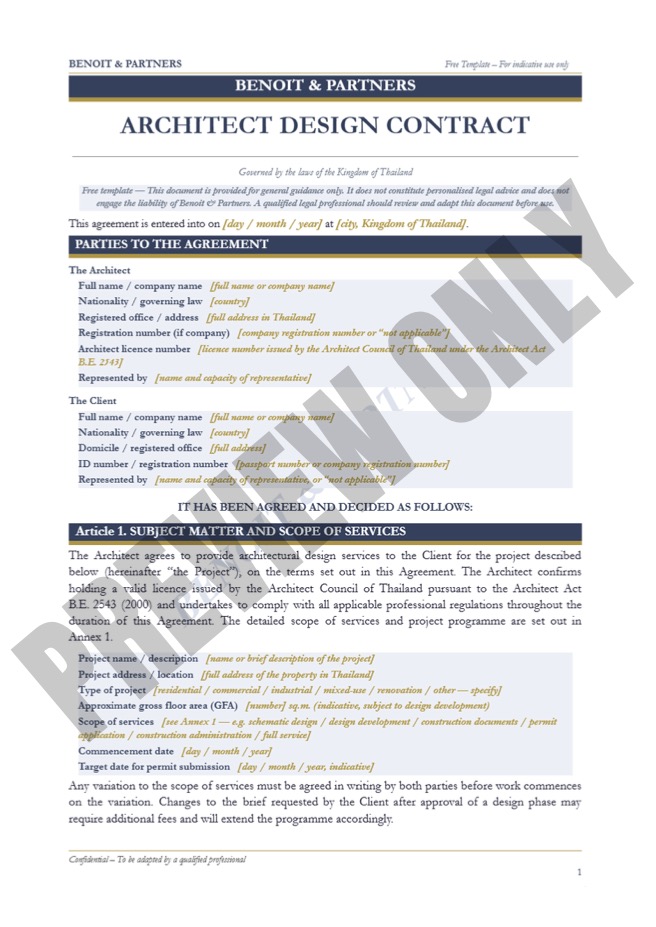
Our Architect Design Contract in Thailand is drafted and reviewed by experienced lawyers to ensure compliance with Thai law and practical business use. It provides a reliable legal framework for formally documenting the appointment of an architect and the scope of professional design services to be provided in connection with a project in Thailand.
Designed for property developers, landowners, and individuals seeking to engage an architect on a legally sound and clearly defined basis in Thailand, this template covers key legal aspects such as identification of the parties, scope of architectural services, fees and payment terms, programme and deliverables, intellectual property ownership, professional indemnity insurance, and compliance with applicable Thai professional licensing and civil law requirements.
However, some situations may require additional clauses or tailored structuring depending on the scale and nature of the project, the stage at which the architect is being engaged, the involvement of other design consultants, or the specific deliverables required by the client or a project financier. Our legal team can assist clients with customised Architect Design Contracts adapted to their specific situation within a short timeframe.
Disclaimer: This template is provided for general informational purposes only and does not constitute legal advice. While it has been prepared by legal professionals, it may not reflect your specific situation or regulatory constraints. For complex or high-value projects, legal advice should be sought to ensure proper structuring and compliance under Thai professional and civil law.
Need a Contract Tailored to Your Needs? Get a Free Consultation.
When should you use an Architect Design Contract in Thailand?
An Architect Design Contract in Thailand is required whenever a client engages an architect to provide professional design services in connection with a building project in Thailand, whether at the concept design stage, for detailed design and documentation, for planning and building permit applications, or for construction-phase supervision.
Architectural services in Thailand are regulated by the Architects Act B.E. 2543 (2000), which requires architects practising in Thailand to hold a valid licence issued by the Council of Architects. The Act establishes professional standards and disciplinary procedures and provides the framework within which architectural services must be delivered.
A properly structured Architect Design Contract provides the client with clarity about what the architect will deliver, when they will deliver it, and what the client will pay. It also establishes the basis for managing design changes, programme delays, and any disputes about the quality or completeness of the design services provided.
More complex appointments may require additional provisions covering the architect’s role as lead consultant, the coordination of other design disciplines, the architect’s authority to issue instructions to the contractor, or the treatment of existing buildings and heritage constraints. Our legal team is available to assist with tailored appointments that reflect the full scope of the architect’s role on the specific project.
Without a clearly documented Architect Design Contract, disputes about scope, fees, and deliverables are a common source of difficulty that can significantly delay a project and undermine the client-architect relationship.

1. Scope of Services
The contract should set out a clear and comprehensive description of the architectural services to be provided, typically organised by project stage.
2. Fees and Payment Terms
The architect's fee whether calculated as a percentage of the construction cost, as a fixed lump sum, or on a time-charge basis should be stated clearly, together with the payment schedule, the basis for fee adjustments in the event of scope changes, and the consequences of late payment.
3. Programme and Deliverable
The contract should specify the timetable for delivery of each stage of the design services, the format and medium in which deliverables are to be provided, and the process for the client's review and approval of each stage before the next stage commences.
4. Intellectual Property
The ownership of the architectural drawings, designs, and documentation produced under the contract should be addressed clearly;
5. Professional Indemnity Insurance
The contract should specify the level of professional indemnity insurance the architect is required to maintain throughout the appointment and for a defined period following completion of the services, together with evidence of cover the client is entitled to request.
6. Liability and Limitation of Liability
The contract should address the architect's liability for errors, omissions, and delays in the design services, and may include a cap on the architect's aggregate liability, subject to any mandatory requirements of Thai professional liability law.
Key Clauses and Essential Elements in an Architect Design Contract
A well-drafted Architect Design Contract in Thailand gives both the client and the architect a clear and agreed understanding of the services to be provided, the fee payable, the programme for delivery, and the standards the architect is required to meet. It provides a structured framework for managing design development, changes in scope, and the architect’s ongoing involvement during the construction phase.
Under Thai law, the architect owes the client a duty to exercise reasonable professional skill and care in the delivery of their services. A well-structured contract builds on this baseline to establish more specific and project-tailored performance standards, deliverables, and accountability mechanisms.
This document is relevant across all scales of architectural appointment from private residential projects to large commercial and mixed-use developments and applies whether the architect is an individual practitioner or an architectural firm.
Why customise an Architect Design Contract with a lawyer in Thailand?
A standard Architect Design Contract in Thailand is a reasonable starting point for a straightforward residential appointment, but many architectural engagements involve considerations that require a more carefully structured approach.
The scale of the project, the complexity of the design brief, the architect’s role in the construction phase, and the client’s requirements regarding intellectual property and liability all shape what the contract needs to achieve.
The contract may, where appropriate, need to take into account: the interaction between the architect’s appointment and the appointments of other design consultants; the architect’s authority and responsibilities during the construction phase, including the issue of instructions to the contractor; the treatment of design changes instructed by the client after a design stage has been approved; the licensing requirements applicable to the specific type of building under Thai construction law; or the requirements of a project financier regarding design documentation and collateral warranties.
Our legal team works with clients and architects to prepare appointment contracts that are clearly structured, professionally appropriate, and tailored to the specific requirements of the project and the parties involved.
Architect Design Contract Thailand
Instant Download
Easy to Customize
Ready to Sign
Crafted by Lawyers
FAQ
What is an Architect Design Contract in Thailand?
A formal written agreement through which a client appoints an architect to provide professional design services in connection with a building project in Thailand, setting out the scope of services, fees, programme, deliverables, and the respective rights and obligations of the parties.
Must an architect in Thailand hold a professional licence?
Yes. Under the Architects Act B.E. 2543 (2000), architects practising in Thailand must hold a valid licence issued by the Council of Architects. Clients should verify that their appointed architect holds a current licence before entering into a contract, as services provided by an unlicensed practitioner may not be legally valid for the purposes of obtaining building permits.
Who owns the architectural drawings produced under the contract in Thailand?
Ownership of the intellectual property in architectural drawings depends on the terms of the contract. In the absence of an express provision, the architect typically retains copyright in the drawings but grants the client a licence to use them for the specific project. The contract should address this point explicitly to avoid disputes.
What is the architect's standard of care in Thailand?
An architect in Thailand is required to exercise the reasonable professional skill and care expected of a competent architect in the same field. Where the architect falls below this standard and the client suffers loss as a result, the client may have a claim for breach of contract or professional negligence.
Can an architect in Thailand act as contract administrator during construction?
Yes. Many architect appointments in Thailand include a construction phase role in which the architect reviews the contractor’s work against the design, issues instructions, certifies payments, and manages the completion process.
What happens if the client changes the design brief after the contract is signed?
Changes to the design brief after contract execution typically entitle the architect to additional fees and, where the changes affect the programme, an extension of time. The contract should include a clear change management mechanism that addresses the process for agreeing the impact of client-initiated changes before they are implemented.
How is a dispute with an architect resolved in Thailand?
Disputes between a client and an architect are typically resolved through negotiation, and if unsuccessful, through mediation, arbitration, or litigation in the Thai courts depending on the dispute resolution mechanism in the contract.
How does the PDPA apply to an Architect Design Contract in Thailand?
Architectural projects may involve the processing of personal data relating to the client, occupants, or other individuals. Both the client and the architect must comply with the Personal Data Protection Act B.E. 2562 (2019) in relation to any personal data processed in connection with the project.