
Business Purchase Agreement Template for Thailand
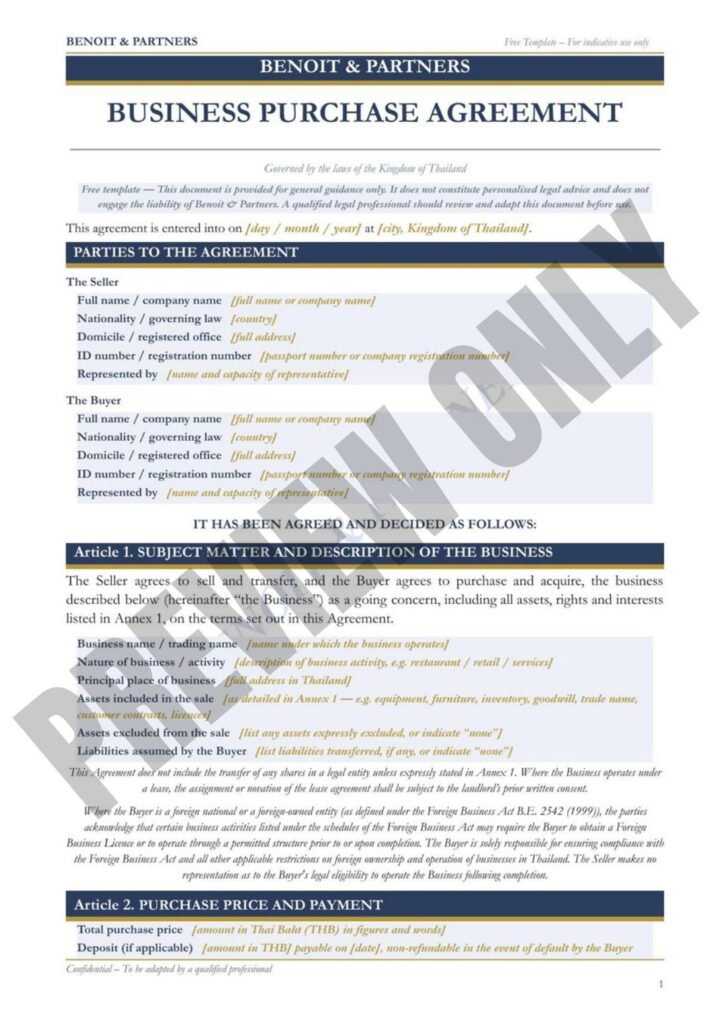
Our Business Purchase Agreement Template for Thailand is drafted and reviewed by experienced lawyers to ensure compliance with Thai law and practical business use. It provides a reliable legal framework for standard business acquisition transactions in Thailand.
Designed for buyers, sellers, and companies involved in the transfer of a business, this template covers key legal aspects such as description of assets and liabilities transferred, purchase price, payment terms, representations and warranties, and regulatory compliance under Thai law.
However, some transactions may require additional clauses or tailored structuring depending on the nature of the business, foreign ownership restrictions, or commercial risks. Our legal team can assist clients with customised Business Purchase Agreements within a short timeframe.
Disclaimer: This template is provided for general informational purposes only and does not constitute legal advice. While it has been prepared by legal professionals, it may not reflect your specific situation or regulatory constraints. For complex or high-value transactions, legal advice should be sought to ensure compliance under Thai law.
Need a Contract Tailored to Your Needs ? Get a Free Consultation.
When should you use a Business Purchase Agreement in Thailand?
A Business Purchase Agreement is used whenever a buyer acquires the assets, operations, or goodwill of an existing business in Thailand. This situation commonly arises in business acquisitions, mergers, management buyouts, investor entry, and commercial restructuring involving the transfer of a going concern.
Under Thai law, business transfers are governed by the Civil and Commercial Code and may also be subject to the Foreign Business Act B.E. 2542 (1999), the Revenue Code, and sector-specific regulations. Where employees are involved, the Labour Protection Act B.E. 2541 (1998) imposes specific obligations on both parties.
This agreement becomes particularly important when the transaction involves significant financial value, multiple assets, ongoing contracts, or existing liabilities. It allows the parties to clearly define the scope of the acquisition, payment conditions, and risk allocation mechanisms.
In more complex transactions, additional clauses may be required regarding tax liabilities, employee transfers, intellectual property assignments, or foreign ownership compliance. Our legal team assists clients with customised Business Purchase Agreements to ensure compliance with Thai law.
Without a properly drafted Business Purchase Agreement, parties expose themselves to disputes over the scope of the transfer, undisclosed liabilities, and potential invalidity of the transaction under Thai commercial law.

1. Identification of the parties and business
The agreement must clearly identify the buyer and the seller, including their full legal names and registration details, as well as a precise description of the business being acquired, including its registered name, activity, and location.
2. Description of assets and liabilities transferred
The agreement must specify the assets included in the transfer, such as equipment, inventory, contracts, licences, and goodwill, as well as any liabilities assumed by the buyer, with reference to schedules where applicable.
3. Purchase price and payment terms
The agreement must define the total purchase price, applicable taxes, payment method, and schedule, including any deferred payment, earn-out mechanisms, or escrow arrangements agreed between the parties.
4. Representations and warranties
The seller must warrant the accuracy of financial information, ownership of assets, absence of undisclosed liabilities, and compliance with applicable laws, while the buyer confirms its legal capacity to complete the transaction.
5. Transfer of ownership and conditions precedent
The agreement must specify the completion date, conditions precedent to closing, and the procedure for transferring ownership of the assets and business operations to the buyer.
6. Tax, regulatory compliance and employee transfers
The agreement must address VAT, stamp duty, and withholding tax obligations, compliance with the Foreign Business Act where applicable, and employee transfer requirements under the Labour Protection Act B.E. 2541 (1998).
Key clauses and additional protections in a Business Purchase Agreement
A Business Purchase Agreement is a key legal document governing the acquisition of a business in Thailand. It defines the rights and obligations of the buyer and seller while ensuring compliance with Thai commercial and corporate law.
Under the Civil and Commercial Code, a business transfer must be properly structured to ensure the valid transfer of assets, contracts, licences, and liabilities. A properly drafted agreement helps secure the transaction and reduce legal risks for both parties.
This type of agreement is commonly used in business acquisitions, asset purchases, and commercial restructuring. While standard transactions may rely on a general template, more complex deals often require additional legal protections and customised clauses depending on the structure of the acquisition.
A properly customised Business Purchase Agreement helps secure the transaction and better protect the interests of the parties involved.
Why customise a Business Purchase Agreement with a lawyer in Thailand?
While a standard Business Purchase Agreement template may be sufficient for simple asset transfers, many transactions involve legal, financial, and regulatory considerations requiring more advanced drafting and tailored protections.
In practice, each transaction has its own structure and level of risk. Foreign buyer involvement, employee transfers, existing contracts, intellectual property, or sector-specific regulations may require provisions not included in a standard template.
Depending on the transaction, specific clauses may be added relating to earn-out and deferred payment arrangements, escrow and conditions precedent, employee transfer obligations, novation of existing contracts, intellectual property and goodwill transfer, tax indemnities, confidentiality and non-compete undertakings, or foreign ownership compliance under the Foreign Business Act.
Tailoring a Business Purchase Agreement allows the parties to better allocate responsibilities and anticipate risks identified during due diligence. This is particularly important for high-value acquisitions, regulated businesses, or cross-border transactions.
Our legal team assists buyers, sellers, and companies with customised Business Purchase Agreements adapted to their transaction structure. In many cases, tailored agreements can be prepared within a short timeframe while ensuring compliance with Thai laws.
A properly drafted agreement reduces the risk of future disputes, regulatory issues, and unexpected liabilities.
Business Purchase Agreement template
Instant Download
Easy to Customize
Ready to Sign
Crafted by Lawyers
FAQ
What is a Business Purchase Agreement in Thailand?
A Business Purchase Agreement is a contract by which a buyer acquires the assets, operations, or goodwill of an existing business. In Thailand, it is governed by the Civil and Commercial Code and may also be subject to the Foreign Business Act and sector-specific regulations.
When should it be used?
It should be used whenever a buyer acquires a business or its assets in Thailand, including in mergers and acquisitions, management buyouts, investor entry, or commercial restructuring involving the transfer of a going concern.
What is the difference between an asset purchase and a share purchase?
An asset purchase transfers specific assets and liabilities, while a share purchase transfers ownership of the company itself. Each structure has different tax, regulatory, and liability implications under Thai law depending on the transaction objectives and due diligence findings.
What are the tax implications of a business purchase in Thailand?
A business purchase may trigger VAT at 7%, specific business tax, stamp duty, and withholding tax under the Thai Revenue Code. The tax treatment depends on the structure of the transaction and the nature of the assets transferred.
Do employee contracts transfer automatically?
Under the Labour Protection Act B.E. 2541 (1998), employees must consent to the transfer of their employment contracts. The seller and buyer must notify affected employees and obtain their agreement before completing the transfer.
Do I need a lawyer?
For simple asset transfers, a standard template may be sufficient. For high-value acquisitions, regulated businesses, or cross-border transactions, legal assistance is strongly recommended to ensure compliance with Thai law.
Can a foreign company acquire a business in Thailand?
Yes, but foreign ownership restrictions apply under the Foreign Business Act B.E. 2542 (1999). Foreign buyers must ensure compliance with applicable ownership limits and obtain a Foreign Business Licence where required.
How does due diligence affect the agreement?
Due diligence findings directly influence the representations and warranties, indemnities, and risk allocation provisions. The agreement should reflect risks identified during the process to protect the buyer against undisclosed liabilities.