
Certificate of Employment Template in Thailand
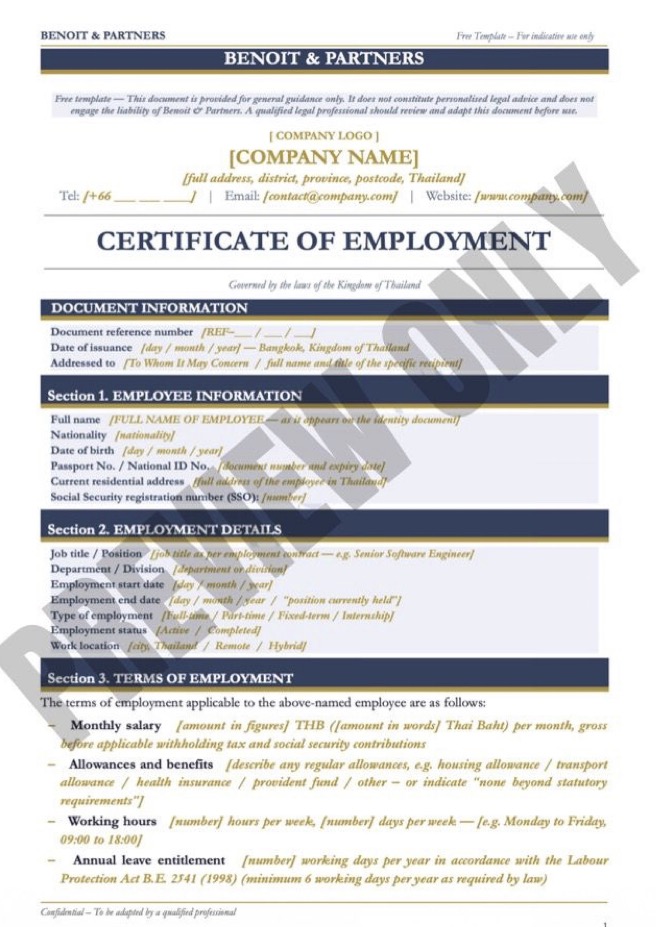
Our Certificate of Employment Template for Thailand is drafted and reviewed by experienced lawyers to ensure compliance with Thai labor practices and administrative requirements. It provides a reliable framework for confirming an employee’s position, salary, employment status, and work conditions in Thailand.
Designed for companies, HR departments, employees, and foreign nationals, this template covers key elements commonly required for visa applications, work permits, banking procedures, and administrative formalities.
Some situations may require additional clauses or customised wording depending on immigration, banking, tax, or embassy requirements. Our legal team can assist clients with tailored Certificate of Employment Templates adapted to their specific needs within a short timeframe.
Disclaimer: This template is provided for general informational purposes only and does not constitute legal advice. For immigration, financial, or sensitive employment matters, legal advice should be sought to ensure compliance under Thai law.
Need a Contract Tailored to Your Needs? Get a Free Consultation.
When should you use a Certificate of Employment in Thailand?
A Certificate of Employment is commonly used when an employee needs official proof of employment from a Thai company. It is frequently requested for visa applications, work permit renewals, bank account openings, loan applications, rental agreements, and administrative procedures in Thailand or abroad.
This document generally confirms key employment information such as the employee’s position, salary, employment status, work location, and duration of employment. While no specific format is required under Thai law, the certificate must remain accurate and consistent with company records.
Certificates of Employment are particularly important when dealing with embassies, immigration authorities, banks, or foreign institutions, as incomplete or inaccurate information may lead to delays or rejection of applications.
In some situations, additional clauses may be required regarding work permits, compensation, remote work arrangements, confidentiality obligations, or PDPA compliance. Our legal team assists companies and employees with customised Certificates of Employment adapted to specific administrative and legal requirements.
Without a properly drafted Certificate of Employment in Thailand, employees may face administrative complications, delays, or additional verification procedures with third parties and government authorities.

1. Identification of the employer and employee
A Certificate of Employment must clearly identify both the employer and the employee. This generally includes the company name, registered address, contact information, and the employee’s full legal name, nationality, identification details, and residential address.
2. Employment details and status
The certificate should specify the employee’s job title, department, employment type, work location, employment commencement date, and whether the employee is currently employed or formerly employed by the company.
3. Salary and employment conditions
The document may confirm salary details, benefits, allowances, working hours, annual leave entitlement, and other employment conditions relevant to the purpose of the certificate.
4. Work permit and immigration information
For foreign employees, the certificate may include work permit details, visa-related information, or confirmation of legal employment status in Thailand.
5. Purpose and legal certification
In practice, many Certificates of Employment specify the intended purpose of the document, such as visa applications, banking procedures, rental agreements, or government registrations, while formally certifying the accuracy of the information provided.
6. Signature, company stamp, and compliance requirements
The certificate should be signed by an authorised representative of the company and may include the company’s official stamp registered with the Department of Business Development. It may also include compliance wording relating to Thai labor law and personal data protection regulations.
Key clauses and additional protections in a Certificate of Employment
A Certificate of Employment is an important corporate and administrative document used to officially confirm an employment relationship in Thailand. It defines the information certified by the employer while helping ensure compliance with Thai labor regulations and corporate practices.
This type of document is commonly used for visa applications, work permit renewals, banking procedures, rental agreements, tax matters, and interactions with embassies, financial institutions, or government authorities. While standard administrative requests may rely on a general template, more sensitive situations often require additional legal protections and customised wording depending on the employee’s profile and the requesting institution’s requirements.
Additional clauses may sometimes be required regarding salary breakdown, probation status, executive functions, confidentiality obligations, remote work arrangements, work permit information, or compliance with the Personal Data Protection Act (PDPA).
A properly customised Certificate of Employment helps strengthen the credibility of the document and better protect the interests of both the employer and the employee.
Why customise a Certificate of Employment with a lawyer in Thailand?
While a standard Certificate of Employment template may be sufficient for simple employment confirmation, many situations involve legal, immigration, financial, and regulatory considerations requiring more advanced drafting and tailored protections.
In practice, each request may involve different administrative requirements and levels of scrutiny. Visa applications, embassy formalities, international banking procedures, work permit renewals, or tax-related matters may require provisions that are not included in a standard template.
Depending on the situation, specific clauses may be added relating to salary certification, employment continuation, work permit compliance, executive responsibilities, confidentiality obligations, personal data protection, or foreign administrative requirements.
Tailoring a Certificate of Employment also allows companies to better control the information officially certified to third parties while reducing the risk of inconsistencies, compliance issues, or disputes arising from inaccurate or incomplete statements. This is particularly important for foreign employees, regulated industries, executive-level positions, or international administrative procedures.
Our legal team assists companies, HR departments, and employees with the preparation and review of customised Certificates of Employment adapted to their administrative requirements and professional objectives. In many cases, tailored documents can be prepared within a short timeframe while ensuring compliance with Thai labor regulations, corporate practices, and immigration requirements.
A properly drafted Certificate of Employment not only helps facilitate administrative and immigration procedures, but also reduces the risk of rejection, delays, regulatory issues, and unexpected liabilities arising from inaccurate employment documentation.
Certificate of Employment Template in Thailand
Instant Download
Easy to Customize
Ready to Sign
Crafted by Lawyers
FAQ
What is a Certificate of Employment in Thailand?
A Certificate of Employment is an official document issued by a company to confirm that an individual is or was employed by the company in Thailand. It typically includes information such as the employee’s position, salary, employment status, and duration of employment.
When is a Certificate of Employment required?
This document is commonly requested for visa applications, work permit renewals, bank account openings, loan applications, rental agreements, tax procedures, embassy formalities, or government registrations in Thailand and abroad.
Is a Certificate of Employment mandatory under Thai law?
Thai law does not impose a single mandatory format for a Certificate of Employment. However, employers must ensure that the information provided is accurate, consistent with company records, and compliant with applicable labor regulations.
Can a Certificate of Employment be issued in English?
Yes. Many companies in Thailand issue Certificates of Employment in English or in bilingual format, particularly when the document is intended for embassies, immigration authorities, international banks, or foreign administrative institutions.
What information is usually included in a Certificate of Employment?
A Certificate of Employment generally includes the employee’s full name, position, department, employment dates, salary details, employment status, company information, and authorised signature. Additional information may be included depending on the purpose of the document.
Can salary information be included in the certificate?
Yes. Salary details are commonly included when the certificate is intended for visa applications, banking procedures, loan applications, or financial verification purposes.
Does the certificate need a company stamp?
In practice, many institutions require the company’s official stamp or seal together with the authorised signature. The stamp should generally match the company stamp registered with the Department of Business Development in Thailand.
Can foreign employees obtain a Certificate of Employment in Thailand?
Yes. Foreign employees working legally in Thailand commonly require Certificates of Employment for visa renewals, work permits, banking procedures, rental agreements, or immigration formalities.