
Child Custody Agreement Template for Thailand
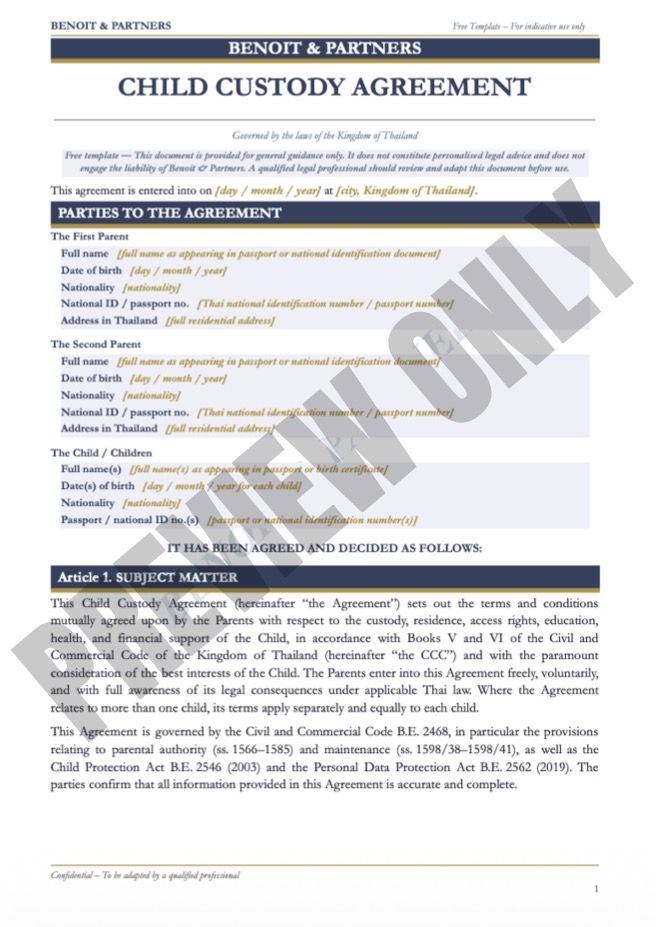
Our Child Custody Agreement template for Thailand is drafted and reviewed by experienced lawyers to ensure compliance with Thai family law and practical enforceability. It provides a reliable legal framework for parents seeking to regulate custody rights, parental authority, and child-related responsibilities following separation or divorce.
Designed for Thai nationals, foreign parents, expatriates, and international families, this template covers key legal aspects such as parental authority, physical custody arrangements, visitation rights, child support obligations, education decisions, healthcare responsibilities, and international travel consent.
For situations involving international custody disputes, relocation abroad, dual nationality children, complex visitation arrangements, or cross-border enforcement issues, our legal team can prepare a customised Child Custody Agreement adapted to your situation within a short timeframe.
Disclaimer: This template is provided for general informational purposes only and does not constitute legal advice. While it has been prepared by legal professionals, it may not reflect your specific family or international circumstances. For disputes involving relocation, international custody, or sensitive family matters, legal advice should be sought to ensure proper protection and compliance under Thai law.
Need a Contract Tailored to Your Needs ? Get a Free Consultation.
When should you use a Child Custody Agreement in Thailand?
A Child Custody Agreement is used when separated or divorced parents wish to establish clear arrangements regarding the care, custody, and upbringing of their child.
This agreement is commonly used to regulate parental authority, physical custody schedules, visitation rights, financial support obligations, and decision-making responsibilities while reducing future disputes between parents.
Under Thai law, custody arrangements may be established by mutual agreement between the parents or determined by the court where disputes arise.
Without a properly drafted Child Custody Agreement in Thailand, conflicts may arise regarding parental authority, child support, international travel, education, or living arrangements.

1. Identification of the parents and child
A Child Custody Agreement must clearly identify both parents and the child concerned. This includes full legal names, identification details, addresses, and the child’s date of birth and nationality.
2. Custody and parental authority arrangements
A Child Custody Agreement should clearly define which parent will exercise custody and parental authority over the child. This may include sole custody, joint custody, or specific decision-making responsibilities regarding the child’s welfare.
3. Visitation and parenting schedules
A Child Custody Agreement should establish visitation rights and parenting schedules between the child and the non-custodial parent. This may include weekends, holidays, school vacations, and communication arrangements.
4. Child support and financial responsibilities
A Child Custody Agreement should define the financial obligations of each parent relating to the child’s upbringing. This may include child support payments, school expenses, healthcare costs, and extracurricular activities.
5. Education, healthcare, and major decisions
A Child Custody Agreement should clarify how important decisions concerning the child will be made. This may include education choices, medical treatment, religious upbringing, and international travel authorisations.
6. Relocation and dispute resolution procedures
A Child Custody Agreement should address relocation restrictions and dispute resolution mechanisms in the event of disagreements between the parents regarding the child’s care or residence.
Key clauses and additional protections in a Child Custody Agreement
A Child Custody Agreement is a key legal document governing parental rights and responsibilities following separation or divorce in Thailand. It helps define custody arrangements, parental authority, financial obligations, and the child’s welfare while ensuring compliance with Thai family law.
Under the Civil and Commercial Code of Thailand, particularly Sections 1520 to 1563, Thai courts and authorities primarily consider the best interests of the child when assessing custody arrangements and parental authority. A properly drafted Child Custody Agreement helps clarify the responsibilities of each parent and reduce future legal disputes.
This type of agreement is commonly used for divorce proceedings, parental separation, international families, or situations involving foreign parents and cross-border custody issues. While straightforward situations may rely on a standard template, more sensitive or international cases often require additional legal protections and customised clauses depending on the family structure, relocation concerns, or financial arrangements involved.
A properly customised Child Custody Agreement helps protect the interests of the child and provides greater legal certainty for both parents under Thai law.
Why customise a Child Custody Agreement with a lawyer in Thailand?
While a standard Child Custody Agreement template may be sufficient for simple family situations, many custody matters involve family, financial, and international considerations that require more advanced drafting and tailored legal protections.
In practice, each custody arrangement presents its own legal complexities. International relocation, dual nationality children, disputes regarding parental authority, education abroad, or international travel restrictions may require provisions that a standard template does not address. Specific clauses may also be added regarding visitation schedules, child support obligations, healthcare decisions, relocation consent, or dispute resolution procedures.
Tailoring a Child Custody Agreement also allows parents to better anticipate legal risks linked to cross-border custody disputes, international enforcement issues, or changes in the child’s residence — particularly important where one or both parents are foreign nationals or live in different jurisdictions.
Our legal team assists parents, expatriates, and international families with the preparation of customised Child Custody Agreements adapted to their family situation, within a short timeframe and in full compliance with Thai family law.
Child Custody Agreement Template
Instant Download
Easy to Customize
Ready to Sign
Crafted by Lawyers
FAQ
What is a Child Custody Agreement?
A Child Custody Agreement is a legal document regulating parental authority, custody arrangements, and responsibilities concerning a child after separation or divorce.
Can parents agree on custody arrangements in Thailand?
Yes. Parents may mutually agree on custody arrangements, subject to Thai law and the best interests of the child.
Does Thai law recognise joint custody?
Thai law may allow shared parental responsibilities depending on the agreement between the parents or court decision.
Can a Child Custody Agreement include child support obligations?
Yes. The agreement commonly includes financial support obligations relating to the child’s upbringing and education.
Can one parent relocate abroad with the child?
International relocation may require the consent of the other parent or court approval depending on the custody arrangement.
Can foreigners enter into a Child Custody Agreement in Thailand?
Yes. Foreign parents living in Thailand commonly use Child Custody Agreements, particularly in international family situations.
Can Thai courts modify custody arrangements?
Yes. Thai courts may modify custody arrangements if circumstances change or if required for the child’s best interests.
Is legal assistance recommended for custody agreements in Thailand?
Yes. Legal assistance is strongly recommended for international custody matters, relocation issues, or disputes involving parental authority.