
Commercial Building Lease Agreement Template for Thailand
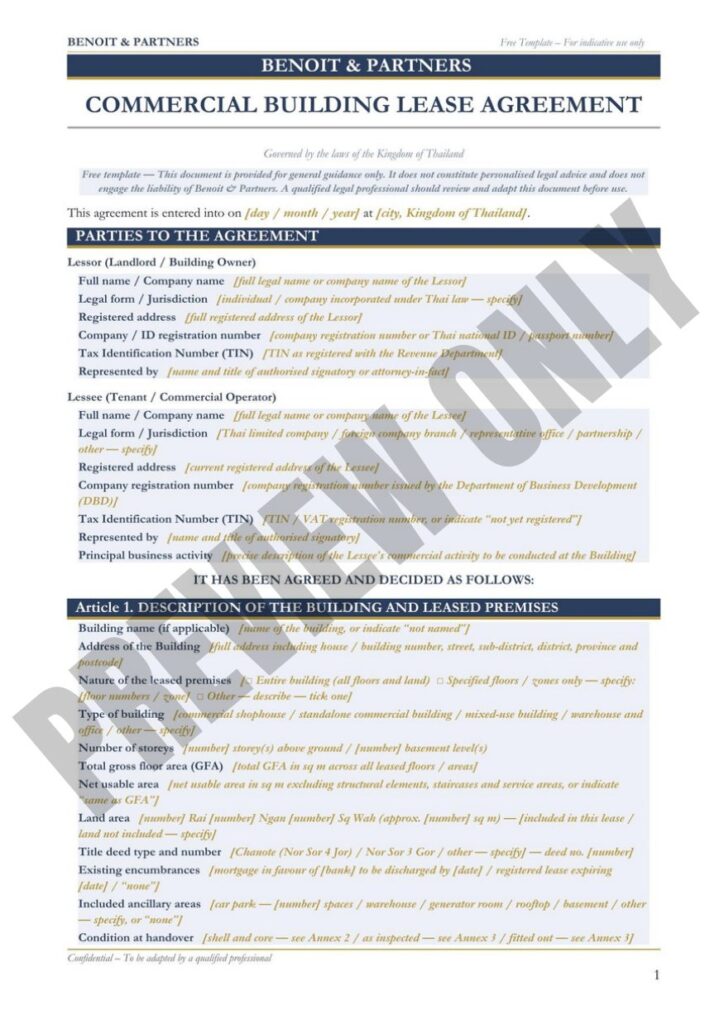
Our Commercial Building Lease Agreement Thailand template has been prepared and reviewed by qualified lawyers to ensure full compliance with Thai property law and the practical requirements of commercial transactions. It provides a solid legal basis for landlords and tenants entering into a lease of commercial premises in Thailand.
Designed for building owners, corporate tenants, and investors, this template addresses the essential legal provisions: identification of the parties, description of the leased premises, rent and payment terms, permitted use, security deposit, maintenance obligations, and regulatory compliance under Thai law. For long-term leases, mixed-use buildings, or agreements involving foreign parties, our legal team can assist with fully customised agreements within a short timeframe.
Disclaimer : This template is provided for general informational purposes only and does not constitute legal advice. For complex transactions, professional legal advice should be sought prior to execution.
Need a Contract Tailored to Your Needs ? Get a Free Consultation.
When should you use a Commercial Building Lease Agreement in Thailand?
A Commercial Building Lease Agreement is required whenever a landlord agrees to make commercial premises available to a tenant for business purposes in exchange for rent. This covers a wide range of situations: leasing an office building, a shophouse, a warehouse, a mixed-use premises, or a standalone commercial structure.
Under Thai law, commercial leases are governed by the Civil and Commercial Code, particularly Sections 537 to 571. Any lease with a term exceeding three years must be registered with the competent Land Office in order to be enforceable for the full agreed period against third parties, pursuant to Section 538 of the Code.
This document is especially important when the lease involves a significant financial commitment, structural works or fit-out obligations, or complex arrangements such as rent-free periods, revenue-based rent, or shared building management. It enables both parties to clearly set out their respective rights and obligations while ensuring the agreement is legally sound and enforceable.
For more complex transactions, particularly those involving foreign companies, BOI-promoted entities, or long-term leases approaching the 30-year statutory ceiling, additional provisions may be necessary. Our legal team advises clients on structuring and drafting commercial leases adapted to their specific context.
Without a properly executed Commercial Building Lease Agreement, both landlord and tenant risk significant legal and financial exposure arising from disputes over terms, regulatory non-compliance, or the unenforceability of the lease under Thai property law.

1. Identification of the parties and description of the premises
The agreement must clearly identify both parties — including their legal form, registration details, and authorised signatories — and provide a precise description of the leased building, its address, floor area, title deed reference, and any ancillary areas included in the lease.
2. Lease term, commencement date and renewal rights
The agreement must set out the start and end dates, total duration, any rent-free or fit-out period, and the conditions governing any renewal option, including applicable notice periods and rent for the renewed term.
3. Rent, service charges and payment conditions
The agreement must define the base rent, escalation mechanism, service charge, parking fees, payment due date, accepted methods of payment, and late payment penalties in line with the Civil and Commercial Code.
4. Security deposit and financial guarantees
The agreement must specify the deposit amount, its form (cash or bank guarantee), payment deadline, conditions for deduction, and the timeline for its return upon expiry or termination.
5. Works, fit-out and reinstatement obligations
The agreement must cover the scope of authorised works, approval requirements, contractor obligations, and the reinstatement standard applicable at the end of the lease — whether full shell-and-core restoration or retention of improvements.
6. Default events, termination rights and dispute resolution
The agreement must list the events of default, applicable notice and cure periods, available remedies upon default, and the competent jurisdiction for resolving disputes under Thai law.
Key clauses and additional protections in a Commercial Building Lease Agreement
A Commercial Building Lease Agreement is a central legal document governing the relationship between a landlord and a commercial tenant in Thailand. It defines the rights and obligations of each party throughout the lease term and provides a framework for managing common situations such as works, maintenance, assignment, and early termination.
Under the Civil and Commercial Code, leases exceeding three years must be registered at the Land Office to be enforceable for their full duration. A properly drafted agreement reduces legal uncertainty and protects both parties against disputes over interpretation or performance.
This type of agreement is used across a wide range of commercial real estate transactions in Thailand, from short-term shophouse leases to multi-floor office buildings and large warehouse facilities. While a standard template may be adequate for straightforward leases, more complex arrangements typically require additional provisions and careful drafting.
A properly customised Commercial Building Lease Agreement provides stronger legal protection and helps the parties anticipate the risks inherent in a long-term commercial relationship.
Why customise a Commercial Building Lease Agreement with a lawyer in Thailand?
While a standard Commercial Building Lease Agreement template may be suitable for simple transactions, many commercial leases involve financial, legal, and regulatory considerations that require more advanced drafting and tailored protections.
In practice, each lease carries its own risk profile. Factors such as the length of the term, the nature of the permitted use, the profile of the tenant, the structure of the rent, and the extent of authorised works can significantly affect the legal framework required.
Depending on the transaction, specific provisions may be needed covering rent escalation and indexation mechanisms, revenue-sharing arrangements, fit-out specifications and technical annexes, building management obligations, shared utility metering, withholding tax and VAT structuring, Land Department registration requirements, subletting and assignment conditions, change of control provisions, or tailored dispute resolution procedures.
Customising a Commercial Building Lease Agreement allows the parties to allocate responsibilities clearly and to anticipate risks specific to their transaction. This is particularly important for high-value commercial leases, long-term agreements, or arrangements involving foreign nationals or BOI-promoted companies.
Our legal team assists landlords, tenants, and corporate clients with the preparation of commercial lease agreements adapted to their particular situation. In most cases, a fully customised agreement can be delivered within a short timeframe while ensuring compliance with Thai property and commercial law.
A properly drafted lease reduces the risk of future disputes, regulatory non-compliance, and unexpected liabilities arising from ambiguous or incomplete contractual terms.
Commercial Building Lease Agreement template
Instant Download
Easy to Customize
Ready to Sign
Crafted by Lawyers
FAQ
What is a Commercial Building Lease Agreement in Thailand?
A Commercial Building Lease Agreement is a legally binding contract by which a landlord makes commercial premises available to a tenant for business purposes in exchange for rent. In Thailand, it is governed by the Civil and Commercial Code and, where the term exceeds three years, must be registered with the Land Office to be fully enforceable.
When should this agreement be used?
This agreement should be used whenever commercial premises — such as an office building, shophouse, warehouse, or mixed-use property — are being leased for business activities. It is required regardless of whether the tenant is a Thai company, a foreign entity, or an individual.
Does the agreement need to be registered?
Any lease with a term exceeding three years must be registered at the competent Land Office to be enforceable for its full duration against third parties. Failure to register limits enforceability to a maximum period of three years under Section 538 of the Civil and Commercial Code.
What are the tax implications of a commercial lease in Thailand?
Commercial leases in Thailand are subject to withholding tax at 5% of the monthly rent, which the tenant must deduct and remit to the Revenue Department. Where the landlord is VAT-registered, VAT at 7% applies on all rental payments. Stamp duty at 0.1% of the total rental value for the lease term is also payable upon registration.
Can a foreign national or foreign company enter into a commercial lease in Thailand?
Yes. Foreign nationals and foreign-registered companies may lease commercial premises in Thailand. However, the total lease term may not exceed 30 years, and the agreement must be registered with the Land Office to be enforceable for the full term against third parties.
Is a security deposit mandatory?
Thai law does not impose a specific minimum for security deposits, but landlords routinely require the equivalent of two to six months of rent as a financial guarantee. The conditions for holding, drawing upon, and returning the deposit should be clearly set out in the agreement.
Do I need a lawyer to draft a commercial lease in Thailand?
For straightforward short-term leases, a standard template may be adequate. For complex transactions, long-term agreements, leases involving foreign parties, or premises subject to specific regulatory requirements, legal assistance is strongly recommended to ensure proper compliance and protection of interests.
What happens if the lease is not properly documented?
In the absence of a properly drafted and, where required, registered lease agreement, the enforceability of the agreed terms may be limited. Disputes over rent, maintenance obligations, permitted use, or early termination are significantly more difficult and costly to resolve without a clear written record.