
Company Internal Regulation in Thailand
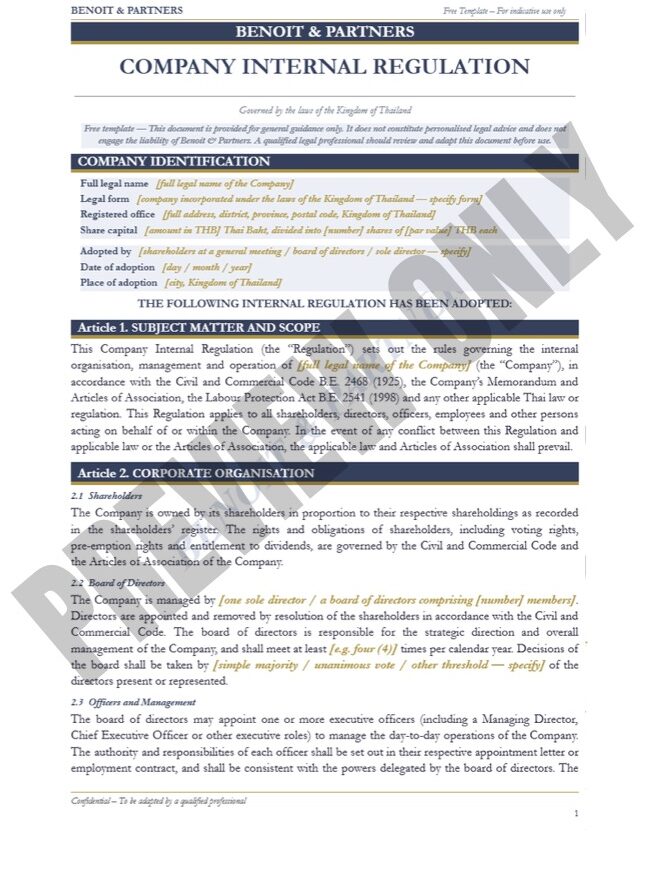
Our Company Internal Regulation in Thailand is drafted and reviewed by experienced lawyers to ensure compliance with Thai law and practical business use. It provides a reliable legal framework for formally establishing the workplace rules, employment conditions, and disciplinary procedures that govern the relationship between an employer and its workforce in Thailand.
Designed for employers, HR professionals, and business owners seeking to establish or update a compliant set of workplace rules for their organisation in Thailand, this template covers key legal aspects such as working hours and leave entitlements, conduct and disciplinary rules, termination procedures, welfare and benefits, and compliance with the registration and content requirements set out in the Labour Protection Act.
However, some situations may require additional clauses or tailored structuring depending on the size of the workforce, the nature of the business, applicable industry-specific regulations, or the presence of a labour union or employee committee. Our legal team can assist clients with customised Company Internal Regulations adapted to their specific situation within a short timeframe.
Disclaimer: This template is provided for general informational purposes only and does not constitute legal advice. While it has been prepared by legal professionals, it may not reflect your specific situation or regulatory constraints. For complex workforce structures or industry-specific compliance requirements, legal advice should be sought to ensure proper structuring and compliance under Thai employment law.
Need a Contract Tailored to Your Needs? Get a Free Consultation.
When should you use a Company Internal Regulation in Thailand?
A Company Internal Regulation in Thailand becomes a legal requirement once an employer in Thailand has ten or more employees. Under Section 108 of the Labour Protection Act B.E. 2541 (1998), any employer meeting this threshold must establish written workplace rules, make them available to employees, and file a copy with the Department of Labour Protection and Welfare within fifteen days of reaching the threshold.
The regulation serves as the central reference document governing the day-to-day employment relationship, covering matters such as working hours, leave entitlements, wage payment arrangements, disciplinary procedures, and grounds for termination. It gives both the employer and the workforce a single, consistent, and legally compliant set of rules to rely upon.
Beyond the strict legal threshold, many smaller employers choose to adopt a Company Internal Regulation voluntarily, recognising that a clear written framework reduces the risk of disputes, supports consistent treatment of employees, and provides a defensible basis for any disciplinary or termination decisions that may later be challenged.
Without a properly drafted and filed regulation, an employer that meets the statutory threshold is in breach of the Labour Protection Act and may face administrative penalties, while also losing the benefit of a clear and enforceable framework for managing its workforce.

1. Working Days, Hours, and Rest Periods
The regulation must specify normal working days and hours, rest periods during the working day, and weekly holidays, in compliance with the maximum hours and minimum rest periods prescribed by the Labour Protection Act.
2. Overtime and Holiday Work
Clear rules should be set out governing when overtime or holiday work may be required, the rate of additional pay applicable, and the process for requesting or authorising such work.
3. Wage, Overtime Pay, Holiday Pay, and Payment Dates
The regulation must specify the dates and method of payment of wages and other entitlements, ensuring compliance with the minimum payment frequency and methods required under Thai law.
4. Leave and Conditions for Taking Leave
All categories of statutory leave including annual leave, sick leave, personal leave, and maternity leave should be set out clearly, together with the procedure employees must follow to request and be granted leave.
5. Discipline and Disciplinary Measures
The regulation should set out the standards of conduct expected of employees and the disciplinary measures that may be applied for breaches, ranging from verbal warnings to written warnings and, in serious cases, termination.
6. Grievance Procedure
A clear process should be established for employees to raise grievances or complaints, including the steps to be followed and the timeframe within which the employer will respond.
Key Clauses and Essential Elements in a Company Internal Regulation
A well-structured Company Internal Regulation in Thailand gives the workforce complete clarity about the terms and conditions of their employment while equipping the employer with a compliant and enforceable framework for managing the relationship. It must address the specific categories of content prescribed by the Labour Protection Act and be presented in a way that employees can readily understand.
Under Section 108 of the Act, the regulation must be made available at the workplace and communicated to employees in a manner they can access, typically through posting, distribution, or inclusion in an employee handbook. Filing with the Department of Labour Protection and Welfare is mandatory and must be completed within the statutory timeframe.
This document applies to organisations across all sectors in Thailand, from manufacturing and retail to services and technology. While the statutory content requirements are consistent, the level of detail and the specific provisions adopted will vary according to the size of the workforce and the nature of the business.
Why customise a Company Internal Regulation with a lawyer in Thailand?
A standard template provides of Company Internal Regulation in Thailand is a useful starting point, but the specific operational and regulatory context of each business often calls for a more carefully tailored set of workplace rules.
Factors such as the size and structure of the workforce, the presence of shift work or remote working arrangements, industry-specific regulatory requirements, or the existence of a labour union can each significantly affect what the regulation needs to address.
Depending on the situation, the regulation may need to incorporate provisions on remote or flexible working arrangements, industry-specific safety or licensing requirements, the interaction between the regulation and individual employment contracts, or coordination with an existing collective bargaining agreement.
Our legal team works with employers to prepare Company Internal Regulations that are fully compliant, operationally practical, and tailored to the specific needs of the organisation, ensuring a smooth registration process with the Department of Labour Protection and Welfare.
Company Internal Regulation Thailand
Instant Download
Easy to Customize
Ready to Sign
Crafted by Lawyers
FAQ
What is a Company Internal Regulation?
A written set of workplace rules, prepared by an employer, that governs working conditions, conduct, discipline, and termination procedures for its employees, as required under the Labour Protection Act once the statutory employee threshold is reached.
When is an employer in Thailand legally required to have a Company Internal Regulation?
Once an employer has ten or more employees, Section 108 of the Labour Protection Act requires the establishment, posting, and filing of written workplace rules within fifteen days of reaching that threshold.
Where must a Company Internal Regulation be filed in Thailand?
The regulation must be filed with the Department of Labour Protection and Welfare, or the relevant provincial labour office, within the prescribed statutory period.
Can an employer amend its Company Internal Regulation after it has been filed?
Yes. An employer may amend the regulation as its business needs change, but any amendment that affects employee entitlements should be communicated clearly and may require re-filing with the labour authority depending on the nature of the change.
What happens if an employer fails to establish a Company Internal Regulation in Thailand?
Failure to comply with the statutory requirement once the employee threshold is reached constitutes a breach of the Labour Protection Act and may result in administrative penalties.
Must employees sign or acknowledge the Company Internal Regulation in Thailand?
There is no strict legal requirement for individual employee signatures, but the regulation must be made accessible and communicated to all employees. Many employers obtain a signed acknowledgement as good practice and to support enforceability of the disciplinary provisions.
Can a Company Internal Regulation reduce statutory employee entitlements in Thailand?
No. The regulation may provide for conditions more favourable to employees than the statutory minimums, but it cannot lawfully reduce entitlements guaranteed under the Labour Protection Act, such as minimum leave, overtime pay, or severance pay.
How does the PDPA apply to a Company Internal Regulation in Thailand?
Where the regulation references the collection or use of employee personal data for example in connection with disciplinary records or attendance monitoring, the employer must ensure that such data handling complies with the Personal Data Protection Act B.E. 2562 (2019).