
Complaint Letter / Email Format Thailand
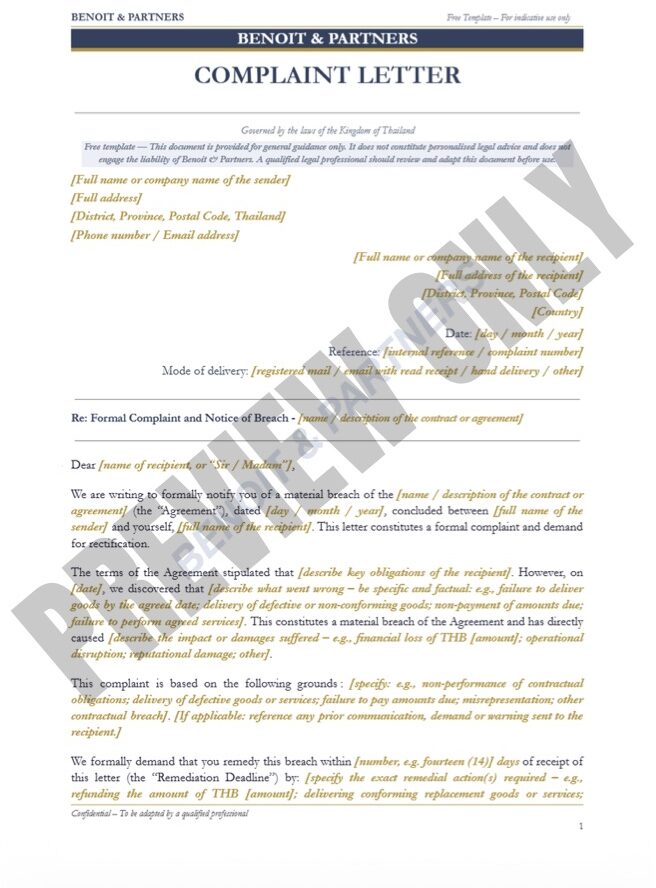
Our Complaint Letter / Email Format Thailand is drafted and reviewed by experienced lawyers to ensure compliance with Thai law and practical business use. It provides a reliable legal framework for formally raising a complaint or grievance with an employer, counterparty, or service provider in Thailand.
Designed for employees, consumers, and businesses seeking to formally articulate a complaint or demand a remedy in Thailand, this template covers key legal aspects such as identification of the parties, a clear description of the conduct or circumstances giving rise to the complaint, the specific remedy sought, a defined timeframe for response, and compliance with applicable Thai employment, consumer protection, and civil law requirements.
However, some situations may require additional clauses or tailored structuring depending on the nature of the complaint, the relationship between the parties, the regulatory framework that applies to the subject matter, or the specific outcome being sought. Our legal team can assist clients with customised complaint letters and emails adapted to their specific situation within a short timeframe.
Disclaimer: This template is provided for general informational purposes only and does not constitute legal advice. While it has been prepared by legal professionals, it may not reflect your specific situation or regulatory constraints. For complex disputes or matters with potential legal consequences, legal advice should be sought to ensure proper structuring and compliance under Thai law.
Need a Contract Tailored to Your Needs? Get a Free Consultation.
When should you use a Complaint Letter or Email in Thailand?
A Complaint Letter / Email Format Thailand is the right approach when an individual or organisation decides to put a grievance or demand on an official footing with another party in Thailand. Situations that commonly call for this step include workplace grievances raised by an employee against their employer, consumer complaints directed at a business following a defective product or inadequate service, commercial disputes between contracting parties, or formal objections submitted to a regulatory body or public authority.
Thai law provides a range of frameworks relevant to different categories of complaint. Workplace grievances are addressed within the structure of the Labour Protection Act B.E. 2541 (1998) and, where collective issues arise, the Labour Relations Act. Consumer complaints may engage the Consumer Protection Act B.E. 2522 (1979) and the jurisdiction of the Office of the Consumer Protection Board. Commercial disputes between businesses are generally governed by the Civil and Commercial Code. Identifying the correct legal framework at the outset shapes both the content of the complaint and the remedies that can properly be sought.
Submitting a complaint in formal written form, whether as a letter or a structured email offers tangible practical advantages. It creates a clear and dated record of the complaint and the remedy sought, demonstrates that the complainant has approached the matter seriously and professionally, and gives the recipient a defined basis on which to respond. A written complaint also serves as the first step in a documented escalation process should the matter need to be referred to a regulator, mediator, or court.
More complex complaints may involve additional considerations, such as the interaction with contractual dispute resolution provisions, applicable limitation periods under Thai law, the evidentiary requirements of a potential tribunal or court process, or PDPA considerations where the complaint necessarily references personal data. Our legal team is available to assist with tailored complaint letters and emails that address these dimensions while ensuring that the communication is legally sound and appropriately calibrated.
A formal written complaint also establishes a contemporaneous record of the complainant’s position, which carries real weight if the matter escalates and the other party later disputes what was communicated or when.
Proceeding through informal channels alone without committing the complaint to writing, leaves the complainant without documentary evidence of their grievance and may weaken their position significantly if the matter ultimately requires formal resolution.

1. Identification of the Parties
The complaint should clearly state the full name and relevant details of the complainant, together with the name and contact details of the individual or organisation to whom the complaint is addressed. In a commercial or employment context, any relevant reference numbers, contract identifiers, or account details should also be included.
2. Clear Statement of the Complaint
The body of the letter should set out the facts of the complaint in a precise and chronological manner, identifying the specific conduct, event, or failure that has given rise to the grievance. Clarity and objectivity are essential a complaint grounded in verifiable facts carries significantly more weight than one framed in general or emotive terms.
3. Reference to Applicable Rights or Obligations
Where the complaint is grounded in a contractual entitlement, a statutory right, or a regulatory obligation, the relevant provision should be identified. This demonstrates that the complaint has a recognised legal or contractual basis and clarifies the standard against which the other party's conduct is being measured.
4. Specific Remedy Sought
The complaint should state clearly what the complainant expects the other party to do in response whether that is a refund, a repair, an apology, a change in conduct, compliance with a contractual obligation, or any other specific outcome. Vague demands are less effective and harder to enforce.
5. Deadline for Response
A defined and reasonable timeframe within which the recipient is expected to respond should be stated. This creates a clear reference point for any subsequent escalation and demonstrates that the complainant has given the other party a fair opportunity to address the matter before further action is taken.
6. Supporting Documentation
Relevant supporting materials — such as receipts, contracts, correspondence, photographs, or other evidence should be referenced in the body of the complaint and attached or enclosed where appropriate. Well-documented complaints are more persuasive and harder to dismiss.
Key Clauses and Essential Elements in a Complaint Letter or Email
A well-constructed Complaint Letter / Email Format Thailand gives the recipient a precise and complete account of the grievance and a clear understanding of what is expected of them in response. It presents the complaint in factual and measured terms, identifies the specific remedy being sought, and establishes a firm but professional basis for resolution.
The evidentiary value of a formal written complaint is considerable. Whether the matter involves an employment relationship, a commercial transaction, or a consumer dispute, a clearly drafted and properly documented complaint provides the foundation on which any subsequent escalation whether to a regulator, an arbitrator, or a court can be built.
This type of document is relevant across a wide range of relationships and dispute categories from individual employees to large organisations and the approach is appropriate whether the complaint is being submitted internally within a business or directed at an external party.
The underlying structure is consistent, though the tone and content will be shaped by the nature of the complaint and the relationship between the parties.
Why customise a Complaint Letter or Email with a lawyer in Thailand?
A Complaint Letter / Email Format Thailand is a reasonable starting point for routine complaints in straightforward situations, but a range of circumstances call for a more carefully considered approach before the communication is sent.
The nature of the complaint and the relationship between the parties significantly determine what the letter or email needs to achieve. A workplace grievance involving potential discrimination or unlawful conduct, a commercial dispute with a counterparty who has the resources and inclination to contest the claim, or a complaint that forms part of a pre-litigation strategy all require a level of precision and legal awareness that goes beyond what a generic template can offer.
Depending on the situation, the letter or email may need to address: the specific statutory or contractual basis for the complaint and the remedies it supports; applicable limitation periods under Thai law and the risk of delay in formal resolution; the interaction between the complaint and any ongoing contractual relationship or dispute resolution clause; the evidentiary requirements of the forum in which the matter may ultimately be resolved; PDPA considerations arising where the complaint references personal data; the tone and framing most likely to produce a productive response from the recipient; or the broader strategic context of the complaint and its potential implications for the parties’ ongoing relationship.
Getting the complaint right from the outset both in its factual accuracy and its legal framing can make a material difference to the outcome, whether the goal is a swift negotiated resolution or a well-prepared escalation.
Our legal team works with individuals, employees, and businesses to prepare complaint letters and emails that are factually precise, legally grounded, and calibrated to produce the most effective response in the specific circumstances. Work is completed promptly, and the result is a communication that puts the complainant in the strongest possible position.
A carefully drafted complaint does more than communicate dissatisfaction, it establishes the complainant’s legal position clearly, creates a documented record that supports any subsequent escalation, and signals to the recipient that the matter will be pursued with seriousness and legal rigour.
Complaint Letter / Email Format Thailand
Instant Download
Easy to Customize
Ready to Sign
Crafted by Lawyers
FAQ
What is a formal complaint letter or email in Thailand?
A structured written communication through which an individual or organisation formally notifies another party of a grievance, sets out the factual basis for the complaint, identifies the remedy being sought, and establishes a record of the claim that can support subsequent escalation if the matter is not resolved.
Is a written complaint required before taking legal action in Thailand?
In many contexts, making a formal written complaint before initiating legal or regulatory proceedings is either a procedural requirement or strongly advisable as a matter of good practice. It demonstrates that the complainant has given the other party a reasonable opportunity to remedy the situation and often satisfies pre-action protocol requirements.
Can a complaint email carry the same legal weight as a formal letter in Thailand?
Yes, provided it is properly structured and sent in a way that can be demonstrated. An email that clearly identifies the parties, sets out the complaint in specific terms, and states the remedy sought is capable of serving as a formal written complaint. Delivery and receipt should be confirmed where possible.
How does the PDPA apply to a complaint letter or email in Thailand?
Where the complaint references personal data — including information about the recipient’s employees or third parties — the complainant must handle that data in accordance with the Personal Data Protection Act B.E. 2562 (2019), using it only to the extent necessary to articulate and support the complaint.
What remedies can be sought through a formal complaint in Thailand?
Depending on the legal basis and the nature of the complaint, available remedies may include financial compensation, specific performance of a contractual obligation, a formal apology, cessation of the relevant conduct, or referral to a regulatory authority. The appropriate remedy will depend on the legal framework applicable to the specific complaint.
How long does a recipient in Thailand have to respond to a formal complaint?
There is no universally prescribed response period, but the complainant should allow a reasonable timeframe typically between seven and thirty days depending on the complexity of the matter before escalating. The deadline stated in the complaint letter creates a clear reference point for any further steps.
What should a complainant do if their complaint is ignored in Thailand?
If no satisfactory response is received within the stated timeframe, the complainant may escalate the matter to a relevant regulatory body, initiate mediation or conciliation through an appropriate body, or commence formal legal proceedings. The documented complaint letter or email serves as an important piece of evidence in any subsequent process.
What language should a formal complaint letter or email be written in Thailand?
In most private and commercial contexts, a complaint may be written in English or Thai. However, for dealings with Thai government agencies, courts, or certain regulatory bodies, Thai language is generally preferred or may be required. In practice, bilingual (Thai–English) documents or an attached certified translation are often used to ensure clarity and avoid procedural issues.