
Compromise Agreement in Thailand
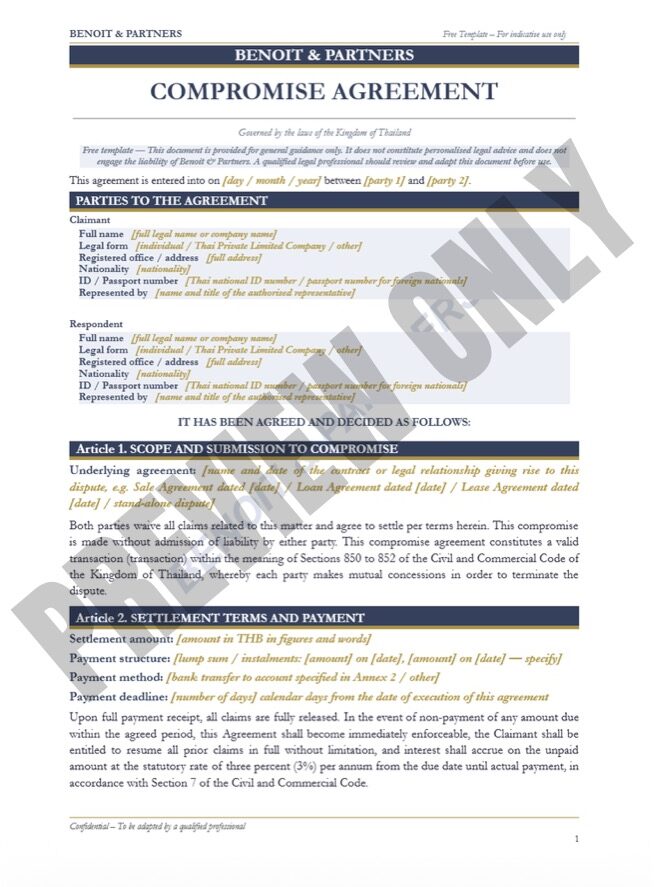
Our Compromise Agreement Thailand is drafted and reviewed by experienced lawyers to ensure compliance with Thai law and practical business use. It provides a reliable legal framework for formally settling a dispute or claim between two or more parties in Thailand on mutually agreed terms.
Designed for businesses and individuals seeking to reach a binding and documented resolution of an existing or potential dispute in Thailand, this template covers key legal aspects such as identification of the parties, a description of the dispute being settled, the agreed settlement terms and any consideration payable, mutual releases of claims, confidentiality obligations, and compliance with the requirements of the Thai Civil and Commercial Code governing compromise agreements.
However, some situations may require additional clauses or tailored structuring depending on the nature and complexity of the dispute, the value of the settlement, the relationship between the parties, or the interaction between the compromise agreement and any ongoing court or arbitral proceedings. Our legal team can assist clients with customised Compromise Agreements adapted to their specific situation within a short timeframe.
Disclaimer: This template is provided for general informational purposes only and does not constitute legal advice. While it has been prepared by legal professionals, it may not reflect your specific situation or regulatory constraints. For complex disputes or matters involving significant financial exposure, legal advice should be sought to ensure proper structuring and compliance under Thai law.
Need a Contract Tailored to Your Needs? Get a Free Consultation.
When should you use a Compromise Agreement in Thailand?
A Compromise Agreement Thailand is the appropriate instrument when two or more parties wish to bring a dispute or potential claim to a final and binding conclusion on agreed terms, without the need for court or arbitral proceedings to run their full course. Common situations include the settlement of a commercial contract dispute, the resolution of an employment claim, the conclusion of a property-related disagreement, or the formalisation of a negotiated resolution to a regulatory matter.
Under the Thai Civil and Commercial Code, a compromise agreement known in Thai law as a “praketkong” is a contract through which the parties make mutual concessions in order to terminate an existing dispute or prevent a future one from arising. Once validly entered into, a compromise agreement extinguishes the original claims of the parties and replaces them with the rights and obligations set out in the settlement.
Documenting the settlement in a formal written agreement carries clear advantages. It eliminates ambiguity about what has been agreed, prevents either party from later reopening the underlying dispute, and provides a clear and enforceable record of the terms on which the matter has been resolved.
More complex settlements may require additional provisions covering structured payment arrangements, non-disparagement obligations, the withdrawal of existing court proceedings, or the interaction between the compromise agreement and related contracts or third-party interests. Our legal team is available to assist with tailored agreements that address these dimensions comprehensively.
Without a properly documented compromise agreement, the risk of subsequent disagreement about the scope or terms of the settlement is significantly elevated, potentially resulting in further litigation on top of the original dispute.

1. Identification of the Parties
The agreement should clearly identify all parties to the settlement by their full legal names and, where applicable, their registered addresses and company registration numbers, together with a brief description of the capacity in which each party is entering into the agreement.
2. Description of the Dispute
A compromise agreement in Thailand should include a concise and accurate description of the dispute or claim being settled, identifying the nature of the disagreement, the relevant underlying contract or relationship, and the approximate period to which the dispute relates.
3. Agreed Settlement Terms
The agreement sets out the key settlement terms, including payments, required actions, transfers of rights or property, and deadlines for performance.
4. Mutual Release of Claims
A mutual release clause confirms that, once the agreed terms are fulfilled, each party releases the other from claims related to the dispute. Its scope should be carefully defined to avoid unintended effects.
5. Confidentiality
Where the parties wish to keep the terms of the settlement private, a confidentiality clause should be included, specifying the information that is to be treated as confidential, the persons to whom disclosure is permitted, and the duration of the confidentiality obligation.
6. Withdrawal of Proceedings
Where court or arbitral proceedings are on foot at the time of settlement, the agreement should specify the steps each party will take to withdraw or discontinue those proceedings and the timetable for doing so.
Key Clauses and Essential Elements in a Compromise Agreement
A well-constructed Compromise Agreement in Thailand gives both parties a clear, complete, and enforceable record of the terms on which their dispute has been resolved. It eliminates the scope for future disagreement about what was agreed, provides a clean legal break from the underlying dispute, and creates a framework for the parties to move forward on defined terms.
Under the Civil and Commercial Code, a compromise agreement must involve mutual concessions from both parties to be valid a unilateral concession does not constitute a compromise in the legal sense. A properly structured agreement that satisfies this requirement and clearly sets out the agreed terms is the foundation of an effective and durable settlement.
This document is relevant across all categories of civil and commercial dispute from bilateral contract claims to multi-party property or employment matters and is applicable whether the parties are both Thai entities, both foreign, or a combination of the two.
Why customise a Compromise Agreement with a lawyer in Thailand?
A standard Compromise Agreement template in Thailand provides a workable starting point for straightforward settlements, but a significant range of situations call for a more carefully considered approach before the agreement is signed.
The nature and complexity of the underlying dispute, the value of the settlement, and the ongoing relationship between the parties all influence what the compromise agreement needs to achieve and how it should be structured. A settlement that resolves a high-value commercial claim, involves structured payments over time, or requires the simultaneous withdrawal of court proceedings demands a level of legal precision that a generic template cannot deliver.
Depending on the situation, the agreement may need to address: the tax treatment of the settlement payment under Thai law; the interaction between the release clause and related claims involving third parties; the enforceability of the agreement if one party subsequently fails to perform; the procedural requirements for withdrawing existing court or arbitral proceedings; or PDPA considerations where the settlement involves personal data.
Our legal team works with businesses and individuals to prepare compromise agreements that are clear, complete, and enforceable and that give both parties confidence that the matter has been properly and finally resolved.
Compromise Agreement Thailand
Instant Download
Easy to Customize
Ready to Sign
Crafted by Lawyers
FAQ
What is a Compromise Agreement in Thailand?
A binding written contract through which two or more parties formally settle an existing or potential dispute on mutually agreed terms, extinguishing their original claims and replacing them with the rights and obligations set out in the settlement.
Is a Compromise Agreement legally binding in Thailand?
Yes, provided it meets the requirements of the Civil and Commercial Code, including the requirement for mutual concessions from both parties. A validly executed compromise agreement is enforceable through the Thai courts and extinguishes the original claims of the parties.
Does a Compromise Agreement need to be in writing in Thailand?
Thai law does not always require a compromise agreement to be in writing, but a written and signed agreement is strongly advisable. It eliminates ambiguity about the terms agreed and provides a clear evidentiary record if either party later disputes the scope or performance of the settlement.
Can a Compromise Agreement be used to settle an employment dispute in Thailand?
Yes. Employment disputes such as wrongful termination, unpaid wages, or severance can be settled through a compromise agreement. It should clearly define the claims and include a full release to prevent future claims before the Labour Court.
What is the effect of a Compromise Agreement on existing court proceedings in Thailand?
Where court proceedings are on foot at the time of settlement, the compromise agreement typically obliges the parties to take steps to withdraw or discontinue those proceedings. The agreement should specify the steps to be taken and the timetable for doing so to avoid delay.
Can a Compromise Agreement be set aside in Thailand?
A compromise agreement may be challenged on grounds of fraud, duress, or fundamental mistake as to the facts. It may also be set aside if it was entered into in respect of a matter that was not actually in dispute between the parties. These grounds are narrow and a properly executed agreement is difficult to challenge.
What are the tax implications of a settlement payment under a Compromise Agreement in Thailand?
How does the PDPA apply to a Compromise Agreement in Thailand?
Where the agreement references personal data including information about individuals connected with the dispute it must be handled in accordance with the Personal Data Protection Act B.E. 2562 (2019). Personal data should be included only to the extent necessary to identify the parties and describe the dispute, and must be stored securely by each party.