
Consent To Sublease Template for Thailand
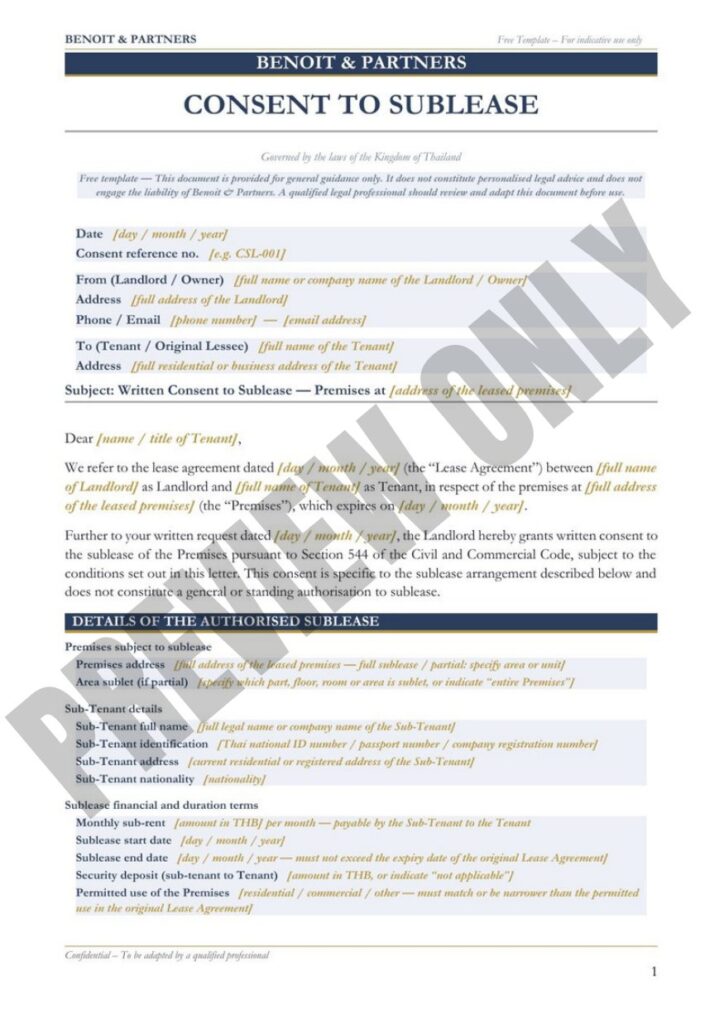
Our Consent to Sublease Thailand template has been prepared and reviewed by qualified lawyers to ensure full compliance with Thai property law and the practical requirements of sublease transactions. It provides a reliable legal framework for landlords formally authorising a tenant to sublet premises to a third party.
Designed for landlords, tenants, and companies seeking to formalise a sublease arrangement, this template addresses the essential legal provisions: identification of all parties, description of the sublet premises, financial and duration terms, permitted use, and the conditions governing the consent under Thai law. For transactions involving foreign parties, commercial premises, or complex sublease structures, our legal team can assist with fully customised documents within a short timeframe.
Disclaimer : This template is provided for general informational purposes only and does not constitute legal advice. Although prepared by legal professionals, it may not address your specific circumstances or regulatory requirements. For complex transactions, professional legal advice should be sought prior to execution.
Need a Contract Tailored to Your Needs ? Get a Free Consultation.
When should you use a Consent To Sublease in Thailand?
A Consent to Sublease in Thailand is required whenever a tenant wishes to sublet all or part of their leased premises to a third party. Under Section 544 of the Civil and Commercial Code, a tenant may not sublease without the landlord’s prior written consent. This document formalises that authorisation while setting out the conditions under which the sublease is permitted.
This situation commonly arises in commercial and residential contexts alike, when a tenant needs to vacate the premises temporarily, reduce their occupied space, or make part of the property available to a business partner or associated entity. Without written consent from the landlord, any sublease arrangement is legally precarious and may constitute a breach of the original lease.
The document is particularly important because, under Section 545 of the Civil and Commercial Code, the sub-tenant becomes directly liable to the landlord for obligations arising from the sublease, making it essential that the consent clearly defines the scope and conditions of the authorised arrangement.
For more complex situations, such as partial subletting of a commercial building, arrangements involving foreign sub-tenants, or subleases approaching the remaining term of the original lease, additional provisions may be required. Our legal team advises clients on structuring sublease consents tailored to their specific transaction.
Without a properly drafted Consent to Sublease, both landlord and tenant risk disputes over the validity of the sublease, liability for the sub-tenant’s conduct, and potential breach of the original lease agreement.

1. Identification of the parties and reference to the original lease
The consent must identify the landlord, tenant, and sub-tenant, and refer precisely to the original lease — including its execution date, premises address, and expiry date.
2. Description of the sublet premises and permitted use
The document must specify whether the premises are sublet in full or in part, and define the permitted use for the sub-tenant, which must remain consistent with the original lease.
3. Financial terms and sublease duration
The consent must set out the monthly sub-rent, start and end dates, and any security deposit. The sublease term must not extend beyond the expiry of the original lease.
4. Continued liability of the original tenant
The consent must confirm that the original tenant remains fully liable to the landlord for all lease obligations, including rent and maintenance, regardless of the sublease.
5. Restrictions on the sub-tenant
The sub-tenant must be prohibited from further subletting or assigning any rights in the premises, and must comply with all obligations applicable under the original lease.
6. Revocation conditions and tax obligations
The consent must specify the circumstances in which the landlord may revoke it, and address the tenant's tax obligations on sub-rental income under Thai revenue law.
Key clauses and additional protections in a Consent To Sublease
A Consent to Sublease is a key legal document governing the authorised subletting of premises in Thailand. It defines the scope of the landlord’s consent, sets out the conditions applicable to the sub-tenant, and preserves the legal integrity of the original lease throughout the sublease period.
Under the Civil and Commercial Code, the sub-tenant is directly liable to the landlord for obligations arising from the sublease, while the original tenant remains bound by all terms of the principal lease. A properly drafted consent ensures that these obligations are clearly understood and enforceable by all parties.
This type of document is used across residential and commercial lease transactions where circumstances have evolved since the original agreement was signed. While a standard template may be sufficient for straightforward arrangements, more complex subleases often require additional legal protections and tailored conditions.
A properly customised Consent to Sublease provides stronger legal certainty and helps all parties manage the risks inherent in a three-party lease arrangement.
Why customise a Consent To Sublease with a lawyer in Thailand?
While a standard Consent to Sublease template may be adequate for simple arrangements, many sublease transactions involve legal, financial, and regulatory considerations that require more advanced drafting and tailored protections.
In practice, each sublease consent carries its own risk profile. Factors such as the nature of the premises, the profile of the sub-tenant, the remaining duration of the original lease, and the financial terms of the sublease can significantly affect the legal framework required.
Depending on the transaction, specific provisions may be needed covering partial subletting arrangements and floor plans, revenue-sharing or cost allocation between tenant and sub-tenant, restrictions on the sub-tenant’s activities, tax structuring for sub-rental income, compliance with foreign business regulations, revocation mechanisms, or dispute resolution procedures adapted to a three-party relationship.
Tailoring a Consent to Sublease allows the landlord to maintain effective control over the use of the premises while giving the tenant the flexibility they require. This is particularly important for commercial properties, long-term leases, or transactions involving foreign nationals or corporate entities.
Our legal team assists landlords, tenants, and companies with the preparation of sublease consents adapted to their specific situation. In most cases, a customised document can be delivered within a short timeframe while ensuring full compliance with Thai property and commercial law.
A properly drafted consent reduces the risk of disputes, unintended liability, and regulatory issues arising from an insufficiently documented sublease arrangement.
Consent To Sublease template
Instant Download
Easy to Customize
Ready to Sign
Crafted by Lawyers
FAQ
What is a Consent to Sublease in Thailand?
A Consent to Sublease is a written document by which a landlord formally authorises a tenant to sublet all or part of the leased premises to a third party. Under Section 544 of the Civil and Commercial Code, such consent is legally required before any sublease can take effect.
When should it be used?
It should be used whenever a tenant intends to sublet their premises — whether in full or in part — to another person or entity. It is required regardless of whether the sublease is commercial or residential in nature.
Does the sub-tenant have direct obligations to the landlord?
Yes. Under Section 545 of the Civil and Commercial Code, the sub-tenant is directly liable to the landlord for obligations arising from the sublease. Any advance payment of sub-rent made to the tenant cannot be used against the landlord.
Does the original tenant remain liable under the lease?
Yes. The original tenant remains fully liable to the landlord for all obligations under the principal lease — including rent, maintenance, and compliance with lease conditions — regardless of the sublease arrangement in place.
Can a foreign national be a sub-tenant in Thailand?
Yes. Foreign nationals may act as sub-tenants in Thailand, subject to any restrictions set out in the original lease and compliance with applicable regulations. The sublease term must remain within the limits of the original lease agreement.
What are the tax implications for the tenant?
Sub-rental income received by the tenant may be subject to personal income tax under the Thai Revenue Code. The tenant is solely responsible for declaring and paying any applicable tax arising from the sublease arrangement.
Do I need a lawyer?
For straightforward sublease arrangements between known parties, a standard template may be sufficient. For commercial premises, foreign sub-tenants, or complex arrangements, legal assistance is recommended to ensure proper compliance and protection of all parties.
What happens if the sublease is not properly authorised?
A sublease entered into without the landlord’s written consent may constitute a material breach of the original lease agreement, potentially entitling the landlord to terminate the lease and seek damages from the tenant.