
Construction Contract in Thailand
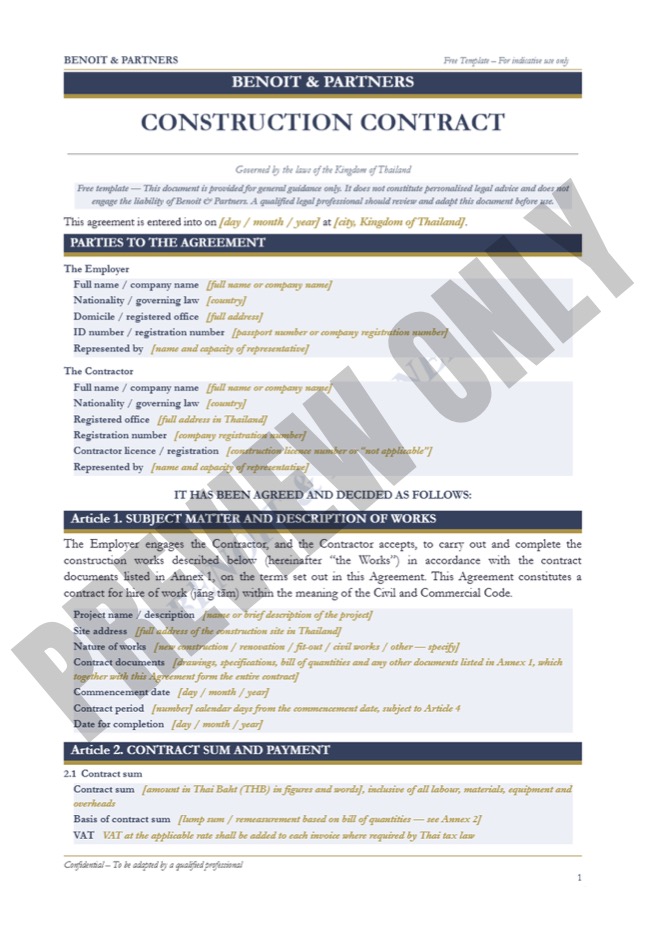
Our Construction Contract in Thailand is drafted and reviewed by experienced lawyers to ensure compliance with Thai law and practical business use. It provides a reliable legal framework for formally documenting the rights and obligations of the employer and contractor in connection with a construction project in Thailand.
Designed for property developers, landowners, contractors, and project managers seeking to govern a construction project on a legally sound and comprehensive basis in Thailand, this template covers key legal aspects such as identification of the parties, description of the works, contract price and payment terms, programme and completion obligations, variations, defects liability, insurance requirements, and compliance with applicable Thai civil and construction law.
However, some situations may require additional clauses or tailored structuring depending on the scale and complexity of the project, the involvement of specialist subcontractors, the source of project financing, applicable planning and regulatory requirements, or the specific risk allocation preferred by the parties. Our legal team can assist clients with customised Construction Contract Thailand adapted to their specific situation within a short timeframe.
Disclaimer: This template is provided for general informational purposes only and does not constitute legal advice. While it has been prepared by legal professionals, it may not reflect your specific situation or regulatory constraints. For complex or high-value construction projects, legal advice should be sought to ensure proper structuring and compliance under Thai construction and civil law.
Need a Contract Tailored to Your Needs? Get a Free Consultation.
When should you use a Construction Contract in Thailand?
A Construction Contract in Thailand is required whenever an employer engages a contractor to carry out building or civil engineering works in Thailand, whether on a residential, commercial, or infrastructure project. The contract governs every material aspect of the parties’ relationship.
Construction contracts in Thailand are governed primarily by the hire of work provisions of the Civil and Commercial Code, which set out the basic rights and obligations of the parties to a contract for the execution of work. The Code provides a default legal framework, but parties to a significant construction project will typically need a far more detailed contractual structure that addresses the specific risks and requirements of the project.
A properly drafted Construction Contract Thailand reduces the risk of disputes by establishing clear and agreed parameters for every stage of the project from design approval and programme milestones to payment certification, variation instructions, and the resolution of defects during the maintenance period. It allocates risk between the parties in a transparent and considered manner and provides a structured mechanism for managing the issues that commonly arise on construction projects.
More complex projects may require additional provisions covering design responsibility, nominated subcontractors, third-party funded works, performance bonds, parent company guarantees, or the interface between the main contract and specialist trade contracts. Our legal team is available to assist with tailored contracts that address these dimensions with the precision that significant construction projects demand.
Without a comprehensive Construction Contract, disputes about scope, programme, payment, and quality are significantly more likely and considerably harder to resolve, often resulting in costly and time-consuming litigation or arbitration.

1. Description of the Works
The contract should include a precise and comprehensive description of the works to be carried out, typically by reference to drawings, specifications, bills of quantities, and other technical documents that form part of the contract. Ambiguity in the scope of works is one of the most common sources of construction disputes.
2. Contract Price and Payment Terms
The contract price whether a lump sum, a remeasurable amount, or a cost-plus figure — should be stated clearly, together with the payment mechanism, the timing and basis for interim payment applications, the certification process, and the consequences of late payment.
3. Programme and Completion
The contract should specify the date for commencement of the works, the programme for their execution, the date for practical completion, and the consequences of delay.
4. Variations
A clear variations mechanism setting out the employer's right to instruct changes, the contractor's obligation to comply, and the process for valuing and agreeing the financial and programme impact of variations — is essential in any construction contract of substance.
5. Defects Liability
The agreement should specify the defects liability period following practical completion, the contractor's obligations to remedy defects notified during that period, the employer's remedies in the event of the contractor's failure to do so, and the release of any retention monies at the conclusion of the period.
6. Insurance Requirements
The contract should set out the insurance policies each party is required to maintain throughout the project including contractors' all-risk insurance, public liability insurance, and any employer's liability cover.
Key Clauses and Essential Elements in a Construction Contract
A well-structured Construction Contract Thailandt gives both employer and contractor a complete and workable framework for the delivery of the project, the management of variations and unforeseen events, and the resolution of any disputes that may arise during or after the works. It provides certainty about the scope of the works, the contract price, the programme, and the quality standards the contractor is required to meet.
Under the Civil and Commercial Code, an employer is entitled to require a Construction Contract Thailand to remedy defective works, and a contractor is entitled to payment for work properly executed. A carefully drafted contract builds on these baseline protections to create a more comprehensive and project-specific framework that reflects the particular requirements and risk profile of the works.
This document is relevant across all categories of construction project from single residential buildings to large commercial developments and applies whether the employer is an individual, a company, or a public body, and whether the contractor is a Thai entity or a foreign construction firm operating in Thailand.
Why customise a Construction Contract with a lawyer in Thailand?
A standard Construction Contract in Thailand provides a starting point for simple construction projects, but the scale, complexity, and risk profile of most significant construction works require a more carefully constructed contractual framework before the parties commit to the arrangement.
The specific nature of the project, the allocation of design responsibility, the contractor’s programme obligations, and the employer’s payment arrangements all shape what the contract needs to achieve and how it should be structured.
In certain circumstances, the Construction Contract Thailand may also need to address: the interaction between the main contract and any design consultant appointments; the treatment of ground conditions and unforeseen physical conditions; the contractor’s obligations under Thai building regulations and planning requirements; the VAT and withholding tax treatment of construction payments; the requirements of any project financier regarding step-in rights and direct agreements; or the specific bonding and security requirements applicable to the project.
Our legal team works with employers, contractors, and developers to prepare construction contracts that are clearly structured, legally sound, and appropriately calibrated to the specific project and risk profile. The result is a contract that gives both parties confidence in the basis on which the works will be delivered.
Construction Contract Thailand
Instant Download
Easy to Customize
Ready to Sign
Crafted by Lawyers
FAQ
What is a Construction Contract in Thailand?
A binding written agreement through which an employer engages a contractor to carry out defined construction works in exchange for payment, governing all material aspects of the parties’ relationship including scope, price, programme, quality, and dispute resolution.
Is a written Construction Contract required in Thailand?
Thai law does not always require construction contracts to be in writing, but a written agreement is essential for any project of substance. Without a written contract, disputes about scope, price, and programme are extremely difficult to resolve, and the parties are left to rely on the limited default provisions of the Civil and Commercial Code.
How is the contract price typically structured in construction contracts in Thailand?
Construction contracts in Thailand may be structured on a lump sum, remeasurable, or cost-plus basis depending on the nature and complexity of the works. Lump sum contracts are most common for well-defined projects, while remeasurable and cost-plus arrangements are more appropriate where the scope is less certain at the outset.
What are liquidated damages in a Thai Construction Contract?
Liquidated damages are a pre-agreed sum payable by the contractor for each day or week of delay in achieving practical completion beyond the contractual date. They provide the employer with a defined remedy for delay without the need to prove actual loss, and incentivise the contractor to maintain the programme.
Can a contractor claim additional time and money for unforeseen conditions in Thailand?
The contractor’s entitlement to additional time and payment for unforeseen conditions depends on the terms of the contract. Many construction contracts include provisions addressing ground conditions and other physical conditions that a competent contractor could not reasonably have anticipated, but the scope and limits of these provisions vary significantly between contracts.
What is the defects liability period in a Thai Construction Contract?
The defects liability period sometimes called the maintenance period is the period following practical completion during which the contractor remains obliged to remedy any defects that emerge in the works at their own cost.
How are disputes resolved under a Construction Contract in Thailand?
Construction disputes in Thailand are commonly resolved through arbitration, adjudication, or litigation in the Thai courts.
How does the PDPA apply to a Construction Contract in Thailand?
Construction projects may involve the processing of personal data relating to workers, subcontractors, and other individuals. Both the employer and contractor must comply with the Personal Data Protection Act B.E. 2562 (2019) in relation to any personal data processed in connection with the project, and the contract should address each party’s data protection responsibilities where relevant.