
Construction Employment Contract in Thailand
Our Construction Employment Contract in Thailand is drafted and reviewed by experienced lawyers to ensure compliance with Thai law and practical business use. It provides a reliable legal framework for formally engaging workers and employees in the construction sector in Thailand.
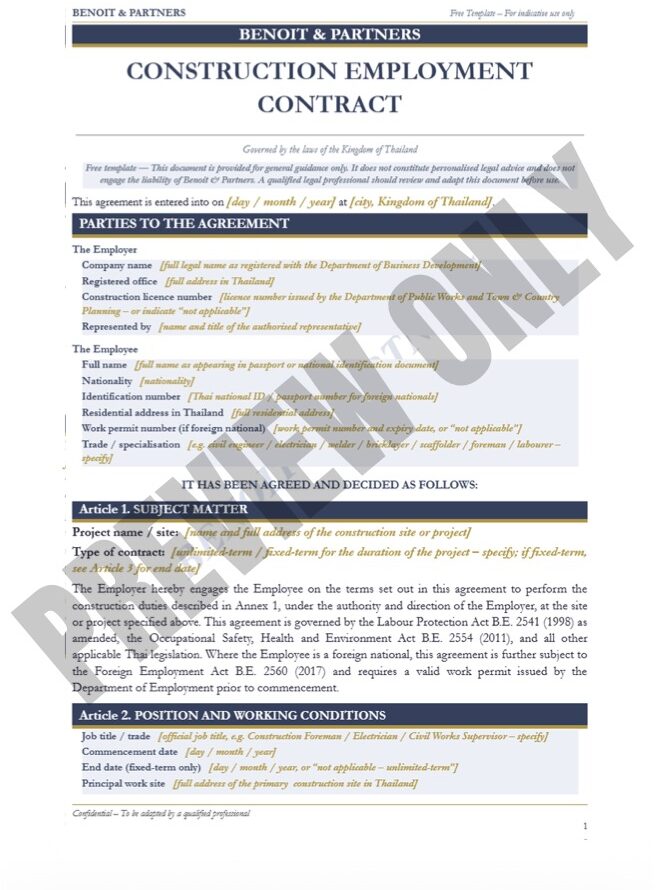
Designed for construction companies, contractors, subcontractors, and project owners seeking to formally engage workers on construction projects in Thailand, this template covers key legal aspects such as identification of the parties, scope of work, project duration, remuneration, health and safety obligations, termination provisions, and compliance with applicable Thai employment, labour, and construction regulations.
However, some situations may require additional clauses or tailored structuring depending on the nature and scale of the project, the seniority of the position, the involvement of foreign workers or specialist contractors, or the specific regulatory requirements applicable to the construction sector. Our legal team can assist clients with customised Construction Employment Contracts adapted to their specific situation within a short timeframe.
Disclaimer: This template is provided for general informational purposes only and does not constitute legal advice. While it has been prepared by legal professionals, it may not reflect your specific situation or regulatory constraints. For complex or large-scale construction projects, legal advice should be sought to ensure proper structuring and compliance under Thai employment and construction law.
Need a Contract Tailored to Your Needs? Get a Free Consultation.
When should you use a Construction Employment Contract in Thailand?
A Construction Employment Contract in Thailand is used whenever a construction company, contractor, or project owner wishes to formally engage a worker or employee for work on a construction project in Thailand. This situation commonly arises in connection with residential, commercial, industrial, or infrastructure projects requiring the engagement of skilled and unskilled workers, site supervisors, engineers, project managers, and other construction professionals.
Under Thai law, employment relationships in the construction sector are primarily governed by the Labour Protection Act B.E. 2541 (1998) and its amendments, as well as sector-specific regulations applicable to the construction industry, including occupational health and safety requirements and licensing obligations for certain categories of construction work. The construction sector is also subject to specific provisions regarding the engagement of subcontractors and the liability of principal contractors for the employment obligations of their subcontractors.
This document becomes particularly important when a construction employer wishes to clearly define the scope and duration of the worker’s engagement, establish the remuneration and benefit arrangements applicable to the project, and set out the health and safety obligations and conduct standards applicable on the construction site. It allows both parties to clearly articulate their respective rights and obligations, confirm the agreed terms of the engagement, and establish a clear framework for managing the employment relationship throughout the duration of the project.
In more complex situations, additional considerations may arise regarding the engagement of foreign workers and applicable work permit requirements, the treatment of the engagement in the event of project delays or early completion, the liability of the principal contractor for subcontractor employment obligations, or the specific safety and licensing requirements applicable to the nature of the construction work. Our legal team assists clients with the preparation of customised Construction Employment Contracts tailored to their specific project requirements and objectives under Thai employment and construction law.
Without a properly drafted Construction Employment Contract, employers risk creating uncertainty about the scope and duration of the engagement, exposing themselves to claims for unfair termination or statutory compensation, and failing to establish the clear framework necessary for the effective management of a construction workforce.

1. Identification of the Parties
The contract must clearly identify the employer and the employee or worker, including their full legal names, residential or registered addresses, and any applicable company registration numbers or professional licensing details, and must also specify the exact date on which the contract is entered into and becomes effective.
2. Scope of Work and Project Detail
The contract must specify the nature of the work to be performed, the location of the construction site or project, and any applicable project reference details, to provide a clear framework for the scope of the engagement and the performance expectations applicable during the employment period.
3. Duration of Engagement
The contract must set out the agreed start date and, where applicable, the expected end date or completion milestone of the engagement, to establish clearly the duration of the employment relationship and its connection to the progress of the construction project, and may also specify adjustment mechanisms in the event of delays, acceleration, or changes to the project timeline.
4. Remuneration and Payment Terms
The contract must set out the employee's agreed wage or salary and the applicable payment frequency and method, confirming compliance with minimum wage requirements under the Labour Protection Act and addressing any applicable piece-rate, daily rate, or project-based payment arrangements.
5. Working Hours and Overtime
The contract must specify the standard working hours applicable to the engagement, in accordance with the maximum working hour limits prescribed by the Labour Protection Act, and address overtime arrangements and compensation applicable to construction work, including any sector-specific provisions.
6. Health, Safety, and Site Conduct
The contract must set out the health and safety obligations applicable to the worker during the engagement, including compliance with applicable occupational health and safety regulations, the use of personal protective equipment, and the conduct standards required on the construction site, reflecting the heightened safety requirements applicable in the construction sector.
Key Clauses and Essential Elements in a Construction Employment Contract
A Construction Employment Contract in Thailand is a key legal document setting out the terms and conditions of employment in the construction sector in Thailand. It provides a clear framework for the employment relationship and ensures sector-specific requirements are addressed in accordance with Thai labour and construction law.
Under the Labour Protection Act and applicable construction sector regulations, employers must provide workers with written employment terms and comply with mandatory health and safety standards on construction sites. A properly drafted Construction Employment Contract satisfies these requirements while addressing the specific operational and legal considerations of construction projects.
This type of document is commonly used by construction companies, main contractors, subcontractors, and project developers across a wide range of construction projects in Thailand, from small residential developments to large-scale infrastructure and commercial projects.
While standard situations may rely on a general template, more complex construction engagements often require tailored content depending on the nature of the project and the specific role of the worker or employee.
Why customise a Construction Employment Contract with a lawyer in Thailand?
While a standard Construction Employment Contract in Thailand may be sufficient for straightforward construction engagements, many construction projects involve legal, regulatory, and operational considerations requiring more careful drafting and a tailored approach.
In practice, each construction employment arrangement has its own context and level of complexity. Large-scale infrastructure projects, engagements involving foreign workers requiring work permit compliance, contracts for specialist engineering or technical roles, or arrangements in projects subject to government licensing or environmental requirements all require a more carefully structured approach than a standard template provides.
Depending on the situation, key considerations may include licensing and permit requirements, contractor liability for subcontractors, work permits and visas for foreign workers, minimum wage and statutory benefits under Thai labour law, occupational health and safety obligations, workplace accident liability, intellectual property ownership over work products, confidentiality duties after termination, provident fund and social security obligations, PDPA compliance, and overall workforce structuring within the project delivery model.
Construction Employment Contract Thailand
Instant Download
Easy to Customize
Ready to Sign
Crafted by Lawyers
FAQ
What is a Construction Employment Contract in Thailand?
Are construction workers entitled to statutory benefits in Thailand?
What health and safety obligations apply to construction employers in Thailand?
Construction employers in Thailand must comply with occupational health and safety laws, including providing a safe workplace and proper protective equipment. Failure to comply may result in significant liability in case of accidents.
Can foreign workers be engaged on construction projects in Thailand?
Yes, subject to compliance with Thai immigration and labour law. Foreign construction workers must hold valid work permits linked to the employer and work site. Employers must ensure permits are obtained before work begins.
Is a principal contractor liable for the employment obligations of subcontractors in Thailand?
Under Thai law, principal contractors may be jointly liable for certain subcontractor employment obligations, including wage payments. Employers should account for this risk when structuring subcontracting arrangements and include appropriate contractual safeguards.
What happens if a construction project is delayed or cancelled in Thailand?
Project delays or cancellations may impact the duration of employment and worker entitlements. A well-drafted Construction Employment Contract should address suspension, delay, or termination of the project to ensure clarity and reduce disputes.
What are the severance pay obligations for construction workers in Thailand?
Construction workers who are dismissed without cause are entitled to statutory severance pay under the Labour Protection Act, calculated based on their length of service. Employers should ensure that severance pay obligations are fully considered when planning workforce arrangements on construction projects.
How does the PDPA apply to a Construction Employment Contract in Thailand?
Personal data collected in construction employment, including identification, wage, and safety records, must comply with Thailand’s PDPA B.E. 2562 (2019), ensuring lawful use for employment purposes and appropriate confidentiality and security.