
Contract to Buy and Sell Real Estate in Thailand
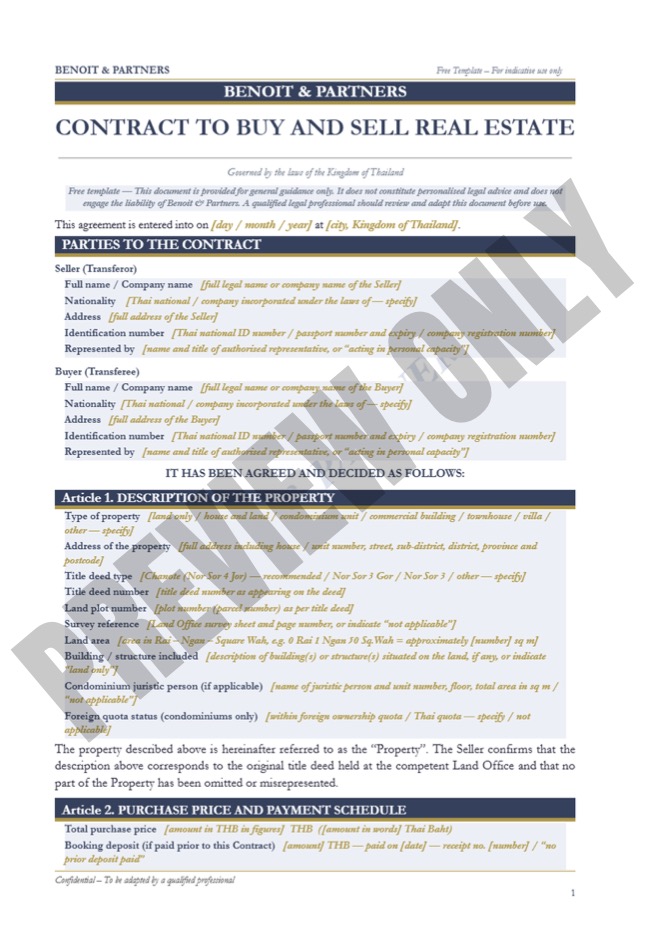
Our Contract to Buy and Sell Real Estate in Thailand is drafted and reviewed by experienced lawyers to ensure compliance with Thai law and practical business use. It provides a reliable legal framework for formally documenting the sale and purchase of real estate between a seller and a buyer in Thailand.
Designed for individuals, investors, and businesses seeking to formally document the purchase or sale of land, a condominium unit, or a building in Thailand, this template covers key legal aspects such as identification of the parties, description of the property, purchase price and payment terms, conditions precedent to completion, and compliance with the Civil and Commercial Code and applicable Land Department registration requirements.
However, some situations may require additional clauses or tailored structuring depending on whether the property is land, a condominium, or a leasehold interest, the nationality of the buyer, the existence of a mortgage or other encumbrance, or the involvement of a deposit and instalment structure prior to title transfer. Our legal team can assist clients with customised Contracts to Buy and Sell Real Estate adapted to their specific situation within a short timeframe.
Disclaimer: This template is provided for general informational purposes only and does not constitute legal advice. While it has been prepared by legal professionals, it may not reflect your specific situation or regulatory constraints. For cross-border purchases or properties with foreign ownership restrictions, legal advice should be sought to ensure proper structuring and compliance under Thai property law.
Need a Contract Tailored to Your Needs? Get a Free Consultation.
When should you use a Contract to Buy and Sell Real Estate in Thailand?
A Contract to Buy and Sell Real Estate in Thailand becomes the necessary instrument whenever a buyer and seller agree on the transfer of land, a condominium unit, or a building in Thailand in exchange for payment. It is used across a wide range of transactions, from off-plan condominium purchases and resale property deals to land transactions involving Thai and foreign parties.
Real estate transactions in Thailand are governed primarily by the Civil and Commercial Code, together with the Land Code and, for condominiums, the Condominium Act. Foreign ownership of land is generally restricted under Thai law, while foreign ownership of condominium units is permitted subject to a statutory quota, making the legal structure of the transaction a critical consideration from the outset.
Documenting the transaction through a properly drafted contract carries significant practical advantages. It sets out the agreed price and payment schedule clearly, defines the conditions that must be satisfied before completion, and provides both parties with a documented basis for proceeding to registration at the Land Department or, for condominiums, transfer of the unit title.
More complex transactions may require additional provisions covering due diligence on title and encumbrances, the seller’s warranties as to the property’s legal status, structured deposit and instalment arrangements for off-plan purchases, or compliance with foreign ownership quotas and the certification requirements for remitting funds from abroad. Our legal team is available to assist with tailored contracts that address these dimensions with precision.
Proceeding on the basis of an informal reservation agreement or a verbal understanding, without a properly drafted contract, exposes both parties to significant risk given the value typically involved in real estate transactions and the strict registration requirements that apply under Thai property law.

1. Identification of the Parties
The contract should state the full names, addresses, and identification or passport details of both the seller and the buyer, together with confirmation of their legal capacity to enter into the transaction.
2. Description of the Property
A precise description of the property should be included, referencing the title deed number, land plot number, location, and area, or, for a condominium, the unit number, floor, building, and condominium registration details.
3. Purchase Price and Payment Schedule
The agreement should state the total purchase price and set out the payment structure, including any deposit, instalment payments, and the balance due on or before the date of title transfer.
4. Conditions Precedent to Completion
Where the transaction is subject to specific conditions such as the discharge of an existing mortgage, the obtaining of foreign exchange certification, or the completion of construction for an off-plan unit these should be clearly stated, together with the consequences of a condition not being satisfied.
5. Seller's Warranties
The seller should warrant that they hold valid and marketable title to the property, that it is free of undisclosed encumbrances, and that there are no pending disputes or claims affecting the property, giving the buyer assurance as to the legal status of the asset being acquired.
6. Transfer of Title and Registration
The agreement should specify the date, location, and process for completing the transfer of title at the Land Department, including which party bears responsibility for the transfer fees, specific business tax, and stamp duty associated with the transaction.
Key Clauses and Essential Elements in a Contract to Buy and Sell Real Estate
A well-drafted Contract to Buy and Sell Real Estate in Thailand gives both parties a complete and legally sound framework governing every stage of the transaction, from signing through to registration of the transfer at the Land Department. It protects the buyer’s interest in receiving clean and marketable title and protects the seller’s interest in receiving timely and complete payment.
Under Thai law, a contract for the sale of immovable property must generally be evidenced in writing to be enforceable, and the actual transfer of ownership is completed only upon registration at the competent Land Office. A properly structured contract bridges the period between the initial agreement and that final registration.
This document is relevant across the full spectrum of Thai real estate transactions from individual house and land purchases to large-scale condominium acquisitions and the core structure remains consistent, though the specific provisions will vary considerably depending on the type of property and the nationality of the buyer.
Why customise a Contract to Buy and Sell Real Estate with a lawyer in Thailand?
A standard template of Contract to Buy and Sell Real Estate in Thailand can provide a useful starting point, but given the value and legal complexity typically involved in Thai real estate transactions, a carefully tailored contract is strongly advisable in almost all cases.
The type of property, the nationality of the buyer, and the structure of the payment all significantly affect what the contract needs to address and how the transaction should be sequenced to manage risk appropriately.
Depending on the situation, the contract may need to address: the foreign ownership quota applicable to condominium purchases and the foreign exchange transaction certificate required to remit purchase funds from abroad; the due diligence findings on title, zoning, and existing encumbrances; the treatment of an existing mortgage and its discharge prior to or simultaneous with transfer; the allocation of transfer taxes and fees between the parties; or the specific protections required for an off-plan purchase from a developer.
Our legal team works with buyers, sellers, and developers to prepare real estate contracts that are legally robust, properly sequenced, and tailored to the specific property and transaction structure, giving all parties confidence that the deal will complete smoothly and securely.
Contract to Buy and Sell Real Estate Thailand
Instant Download
Easy to Customize
Ready to Sign
Crafted by Lawyers
FAQ
What is a Contract to Buy and Sell Real Estate in Thailand?
A written agreement documenting the sale and purchase of land, a condominium unit, or a building, setting out the purchase price, payment terms, conditions precedent, and the process for completing transfer of title at the Land Department.
Can foreigners buy land in Thailand?
As a general rule, foreign individuals are restricted from owning land directly under the Land Code, subject to limited exceptions such as investment-linked schemes or specific promoted categories. Foreign nationals more commonly acquire land-related interests through long-term leasehold structures or by purchasing condominium units, which are subject to a different ownership regime.
Can foreigners buy condominiums in Thailand?
Yes. Foreign nationals may own condominium units outright, subject to the statutory requirement that foreign ownership within a single condominium project does not exceed 49 percent of the total saleable area, calculated by reference to all units in the project.
What is a Foreign Exchange Transaction Certificate and why does it matter for property purchases in Thailand?
This certificate confirms that funds used to purchase a condominium were remitted into Thailand from abroad in foreign currency. It is generally required to register foreign ownership of a condominium unit at the Land Department and should be obtained from the receiving Thai bank at the time the funds are transferred.
What taxes and fees apply to a real estate transaction in Thailand?
Transactions are typically subject to a transfer fee, withholding tax, and either specific business tax or stamp duty, depending on the length of ownership and the nature of the seller. The contract should specify how these costs are allocated between the buyer and seller.
What happens if a buyer defaults on a real estate purchase contract in Thailand?
The consequences depend on the terms of the contract, but commonly include forfeiture of any deposit paid to the seller. The seller may also be entitled to pursue the buyer for further damages where the contract so provides and Thai law supports such a claim.
Is a deposit refundable if a real estate transaction in Thailand falls through?
This depends on the reason for the transaction not proceeding and the specific terms of the contract. Where the buyer withdraws without cause, the deposit is typically forfeited. Where the seller fails to perform or a condition precedent is not satisfied, the contract may provide for the deposit to be returned.
How does the PDPA apply to a real estate sale contract in Thailand?
The contract contains personal data, including the identification details of both parties. Under the Personal Data Protection Act B.E. 2562 (2019), this data should be used only for the purposes of completing the transaction and any related registration, and must be stored securely by both parties and any involved intermediaries.