
Copyright Transfer Agreement Template in Thailand
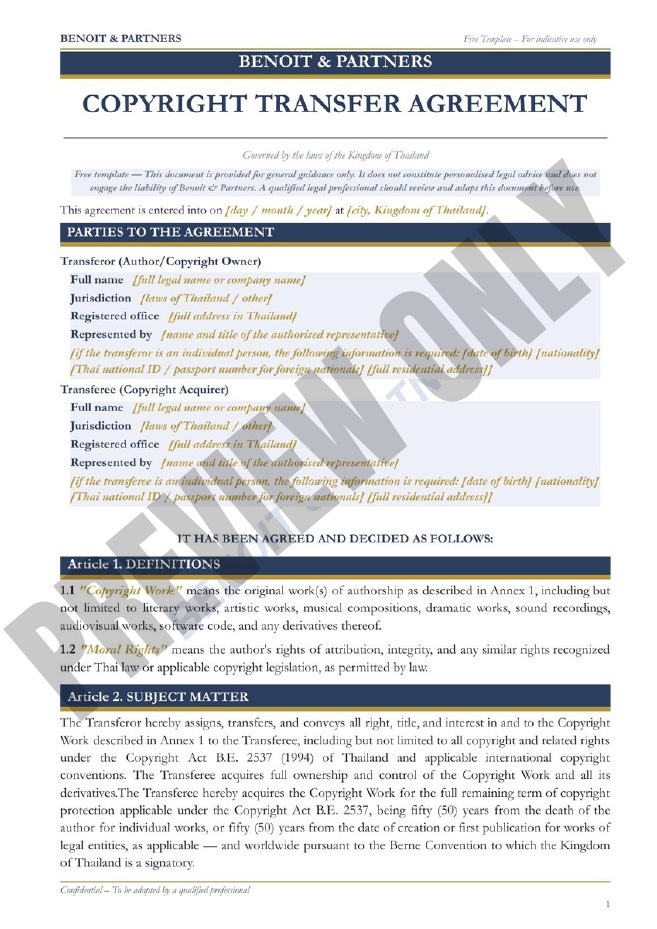
Our Copyright Transfer Agreement template for Thailand has been carefully drafted and reviewed by experienced lawyers to comply with Thai intellectual property law and commercial practice. It establishes a clear legal framework for the assignment and transfer of copyright ownership in Thailand.
Prepared for authors, creators, businesses, investors, and parties involved in intellectual property transactions, this template addresses important legal elements including the transfer of economic rights, scope of assigned copyrights, moral rights considerations, compensation arrangements, representations and warranties, and compliance with applicable Thai regulations.
Certain transactions may nevertheless require more advanced drafting or tailored contractual provisions, particularly where international exploitation, licensing structures, royalty arrangements, software rights, or significant commercial exposure are involved. In such cases, our legal team can prepare a customised Copyright Transfer Agreement adapted to the specific structure and objectives of the transaction within a short timeframe.
Disclaimer: This template is provided for general informational purposes only and should not be considered legal advice. Although prepared by legal professionals, it may not fully address the specific legal, regulatory, or commercial circumstances of your transaction. Independent legal advice is recommended for complex, international, or high-value copyright transfers under Thai law.
Need a Contract Tailored to Your Needs? Get a Free Consultation.
When should you use a Copyright Transfer Agreement in Thailand?
A Copyright Transfer Agreement is used whenever the ownership of a copyright work is assigned from one party to another in Thailand. This situation commonly arises in creative industries, software development, publishing, music production, audiovisual content creation, or any commercial arrangement involving the full transfer of intellectual property rights.
Under Thai law, copyright is governed by the Copyright Act B.E. 2537 (1994), which protects original works of authorship including literary works, artistic works, musical compositions, dramatic works, sound recordings, audiovisual works, and software code. The transfer of copyright must be made in writing and signed by the transferor to be enforceable.
This agreement becomes particularly important when the transaction involves significant financial value, international exploitation of the work, multiple rights holders, or complex licensing arrangements. It allows the parties to clearly define the scope of the transfer, including the exclusive rights assigned, payment conditions, moral rights provisions, and risk allocation mechanisms.
In more complex transactions, additional clauses may be required regarding sublicensing rights, royalty arrangements, exploitation territories, tax liabilities, confidentiality, dispute resolution, or PDPA compliance. Our legal team assists clients with the preparation of customised Copyright Transfer Agreements tailored to their transaction in order to provide stronger legal protection and ensure compliance with Thai law.
In practice, this agreement is also crucial when due diligence has been conducted on the copyright work, as it formalises the allocation of risks identified during the review process.
Without a properly drafted Copyright Transfer Agreement, parties expose themselves to disputes over ownership, unauthorised use of the work, regulatory issues, and potential invalidity of the transfer under Thai intellectual property law.

1. Identification of the parties and company
A Copyright Transfer Agreement must clearly identify the transferor and the transferee, including their full legal names, registration details, addresses, and the names of authorised representatives empowered to bind each party to the transaction.
2. Description of the transferred shares
The agreement must specify the nature and description of the copyright work being transferred, including its category under the Copyright Act B.E. 2537, such as literary, artistic, musical, audiovisual, or software works, with reference to the annexes where applicable.
3. Purchase price and payment terms
The agreement must clearly define the exclusive rights assigned to the transferee, including reproduction, distribution, preparation of derivative works, public performance, and communication to the public, as well as any sublicensing rights.
4. Representations and warranties
The agreement must define the consideration paid for the transfer, including the amount, applicable VAT, payment method, and due date, as well as the consequences of late payment in accordance with Thai law.
5. Transfer and registration of ownership
The agreement must address moral rights, which are personal and inalienable under Thai law. The transferor may consent to modification and use without attribution to the maximum extent permitted by the Copyright Act B.E. 2537.
6. Tax and regulatory compliance
The transferor must warrant ownership of the copyright work, its originality, and the absence of third-party claims. The agreement must also address PDPA compliance and any applicable tax obligations under the Thai Revenue Code.
Key clauses and additional protections in a Copyright Transfer agreement
A Copyright Transfer Agreement is a key legal document governing the assignment of copyright in Thailand. It defines the rights and obligations of the transferor and transferee while ensuring compliance with Thai intellectual property law.
Under the Copyright Act B.E. 2537 (1994), a copyright transfer must be made in writing and signed by the transferor to be valid and enforceable. A properly drafted Copyright Transfer Agreement helps secure the transaction and reduce legal risks for both parties.
This type of agreement is commonly used in creative and commercial transactions, including software development, publishing, music and audiovisual production, and any arrangement requiring the full assignment of intellectual property rights. While standard transactions may rely on a general template, more complex deals often require additional legal protections and customised clauses depending on the scope of exploitation and the risks involved.
A properly customised Copyright Transfer Agreement helps secure the transaction and better protect the interests of the parties involved.
Why customise a Copyright Transfer agreement with a lawyer in Thailand?
Although a standard Copyright Transfer Agreement template may work for straightforward copyright assignments, many intellectual property transactions involve commercial, legal, and international considerations requiring more sophisticated drafting and carefully adapted protections.
In practice, copyright transfers often concern assets with significant financial value or international exploitation potential. The transfer of software rights, creative content, audiovisual works, digital assets, publishing rights, or technology-related materials may require contractual provisions that are not adequately addressed in a generic template. Matters relating to royalty arrangements, sublicensing rights, territorial limitations, moral rights, confidentiality obligations, or cross-border use of the work frequently require tailored drafting depending on the nature of the transaction.
Customising a Copyright Transfer Agreement also allows the parties to clearly allocate ownership rights, define the permitted scope of exploitation, and anticipate legal risks identified during negotiations or due diligence. This is particularly important where multiple creators are involved, where the work may be commercially exploited internationally, or where intellectual property forms part of a broader commercial transaction.
While free templates may be useful for basic assignments or preliminary understanding, preparing a Copyright Transfer Agreement with a lawyer in Thailand remains strongly recommended. Proper legal drafting helps ensure compliance with Thai intellectual property regulations, protects the parties against future ownership disputes, and reduces the risk of unauthorised use or contractual ambiguity.
Our legal team assists creators, authors, investors, and companies with the preparation and review of customised Copyright Transfer Agreements adapted to their commercial objectives and transaction structure, within a short timeframe and in compliance with Thai intellectual property and commercial law.
Copyright Transfer agreement template
Instant Download
Easy to Customize
Ready to Sign
Crafted by Lawyers
FAQ
What is a Copyright Transfer Agreement in Thailand?
A Copyright Transfer Agreement is a written contract by which the owner of a copyright work assigns all or part of their intellectual property rights to another party. In Thailand, it is governed by the Copyright Act B.E. 2537 (1994) and must be made in writing and signed by the transferor to be enforceable.
Is a Copyright Transfer Agreement legally binding in Thailand?
Yes. Under Thai law, a copyright transfer is legally binding when made in writing and signed by the transferor. The agreement must clearly define the scope of rights transferred to be enforceable against third parties.
What rights are transferred under a Copyright Transfer Agreement in Thailand?
The agreement typically transfers exclusive rights including reproduction, distribution, preparation of derivative works, public performance and display, and communication to the public. The scope of rights transferred should be clearly defined in the agreement.
What are moral rights and can they be waived in Thailand?
Under the Copyright Act B.E. 2537, moral rights, including the right of attribution and the right of integrity, are personal and inalienable. They cannot be fully waived under Thai law, but the transferor may consent to the transferee modifying and using the work without attribution to the maximum extent permitted by law.
How long does copyright protection last in Thailand?
For individual works, copyright protection lasts fifty (50) years from the death of the author. For works created by legal entities, protection lasts fifty (50) years from the date of creation or first publication, in accordance with the Copyright Act B.E. 2537.
Do I need a lawyer to draft a Copyright Transfer Agreement in Thailand?
For simple assignments, a standard template may be sufficient. For high-value works, international exploitation, or complex licensing arrangements, legal assistance is strongly recommended to ensure the agreement is compliant with Thai law and protective of the parties’ interests.
Can a Copyright Transfer Agreement cover international exploitation?
Yes. Thailand is a signatory to the Berne Convention, which provides international copyright protection. A properly drafted agreement can cover worldwide exploitation of the work, though specific clauses may be required to address foreign jurisdictions and international licensing arrangements.
How does the PDPA apply to a Copyright Transfer Agreement in Thailand?
If the agreement involves the exchange of personal data between the parties, both parties must comply with the Personal Data Protection Act B.E. 2562 (2019). The agreement should include appropriate confidentiality and data processing provisions to ensure full compliance.