
Debt Collection Letter Thailand
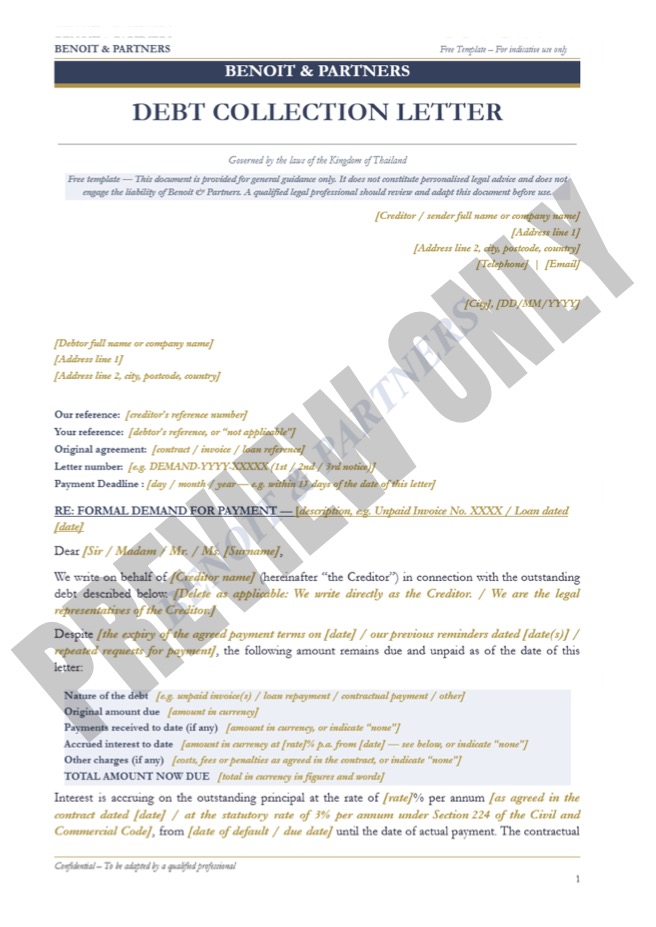
Our Debt Collection Letter Thailand is drafted and reviewed by experienced lawyers to ensure compliance with Thai law and practical business use. It provides a reliable legal framework for formally demanding repayment of an outstanding debt from an individual or company in Thailand.
Designed for creditors, lenders, and companies seeking to formally recover an unpaid debt in Thailand, this template covers key legal aspects such as identification of the parties, description of the outstanding debt, formal demand for payment, applicable interest and penalties, consequences of non-payment, and regulatory compliance under Thai law.
However, some situations may require additional clauses or tailored structuring depending on the nature of the debt, the debtor’s circumstances, security arrangements, or cross-border considerations. Our legal team can assist clients with customised Debt Collection Letters adapted to their specific situation within a short timeframe.
Disclaimer: This template is provided for general informational purposes only and does not constitute legal advice. While it has been prepared by legal professionals, it may not reflect your specific situation or regulatory constraints. For complex or high-value matters, legal advice should be sought to ensure proper structuring and compliance under Thai law.
Need a Contract Tailored to Your Needs? Get a Free Consultation.
When should you use a Debt Collection Letter in Thailand?
A Debt Collection Letter is used whenever a creditor wishes to formally demand repayment of an outstanding debt from a debtor who has failed to pay within the agreed timeframe. This situation commonly arises following non-payment of a loan, overdue commercial invoices, unpaid service fees, failure to honour a promissory note, or any other situation where a debtor has failed to meet a financial obligation owed to the creditor.
Under Thai law, debt collection is governed by the Civil and Commercial Code B.E. 2468 (1925), notably the provisions relating to obligations, default, and the right to claim damages for non-performance. A formal written demand is often a prerequisite before initiating legal proceedings, and constitutes important documentary evidence of the creditor’s attempts to recover the debt prior to litigation. In certain cases, a formal demand letter also triggers the running of default interest under Section 224 of the Civil and Commercial Code.
This document becomes particularly important when the debtor has failed to respond to informal payment reminders, as it puts the debtor on formal notice of the outstanding amount, the applicable interest and penalties, and the legal consequences of continued non-payment. It allows the creditor to clearly document the amount owed, the basis of the claim, the payment deadline, and the steps that will be taken in the event of further non-payment.
In more complex situations, additional provisions may be required regarding the enforcement of associated security, the involvement of guarantors, cross-border debt recovery considerations, or the initiation of insolvency proceedings against the debtor. Our legal team assists clients with the preparation of customised Debt Collection Letters tailored to their specific situation to provide maximum legal protection and ensure compliance with Thai law.
In practice, issuing a formal Debt Collection Letter is also a critical step before filing a civil claim before the Thai courts, as it demonstrates the creditor’s good faith attempts to resolve the matter and establishes the factual and legal basis of the claim.
Without a properly drafted Debt Collection Letter, creditors risk undermining their legal position, failing to trigger default interest, and exposing themselves to procedural challenges when initiating litigation or enforcement proceedings in Thailand.

1. Identification of the Parties
The letter must clearly identify the creditor and the debtor, including their full legal names, registration details, and addresses, as well as the basis on which the creditor is entitled to demand payment.
2. Description of the Outstanding Debt
The letter must specify the nature and origin of the debt, including the underlying contract or agreement, the original amount owed, the due date for payment, and any amounts already paid, leaving a clear statement of the outstanding balance.
3. Formal Demand for Payment
The letter must contain a clear and unambiguous demand for payment of the outstanding amount, specifying the total sum demanded, the deadline for payment, and the method and account details for making payment.
4. Interest, Penalties and Additional Charges
The letter must specify any default interest accruing on the outstanding balance, whether at the contractual rate or at the statutory rate of 5% per annum under Section 224 of the Civil and Commercial Code, as well as any penalty clauses or collection costs being claimed.
5. Consequences of Non-Payment
The letter must clearly set out the steps the creditor intends to take in the event of continued non-payment, including initiating civil proceedings before the Thai courts, enforcing any security provided, demanding payment from guarantors, or reporting the debtor to relevant credit or regulatory authorities.
6. Payment Deadline and Final Notice
The letter must specify a clear and reasonable deadline by which payment must be received, after which the creditor reserves the right to take immediate legal action without further notice. The deadline should be specific and unambiguous to avoid any dispute as to whether sufficient notice was given.
Key Clauses and Essential Elements in a Debt Collection Letter
A Debt Collection Letter is a key legal document formally demanding repayment of an outstanding debt in Thailand. It sets out the basis of the creditor’s claim, the amount owed, and the consequences of continued non-payment under Thai civil and commercial law.
Under the Civil and Commercial Code, a formal written demand is often required to trigger default interest and to establish the debtor’s formal state of default. A properly drafted Debt Collection Letter helps protect the creditor’s legal position and provides essential documentary evidence for any subsequent legal proceedings.
This type of document is commonly used for recovery of unpaid loans, overdue invoices, dishonoured promissory notes, unpaid service fees, and any other outstanding financial obligations.
While standard situations may rely on a general template, more complex recovery situations often require additional legal protections and customised clauses depending on the nature of the debt and the debtor’s circumstances.
Why customise a Debt Collection Letter with a lawyer in Thailand?
While a standard Debt Collection Letter template for Thailand may be sufficient for straightforward recovery situations, many debt collection cases involve legal, procedural, and strategic considerations requiring more careful drafting and tailored protections.
In practice, each debt recovery situation has its own structure and level of risk. The nature of the underlying debt, the identity and financial position of the debtor, the availability of security or guarantees, and the likelihood of litigation all affect how the letter should be drafted and what remedies should be threatened.
Depending on the situation, specific provisions may be added relating to the precise calculation of default interest and penalties, the involvement of guarantors and the demand for payment from them, the enforcement of security interests over assets or property, the initiation of insolvency or bankruptcy proceedings against the debtor, cross-border debt recovery and enforcement considerations, PDPA compliance where personal data is involved, dispute resolution procedures and governing law, or the strategic decision between negotiating a repayment arrangement and proceeding directly to litigation.
Tailoring a Debt Collection Letter also allows the creditor to adopt the most effective tone and legal approach for the specific situation, maximise the chances of voluntary payment, and ensure that all procedural requirements for subsequent litigation have been met. This is particularly important for high-value claims, cross-border recovery situations, regulated industries, or cases involving corporate debtors with complex structures.
Our legal team assists creditors, lenders, and companies with the preparation and review of customised Debt Collection Letters for Thailand adapted to their specific recovery situation and commercial objectives. In many cases, tailored letters can be prepared within a short timeframe while ensuring full compliance with Thai civil, procedural, and regulatory law.
A properly drafted Debt Collection Letter not only maximises the chances of voluntary repayment, but also strengthens the creditor’s legal position and reduces the risk of procedural challenges if the matter proceeds to litigation or enforcement.
Debt Collection Letter Thailand
Instant Download
Easy to Customize
Ready to Sign
Crafted by Lawyers
FAQ
What is a Debt Collection Letter in Thailand?
A formal written demand by which a creditor notifies a debtor of an outstanding debt, demands payment within a specified period, and sets out the legal consequences of continued non-payment. Governed by the Civil and Commercial Code and subject to applicable procedural requirements under Thai law.
Is a Debt Collection Letter legally required before suing in Thailand?
Not strictly required in all cases, but strongly recommended. A formal written demand establishes the debtor’s default, triggers default interest under Section 224 of the Civil and Commercial Code, and demonstrates the creditor’s good faith before the Thai courts.
Can a foreigner issue a Debt Collection Letter in Thailand?
Yes. Foreign nationals and foreign companies may issue a Debt Collection Letter in Thailand in respect of debts governed by Thai law. Legal assistance is recommended to ensure the letter complies with Thai procedural requirements and maximises the chances of recovery.
Does a Debt Collection Letter trigger default interest in Thailand?
Yes. A formal written demand triggers the running of default interest at the statutory rate of 5% per annum under Section 224 of the Civil and Commercial Code, unless a higher contractual rate has been agreed. Clear dating and delivery of the letter are essential.
What happens if the debtor ignores a Debt Collection Letter in Thailand?
The creditor may initiate civil proceedings before the competent Thai courts, enforce any security provided, demand payment from guarantors, or consider insolvency proceedings where the debtor is insolvent. The letter serves as key evidence of the creditor’s prior demand.
How long does debt collection take in Thailand?
Timelines vary depending on the complexity of the claim, the debtor’s response, and whether litigation is required. Simple undisputed claims may be resolved quickly following a formal demand. Contested claims before the Thai courts may take significantly longer depending on the court’s caseload and the complexity of the dispute.
Can a Debt Collection Letter be sent to a guarantor in Thailand?
Yes. Where a guarantee has been provided, a formal demand may also be sent to the guarantor, subject to the conditions set out in the guarantee and the applicable provisions of the Civil and Commercial Code governing the enforcement of guarantees.
How does the PDPA apply to a Debt Collection Letter in Thailand?
Where personal data is referenced or processed in connection with the debt collection — such as identification documents or financial records — the creditor must comply with the Personal Data Protection Act B.E. 2562 (2019). Appropriate data handling procedures should be followed when preparing and sending the letter.