
Debt Discharge Letter Thailand
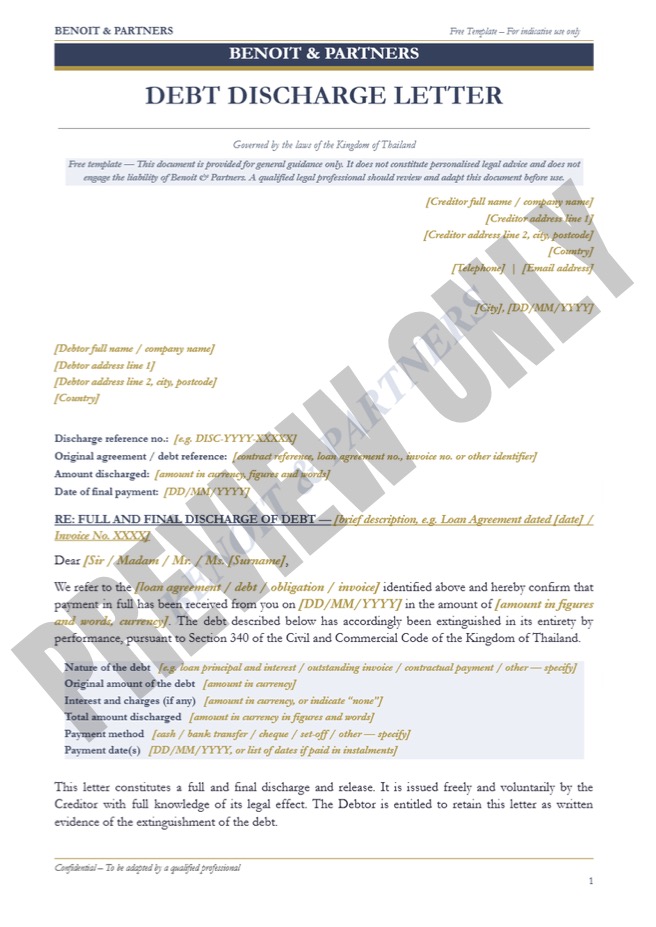
Our Debt Discharge Letter template for Thailand is drafted and reviewed by experienced lawyers to ensure compliance with Thai law and practical business use. It provides a reliable legal framework for formally documenting the full or partial discharge of a debt between individuals or companies in Thailand.
Designed for creditors, debtors, and companies seeking to formally record the settlement and release of a debt obligation in Thailand, this template covers key legal aspects such as identification of the parties, description of the original debt, confirmation of payment or settlement, scope of the discharge, release of all related claims, and regulatory compliance under Thai law.
However, some situations may require additional clauses or tailored structuring depending on the nature of the debt, the terms of the settlement reached, tax implications, or cross-border considerations. Our legal team can assist clients with customised Debt Discharge Letters adapted to their specific situation within a short timeframe.
Disclaimer: This template is provided for general informational purposes only and does not constitute legal advice. While it has been prepared by legal professionals, it may not reflect your specific situation or regulatory constraints. For complex or high-value matters, legal advice should be sought to ensure proper structuring and compliance under Thai law.
Need a Contract Tailored to Your Needs? Get a Free Consultation.
When should you use a Debt Discharge Letter in Thailand?
A Debt Discharge Letter is used whenever a creditor wishes to formally confirm that a debt owed by a debtor has been fully or partially settled, and to release the debtor from further liability in respect of that debt. This situation commonly arises following full repayment of a loan, settlement of outstanding invoices, resolution of a commercial dispute, or agreement on a reduced settlement amount between the parties.
Under Thai law, the discharge of obligations is governed by the Civil and Commercial Code B.E. 2468 (1925), notably Sections 340 to 348, which regulate the release and extinction of obligations, including the conditions under which a creditor may formally release a debtor from its obligations and the legal effect of such release on any guarantors or co-debtors. A written discharge letter provides clear documentary evidence of the extinction of the debt and protects both parties against future claims.
This document becomes particularly important when the debt has been the subject of dispute, negotiation, or partial settlement, as it formally records the agreed terms of resolution and prevents the creditor from making further claims in respect of the discharged amount. It allows the parties to clearly document the original debt, the amount settled, the date of discharge, and the scope of the release granted by the creditor.
In more complex situations, additional provisions may be required regarding the release of associated guarantors or co-debtors, the treatment of accrued interest and penalties, tax implications of debt forgiveness including potential income recognition by the debtor, or the interaction between the discharge and any security or collateral previously provided. Our legal team assists clients with the preparation of customised Debt Discharge Letters tailored to their specific situation to provide clear legal certainty and ensure compliance with Thai law.
In practice, this document is also crucial when the debt discharge forms part of a broader settlement or restructuring arrangement, as it provides the debtor with formal written confirmation that the creditor has no further claims in respect of the discharged obligation.
Without a properly drafted Debt Discharge Letter, parties expose themselves to future disputes over the scope of the release, the treatment of associated obligations, and the risk of continued enforcement action in respect of debts that have already been settled.

1. Identification of the Parties
The letter must clearly identify the creditor and the debtor, including their full legal names, registration details, and addresses, as well as the capacity in which each party enters into the discharge arrangement.
2. Description of the Original Debt
The letter must specify the original debt being discharged, including its nature, the amount originally owed, the date it arose, and a reference to the underlying contract or agreement from which it derives.
3. Confirmation of Payment or Settlement
The letter must confirm the amount paid or the terms of the settlement agreed between the parties, including the date of payment or settlement, the method of payment, and whether the discharge covers the full debt or only a specified portion thereof.
4. Scope of the Discharge and Release
The letter must clearly define the scope of the discharge granted by the creditor, specifying whether it covers the principal debt only or also accrued interest, penalties, costs, and any other related claims, and whether it constitutes a full and final settlement of all claims between the parties arising from the underlying obligation.
5. Release of Guarantors and Co-Debtors
The letter must address whether the discharge extends to any guarantors or co-debtors associated with the original obligation, in accordance with Sections 698 and 340 of the Civil and Commercial Code, and confirm their release from liability where applicable.
6. Tax and Regulatory Considerations
The letter must address any tax implications arising from the debt discharge, including potential income recognition by the debtor where a debt is forgiven at below its face value, withholding tax considerations, and stamp duty obligations under the Thai Revenue Code.
Key Clauses and Essential Elements in a Debt Discharge Letter
A Debt Discharge Letter is a key legal document confirming the extinction of a debt obligation and the release of the debtor from further liability in Thailand. It provides documentary evidence of the settlement and protects both parties against future claims under Thai civil and commercial law.
Under the Civil and Commercial Code, the release of an obligation must be clearly expressed and documented to be enforceable. A properly drafted Debt Discharge Letter helps provide legal certainty for both the creditor and the debtor and reduces the risk of future disputes.
This type of document is commonly used following full repayment of loans, settlement of commercial disputes, resolution of outstanding invoices, and debt restructuring arrangements.
While standard situations may rely on a general template, more complex settlements often require additional legal protections and customised clauses depending on the nature of the debt and the terms of the discharge.
Why customise a Debt Discharge Letter with a lawyer in Thailand?
While a standard Debt Discharge Letter template for Thailand may be sufficient for simple debt settlements, many discharge situations involve legal, financial, and tax considerations requiring more careful drafting and tailored protections.
In practice, each debt discharge has its own structure and level of risk. Partial settlements, releases of guarantors, debt forgiveness with tax implications, or cross-border discharge arrangements may all require provisions that are not included in a standard template.
Depending on the situation, specific clauses may be added relating to the precise scope of the release and whether it constitutes a full and final settlement, the treatment of accrued interest, penalties, and associated costs, the release of guarantors and co-debtors and its effect under Thai law, tax implications of debt forgiveness including income recognition and withholding tax, stamp duty obligations under the Thai Revenue Code, PDPA compliance where personal data is involved, dispute resolution procedures and governing law, or the interaction between the discharge and any ongoing security or collateral arrangements.
Tailoring a Debt Discharge Letter also allows the parties to clearly document the agreed terms of settlement, avoid ambiguity as to the scope of the release, and ensure that the discharge is legally effective and enforceable under Thai law. This is particularly important for high-value debt settlements, cross-border arrangements, or situations involving multiple debtors, guarantors, or complex underlying obligations.
Our legal team assists creditors, debtors, and companies with the preparation and review of customised Debt Discharge Letters for Thailand adapted to their specific situation and settlement terms. In many cases, tailored documents can be prepared within a short timeframe while ensuring full compliance with Thai civil, commercial, and tax law.
A properly drafted Debt Discharge Letter not only provides legal certainty for both parties, but also reduces the risk of future disputes, enforcement actions, and unexpected tax or regulatory consequences arising from the settlement.
Debt Discharge Letter Thailand
Instant Download
Easy to Customize
Ready to Sign
Crafted by Lawyers
FAQ
What is a Debt Discharge Letter in Thailand?
A formal written document by which a creditor confirms that a debt has been fully or partially settled and releases the debtor from further liability. Governed by the Civil and Commercial Code, Sections 340 to 348, regulating the release and extinction of obligations under Thai law.
Is a Debt Discharge Letter legally binding in Thailand?
Yes, upon signature by the creditor. It constitutes formal documentary evidence of the extinction of the debt and the release of the debtor. It is strongly recommended that the debtor also countersign the letter to confirm receipt and agreement.
Can a Debt Discharge Letter release guarantors from their obligations in Thailand?
Yes, provided the letter expressly extends the release to the guarantors. Under the Civil and Commercial Code, a release granted to the principal debtor does not automatically discharge the guarantor unless specifically stated. Clear drafting is essential to avoid ambiguity.
Are there tax implications to a Debt Discharge Letter in Thailand?
Yes. Where a debt is forgiven at below its face value, the debtor may be required to recognise the forgiven amount as taxable income under Thai tax law. Withholding tax obligations may also arise. Legal and tax advice should be sought before finalising the terms of the discharge.
Does a Debt Discharge Letter need to be registered in Thailand?
Registration is not generally required. However, stamp duty may apply depending on the nature of the underlying obligation. Where the discharge relates to a secured debt, separate steps may be needed to release the security registered with the Land Department or other authorities.
What is the difference between a full and partial Debt Discharge Letter in Thailand?
A full discharge confirms that the entire debt, including principal, interest, and associated costs, has been settled and releases the debtor from all further liability. A partial discharge confirms settlement of a specified portion only, with the remainder continuing to be owed. The scope must be clearly defined in the letter.
What happens if the creditor makes further claims after issuing a Debt Discharge Letter in Thailand?
A properly drafted Debt Discharge Letter constitutes a binding release of the discharged claims. Any further claim by the creditor in respect of the discharged amount may be resisted by the debtor on the basis of the letter. Clear and unambiguous drafting of the scope of the release is essential to provide effective protection.
How does the PDPA apply to a Debt Discharge Letter in Thailand?
Where personal data is exchanged in connection with the discharge — such as identification documents or financial records — both parties must comply with the Personal Data Protection Act B.E. 2562 (2019). The letter and related documentation should include appropriate data protection provisions.