
Debt Repayment Agreement Thailand
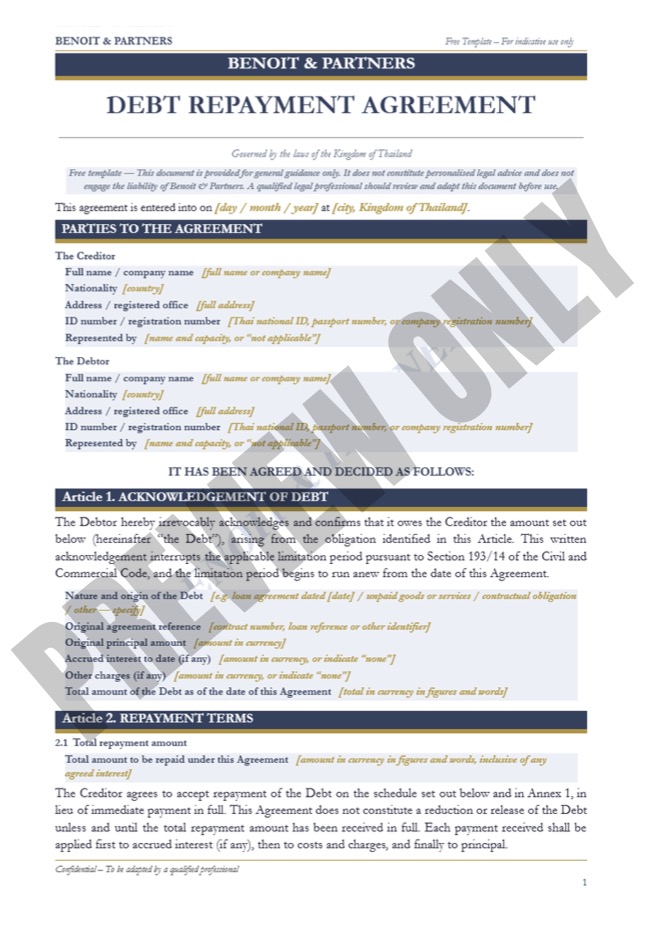
Our Debt Repayment Agreement Thailand is drafted and reviewed by experienced lawyers to ensure compliance with Thai law and practical business use. It provides a reliable legal framework for formally documenting the terms under which an outstanding debt will be repaid between individuals or companies in Thailand.
Designed for creditors, debtors, and companies seeking to formally record and structure the repayment of an existing debt obligation in Thailand, this template covers key legal aspects such as identification of the parties, description of the original debt, agreed repayment schedule, consequences of default, release of claims upon full repayment, and regulatory compliance under Thai law.
However, some situations may require additional clauses or tailored structuring depending on the nature of the debt, the complexity of the repayment terms agreed, security arrangements, tax implications, or cross-border considerations. Our legal team can assist clients with customised Debt Repayment Agreements adapted to their specific situation within a short timeframe.
Disclaimer: This template is provided for general informational purposes only and does not constitute legal advice. While it has been prepared by legal professionals, it may not reflect your specific situation or regulatory constraints. For complex or high-value matters, legal advice should be sought to ensure proper structuring and compliance under Thai law.
Need a Contract Tailored to Your Needs? Get a Free Consultation.
When should you use a Debt Repayment Agreement in Thailand?
A Debt Repayment Agreement is used whenever a creditor and a debtor wish to formally document the terms under which an existing debt will be repaid, typically following a default, a missed payment, or a mutual agreement to restructure the original repayment obligations. This situation commonly arises following non-payment of a loan, settlement of overdue commercial invoices, restructuring of an existing financing arrangement, or agreement on a revised payment schedule following financial difficulty.
Under Thai law, debt repayment arrangements are governed by the Civil and Commercial Code B.E. 2468 (1925), notably the provisions relating to obligations, novation, and the modification of existing contractual arrangements. A written Debt Repayment Agreement provides clear documentary evidence of the revised terms agreed between the parties and protects both the creditor and the debtor against future disputes over the scope of the arrangement and the consequences of any further default.
This document becomes particularly important when the original debt has been the subject of dispute or when the debtor has been unable to meet the original repayment terms, as it formally records the revised schedule, any reduction in the amount owed, any waiver of penalties or interest, and the consequences of any further failure to pay. It allows the parties to clearly document the outstanding balance, the agreed instalments, the applicable interest rate, and the creditor’s rights in the event of a subsequent default.
In more complex situations, additional provisions may be required regarding security arrangements to support the revised repayment plan, the release of guarantors or co-debtors upon full repayment, tax implications of any debt reduction or interest waiver, or cross-border enforcement considerations. Our legal team assists clients with the preparation of customised Debt Repayment Agreements tailored to their specific situation to provide legal certainty and ensure compliance with Thai law.
In practice, this document is also crucial when the debt repayment forms part of a broader commercial settlement or restructuring arrangement, as it provides both parties with a clear and enforceable framework governing the resolution of the outstanding obligation.
Without a properly drafted Debt Repayment Agreement, parties expose themselves to disputes over the revised repayment terms, the treatment of accrued interest and penalties, the consequences of further default, and the risk of continued or renewed enforcement action by the creditor.

1. Identification of the Parties
The agreement must clearly identify the creditor and the debtor, including their full legal names, registration details, and addresses, as well as the capacity in which each party enters into the repayment arrangement.
2. Description of the Original Debt
The agreement must specify the original debt being restructured, including its nature, the total amount originally owed, accrued interest and penalties as of the date of the agreement, and a reference to the underlying contract or agreement from which the debt derives.
3. Outstanding Balance and Agreed Settlement Amount
The agreement must confirm the total outstanding balance as of the date of the agreement, including any agreed reduction, waiver of interest or penalties, and the final amount that the debtor undertakes to repay under the revised arrangement.
5. Interest and Charges
The agreement must specify whether interest continues to accrue on the outstanding balance during the repayment period, the applicable rate, the method of calculation, and whether any previously accrued interest or penalties have been waived or capitalised as part of the revised arrangement.
5. Damages and Financial Claims
The notice must set out any amounts currently claimed, the basis of those claims, and whether default interest is applicable, whether at the contractual rate or at the statutory rate of 5% per annum under Section 224 of the Civil and Commercial Code.
6. Consequences of Default
The agreement must clearly define the consequences of any further failure to pay in accordance with the revised schedule, including the right of the creditor to accelerate the full outstanding balance, reinstate previously waived penalties, enforce any security, and initiate legal proceedings for recovery.
Key Clauses and Essential Elements in a Debt Repayment Agreement
A Debt Repayment Agreement is a key legal document formally recording the terms under which an outstanding debt will be repaid in Thailand. It defines the rights and obligations of the creditor and the debtor while providing legal certainty and enforceability under Thai civil and commercial law.
Under the Civil and Commercial Code, the modification of an existing obligation must be clearly documented to be enforceable. A properly drafted Debt Repayment Agreement helps provide legal certainty for both parties and reduces the risk of future disputes over the terms of repayment.
This type of agreement is commonly used following loan defaults, overdue commercial invoices, financial restructuring arrangements, and negotiated settlements of outstanding obligations.
While standard situations may rely on a general template, more complex arrangements often require additional legal protections and customised clauses depending on the nature of the debt and the repayment structure agreed.
Why customise a Debt Repayment Agreement with a lawyer in Thailand?
While a standard Debt Repayment Agreement template for Thailand may be sufficient for simple repayment arrangements, many debt restructuring situations involve legal, financial, and tax considerations requiring more careful drafting and tailored protections.
In practice, each debt repayment arrangement has its own structure and level of risk. Partial settlements, interest waivers, security arrangements, guarantor releases, or cross-border repayment structures may all require provisions that are not included in a standard template.
Depending on the situation, specific clauses may be added relating to the precise calculation and treatment of accrued interest and penalties, the conditions under which previously waived amounts may be reinstated upon further default, security arrangements supporting the revised repayment plan, the release of guarantors and co-debtors upon full repayment, tax implications of any debt reduction or interest waiver including income recognition by the debtor, stamp duty obligations under the Thai Revenue Code, PDPA compliance where personal data is involved, dispute resolution procedures and governing law, or cross-border enforcement considerations where the parties are based in different jurisdictions.
Tailoring a Debt Repayment Agreement also allows the parties to clearly document the revised terms, avoid ambiguity as to the consequences of further default, and ensure that the arrangement is legally effective and enforceable under Thai law. This is particularly important for high-value debt restructurings, arrangements involving multiple creditors or debtors, cross-border situations, or cases where the original debt is the subject of ongoing dispute.
Our legal team assists creditors, debtors, and companies with the preparation and review of customised Debt Repayment Agreements for Thailand adapted to their specific situation and commercial objectives. In many cases, tailored documents can be prepared within a short timeframe while ensuring full compliance with Thai civil, commercial, and tax law.
A properly drafted Debt Repayment Agreement not only provides legal certainty for both parties, but also reduces the risk of future disputes, failed enforcement actions, and unexpected tax or regulatory consequences arising from the restructuring.
Debt Repayment Agreement Thailand
Instant Download
Easy to Customize
Ready to Sign
Crafted by Lawyers
FAQ
What is a Debt Repayment Agreement in Thailand?
A formal contract documenting the revised terms under which an outstanding debt will be repaid, typically following a default or financial restructuring. Governed by the Civil and Commercial Code and subject to applicable tax and stamp duty regulations under Thai law.
Is a Debt Repayment Agreement legally binding in Thailand?
Yes, upon signature by both parties. It constitutes a binding modification of the original repayment obligation and is enforceable before the Thai courts. Clear drafting of the repayment schedule and default consequences is essential.
Can a Debt Repayment Agreement reduce the amount originally owed in Thailand?
Yes. The parties may agree to reduce the outstanding balance, waive accrued interest or penalties, or settle for a lower amount as part of the revised arrangement. Any reduction must be clearly documented. Tax implications of debt forgiveness should be considered before finalising the terms.
Are there tax implications to a Debt Repayment Agreement in Thailand?
Yes. Where the agreement involves a reduction of the original debt or a waiver of interest, the debtor may be required to recognise the forgiven amount as taxable income. Withholding tax obligations may also arise on interest payments. Legal and tax advice should be sought.
Does a Debt Repayment Agreement need to be registered in Thailand?
Registration is not generally required. However, stamp duty may apply depending on the nature of the underlying obligation. Where the agreement is supported by security over immovable property, separate registration steps may be required at the Land Department.
What happens if the debtor fails to comply with the Debt Repayment Agreement in Thailand?
The creditor may accelerate the full outstanding balance, reinstate previously waived penalties, enforce any security provided, and initiate legal proceedings for recovery. Clear provisions on the consequences of further default are essential to protect the creditor’s position.
Can a Debt Repayment Agreement release guarantors from their obligations in Thailand?
Yes, provided the agreement expressly addresses the position of guarantors. Under the Civil and Commercial Code, a modification of the principal obligation may affect the guarantor’s liability. Clear drafting is essential to confirm whether guarantors remain bound by the revised terms.
How does the PDPA apply to a Debt Repayment Agreement in Thailand?
Where personal data is exchanged in connection with the agreement — such as identification documents or financial records — both parties must comply with the Personal Data Protection Act B.E. 2562 (2019). Appropriate data protection provisions should be included in the agreement.