
Delivery Note in Thailand
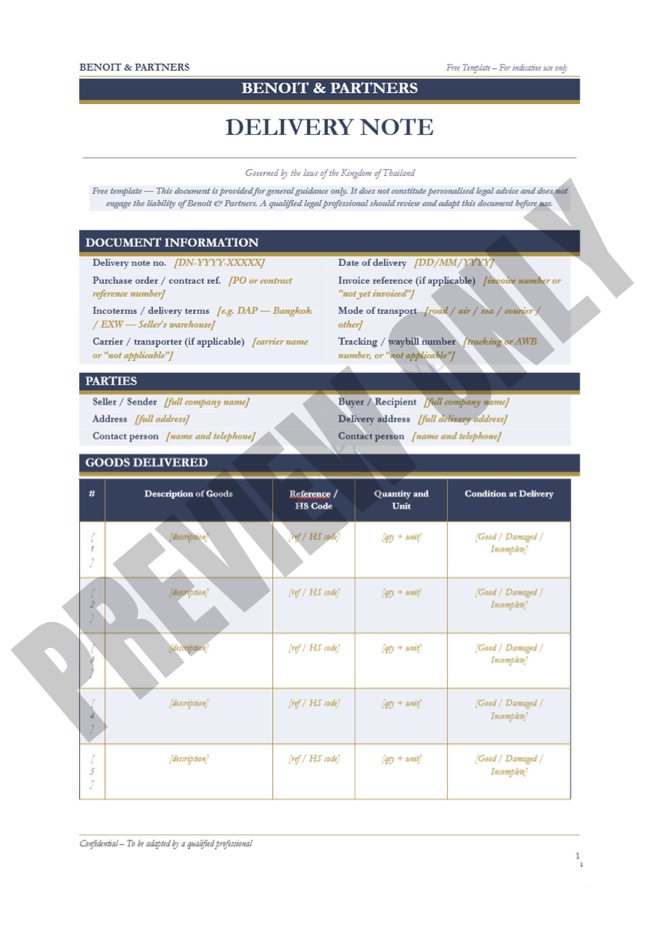
Our Delivery Note in Thailand is drafted and reviewed by experienced lawyers to ensure compliance with Thai law and practical business use. It provides a reliable legal framework for formally documenting the delivery of goods from a supplier to a recipient in Thailand, creating a clear and legally sound record of what was delivered, when, and in what condition.
Designed for businesses and logistics providers seeking to document the transfer of goods to a customer or consignee in Thailand, this template covers key legal aspects such as identification of the parties, a precise description of the goods delivered, the quantity and condition at the time of delivery, the date and place of delivery, and compliance with applicable Thai commercial and consumer law requirements.
However, some situations may require additional clauses or tailored structuring depending on the nature and value of the goods, the terms of the underlying supply contract, applicable customs or import requirements, or the specific inspection and acceptance procedures agreed between the parties. Our legal team can assist clients with customised Delivery Note Thailand adapted to their specific situation within a short timeframe.
Disclaimer: This template is provided for general informational purposes only and does not constitute legal advice. While it has been prepared by legal professionals, it may not reflect your specific situation or regulatory constraints. For complex supply arrangements or high-value goods deliveries, legal advice should be sought to ensure proper documentation and compliance under Thai commercial law.
Need a Contract Tailored to Your Needs? Get a Free Consultation.
When should you use a Delivery Note in Thailand?
A Delivery Note in Thailand is the appropriate document whenever a supplier physically transfers goods to a customer or consignee in Thailand and wishes to create a formal record of that delivery. Common situations include the delivery of manufactured goods under a supply contract, the transfer of equipment or materials to a construction site, the dispatch of retail or wholesale goods to a distributor or end customer, or the handover of imported goods following customs clearance.
Thai commercial law requires that the transfer of ownership of goods and the allocation of risk in transit be addressed clearly in the supply arrangement. A delivery note serves as the documentary record of when and in what condition the goods reached the recipient information that is directly relevant to determining when ownership and risk passed under the terms of the supply contract.
A properly completed Delivery Note Thailand carries clear practical advantages for both parties. The supplier has documented confirmation that the goods were delivered in the agreed quantity and condition, protecting them against unsubstantiated claims of short delivery or damage in transit.
More complex delivery arrangements may require additional documentation alongside the delivery note, such as a packing list, a certificate of conformity, a customs declaration, or a formal acceptance certificate. Our legal team is available to assist with tailored delivery documentation that reflects the specific requirements of the supply arrangement.
Without a properly completed delivery note, disputes about the quantity, quality, or timing of delivery are significantly harder to resolve, and both parties are exposed to the risk of commercially damaging disagreements that a clear documentary record would have prevented.

1. Identification of the Parties
The delivery note should clearly identify the supplier and the recipient by their full legal names and addresses, together with any relevant customer or account reference numbers that link the delivery to the underlying commercial relationship.
2. Description of the Goods
Each item delivered should be described with sufficient specificity to allow it to be identified and matched against the purchase order or supply contract.
3. Quantity Delivered
The quantity of each item delivered should be stated precisely, and should be checked by the recipient against the quantities specified in the purchase order.
4. Condition at Delivery
The delivery note should include a section for the recipient to record the condition of the goods at the time of receipt. Any visible damage, defects, or discrepancies from the agreed specification should be noted before the recipient signs the document.
5. Date and Place of Delivery
The date and location at which the goods were delivered should be stated precisely, as these details are relevant to the passage of risk under the supply contract and to any claim for delay or non-delivery.
6. Purchase Order or Contract Reference
The delivery note should reference the purchase order number, contract reference, or other identifying document to which the delivery relates, allowing both parties to match the delivery against the outstanding order and process payment accordingly.
Key Clauses and Essential Elements in a Delivery Note
A well-prepared Delivery Note in Thailand gives both the supplier and the recipient a precise and complete record of the delivery transaction.
It identifies the goods delivered, confirms the quantity and condition at the point of handover, and creates an unambiguous reference point for subsequent payment, inspection, and dispute resolution purposes.
Under Thai commercial law, the delivery note forms part of the documentary chain that evidences the performance of the supplier’s obligations under the supply contract.
A properly completed note that is countersigned by the recipient on delivery is a valuable piece of evidence if any aspect of the delivery is subsequently disputed.
This document is relevant across all sectors and categories of goods delivery from consumer retail to industrial manufacturing and construction and is applicable whether the Delivery Note Thailand is domestic or cross-border, whether the goods are new or used, and whether they are being sold, loaned, or transferred on any other basis.
Why customise a Delivery Note with a lawyer in Thailand?
A standard Delivery Note template in Thailand is adequate for straightforward domestic goods deliveries, but a range of situations call for a more carefully structured document to ensure that the delivery record is legally accurate and commercially protective.
The nature and value of the goods, the terms of the underlying supply contract, and the regulatory context of the delivery all influence what the document needs to contain. A delivery note accompanying high-value equipment, controlled substances, imported goods subject to customs requirements, or goods delivered under a complex contractual acceptance procedure requires a level of precision that a generic template cannot provide.
The Delivery Note Thailand note may also need to consider: the interaction between the delivery note and the formal acceptance procedure under the supply contract; the allocation of risk in transit and the point at which risk passes to the recipient; customs documentation requirements for imported goods; the interaction between the delivery record and the supplier’s tax invoice and VAT obligations; or the treatment of partial deliveries and the documentation of outstanding quantities.
Our legal team works with businesses to prepare delivery documentation that is accurate, legally sound, and consistent with the terms of the underlying supply arrangement. The result is a document that protects both parties and provides a reliable foundation for payment and dispute resolution.
Delivery Note Thailand
Instant Download
Easy to Customize
Ready to Sign
Crafted by Lawyers
FAQ
What is a Delivery Note?
A formal commercial document issued by a supplier that records the delivery of goods to a customer or consignee, specifying the items delivered, the quantities, the condition at delivery, and the date and place of handover, and which is countersigned by the recipient as confirmation of receipt.
Is a Delivery Note legally required in Thailand?
There is no universal statutory requirement to issue a delivery note for every goods delivery, but a delivery note is strongly advisable as a matter of good commercial practice
What is the difference between a Delivery Note and a Tax Invoice in Thailand?
A delivery note records the physical transfer of goods and is signed by the recipient at the point of delivery. A tax invoice is issued by a VAT-registered supplier to document a taxable supply and forms the basis of the recipient’s VAT input credit claim.
What should a recipient do if the goods delivered do not match the Delivery Note in Thailand?
The recipient should note any discrepancy in quantity, specification, or condition on the delivery note before signing it, and should promptly notify the supplier in writing. Signing a delivery note without recording a discrepancy may make it harder to dispute the delivery subsequently.
Can a Delivery Note be used as evidence in a dispute in Thailand?
Yes. A properly completed and countersigned delivery note is a contemporaneous document that carries significant evidential weight in a commercial dispute about the quantity, quality, or timing of a delivery. Courts and arbitral tribunals in Thailand will treat a signed delivery note as strong evidence of what was delivered and when.
How should damaged goods be recorded on a Delivery Note in Thailand?
Any visible damage to the goods at the time of delivery should be described specifically on the delivery note before the recipient signs it. A general endorsement such as “received subject to inspection” provides less protection than a specific description of the damage observed.
Does a Delivery Note need to be signed in Thailand?
While there is no absolute legal requirement for the recipient to sign the delivery note, a countersigned note is significantly more valuable as evidence. Suppliers should ensure that deliveries are acknowledged in writing by an authorised representative of the recipient at the time of handover.
How does the PDPA apply to a Delivery Note in Thailand?
Where the delivery note contains personal data such as the name and address of an individual recipient that data must be handled in accordance with the Personal Data Protection Act B.E. 2562 (2019), stored securely, and used only for the purpose of documenting and managing the delivery transaction.