
Employment Offer Letter Thailand
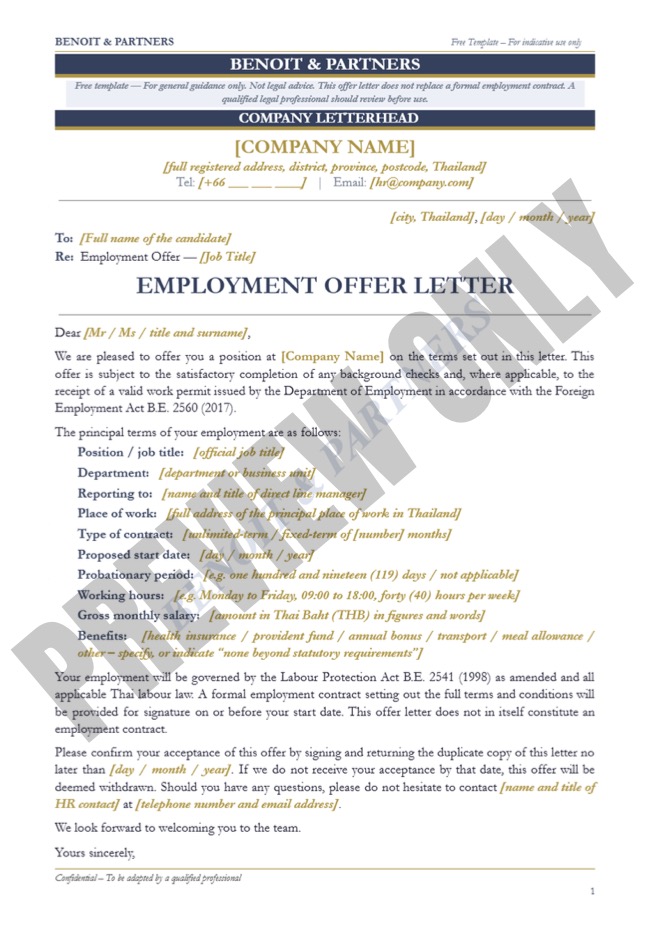
Our Employment Offer Letter template for Thailand is drafted and reviewed by experienced lawyers to ensure compliance with Thai law and practical business use. It provides a reliable legal framework for formally extending an offer of employment to a candidate in Thailand, prior to the execution of a full employment contract.
Designed for employers, HR departments, and companies recruiting staff in Thailand, this template covers key legal aspects such as identification of the parties, position offered, proposed remuneration and benefits, start date, conditions precedent to employment, and compliance with the Labour Protection Act and other applicable Thai employment regulations.
However, some situations may require additional clauses or tailored structuring depending on the seniority of the position, the nationality of the candidate, the nature of the employment, visa and work permit requirements, or the specific terms of the remuneration package. Our legal team can assist clients with customised Employment Offer Letters adapted to their specific situation within a short timeframe.
Disclaimer: This template is provided for general informational purposes only and does not constitute legal advice. While it has been prepared by legal professionals, it may not reflect your specific situation or regulatory constraints. For complex or senior-level appointments, legal advice should be sought to ensure proper structuring and compliance under Thai employment law.
Need a Contract Tailored to Your Needs? Get a Free Consultation.
When should you use an Employment Offer Letter in Thailand?
An Employment Offer Letter is used whenever an employer wishes to formally extend an offer of employment to a selected candidate before a full employment contract is executed. This situation commonly arises following the completion of a recruitment process, whether for local Thai employees or foreign nationals requiring a work permit, and serves as the first formal step in establishing the employment relationship.
Under Thai law, employment relationships are primarily governed by the Labour Protection Act B.E. 2541 (1998) and its amendments, which regulate minimum employment standards including working hours, rest periods, leave entitlements, termination procedures, and severance pay obligations. While an Employment Offer Letter is not itself a full employment contract, it may be legally binding in respect of the terms it contains and should therefore be drafted with care to avoid unintended commitments.
This document becomes particularly important when the candidate needs to resign from a current position, relocate, or make other significant personal arrangements in reliance on the offer, as it provides formal written confirmation of the key terms of the proposed employment. It allows the employer to clearly set out the position, reporting line, remuneration, benefits, start date, and any conditions that must be satisfied before employment commences, such as satisfactory background checks or the obtaining of a work permit.
In more complex situations, additional provisions may be required regarding relocation assistance, sign-on bonuses, probationary period terms, confidentiality and non-solicitation obligations, visa and work permit sponsorship, or the treatment of the offer letter in relation to the subsequent employment contract. Our legal team assists clients with the preparation of customised Employment Offer Letters tailored to their specific recruitment situation and compliance requirements under Thai employment law.
In practice, this document is also crucial when recruiting foreign nationals, as it is often required as supporting documentation for work permit and visa applications in Thailand, and must therefore accurately reflect the proposed terms of employment.
Without a properly drafted Employment Offer Letter, employers risk creating unintended contractual commitments, failing to satisfy work permit documentation requirements, and exposing themselves to disputes with candidates over the terms of the proposed employment.

1. Identification of the Parties
The letter must clearly identify the employer and the candidate, including the employer's full legal name and registered address, and the candidate's full name and contact details, as well as the name and title of the authorised representative signing on behalf of the employer.
2. Position and Reporting Line
The letter must specify the position being offered, the department or business unit in which the candidate will work, the location of employment, and the reporting line, including the title of the direct supervisor or manager to whom the candidate will report.
3. Remuneration and Benefits
The letter must set out the proposed base salary, the frequency of payment, any variable or performance-based components, and a summary of the key benefits offered, such as health insurance, provident fund contributions, annual leave entitlement, and any other material components of the remuneration package.
4. Start Date and Probationary Period
The letter must confirm the proposed start date of employment and the duration of any probationary period, during which either party may terminate the employment on shorter notice, in accordance with the Labour Protection Act and the terms of the subsequent employment contract
5. Conditions Precedent to Employment
The letter must specify any conditions that must be satisfied before the offer becomes unconditional, such as satisfactory completion of background checks, medical examination, reference verification, or the obtaining of a valid work permit and non-immigrant visa for foreign national candidates.
6. Work Permit and Visa Sponsorship
Where the candidate is a foreign national, the letter must address the employer's commitment to sponsor the work permit and visa application, the timeline for obtaining the necessary authorisations, and the consequences if the work permit application is unsuccessful.
Key Clauses and Essential Elements in an Employment Offer Letter
An Employment Offer Letter is a key document formally setting out the proposed terms of employment in Thailand. It defines the key elements of the employment relationship and provides the candidate with clear and legally compliant information about the proposed position in accordance with Thai employment law.
Under the Labour Protection Act, employers must comply with minimum employment standards regardless of what is stated in the offer letter or employment contract. A properly drafted Employment Offer Letter helps ensure compliance with these requirements and reduces the risk of future disputes over the agreed terms of employment.
This type of document is commonly used for all categories of employment in Thailand, including executive and senior management appointments, technical and professional roles, and positions requiring work permit sponsorship for foreign nationals.
While standard situations may rely on a general template, more complex appointments often require additional provisions depending on the seniority of the role and the specific terms of the package.
Why customise an Employment Offer Letter with a lawyer in Thailand?
While a standard Employment Offer Letter template for Thailand may be sufficient for straightforward local hiring situations, many employment offers involve legal, regulatory, and commercial considerations requiring more careful drafting and tailored protections.
In practice, each recruitment situation has its own structure and level of risk. Senior executive appointments, foreign national hiring, complex remuneration packages, work permit sponsorship obligations, or situations where the offer letter may itself constitute a binding contract all require provisions that are not included in a standard template.
Depending on the situation, specific clauses may be added relating to sign-on bonus structures and clawback provisions, relocation assistance, non-competition and non-solicitation undertakings, probationary period terms, work permit and visa sponsorship commitments, the relationship between the offer letter and the subsequent employment contract, PDPA compliance in respect of personal data collected during recruitment, or compliance with applicable work permit quota requirements.
Tailoring an Employment Offer Letter also allows the employer to clearly communicate the proposed terms, manage candidate expectations, and ensure that the document accurately reflects the agreed package while remaining compliant with Thai employment law. This is particularly important for senior hires, foreign national appointments, or roles with complex remuneration structures.
Our legal team assists employers, HR departments, and companies with the preparation and review of customised Employment Offer Letters for Thailand adapted to their specific recruitment situation and workforce management objectives. In many cases, tailored letters can be prepared within a short timeframe while ensuring full compliance with Thai labour, immigration, and data protection law.
A properly drafted Employment Offer Letter not only provides clarity and certainty for both the employer and the candidate, but also reduces the risk of future employment disputes, work permit complications, and unexpected legal liabilities arising from the recruitment process.
Employment Offer Letter Thailand
Instant Download
Easy to Customize
Ready to Sign
Crafted by Lawyers
FAQ
What is an Employment Offer Letter in Thailand?
A formal written document by which an employer extends an offer of employment to a selected candidate, setting out the key proposed terms of the employment relationship. While not a full employment contract, it may be legally binding in respect of the terms it contains and should be drafted with care under Thai employment law.
Is an Employment Offer Letter legally binding in Thailand?
Yes, to the extent that it contains clear and specific commitments accepted by the candidate. Employers should ensure that the letter accurately reflects the intended terms and includes appropriate conditions precedent to avoid unintended binding obligations before all requirements are satisfied.
Is an Employment Offer Letter required for a work permit application in Thailand?
Yes. For foreign national employees, an Employment Offer Letter is typically required as supporting documentation for the work permit and non-immigrant visa application. It must accurately reflect the proposed position, salary, and employer details to satisfy the requirements of the Department of Employment.
What is the probationary period under Thai employment law?
Thai law does not prescribe a mandatory probationary period, but employers commonly include a probationary period of up to 119 days, during which the employee may be terminated without severance pay obligations under the Labour Protection Act. The terms of the probationary period should be clearly set out in both the offer letter and the employment contract.
Can an employer withdraw an Employment Offer Letter in Thailand?
Yes, prior to acceptance by the candidate. Once accepted, withdrawal may give rise to a claim for damages if the candidate has suffered loss in reliance on the offer. Clear expiry provisions and conditions precedent help manage this risk.
What minimum employment standards must an Employment Offer Letter comply with in Thailand?
The letter must comply with the minimum standards set out in the Labour Protection Act, including minimum wage requirements, maximum working hours, statutory leave entitlements, and applicable social security contribution obligations. Any terms less favourable than the statutory minimums are unenforceable.
Does an Employment Offer Letter replace an Employment Contract in Thailand?
No. An Employment Offer Letter sets out the key proposed terms of employment and is typically followed by a full employment contract setting out the detailed rights and obligations of both parties. Both documents should be consistent with each other and with the requirements of Thai employment law.
How does the PDPA apply to an Employment Offer Letter in Thailand?
Personal data collected during the recruitment process and referenced in the offer letter must be handled in accordance with the Personal Data Protection Act B.E. 2562 (2019). Employers should ensure that appropriate consent or another lawful basis exists for processing the candidate’s personal data and that it is used only for the purposes of the recruitment and onboarding process.