
Franchise Agreement in Thailand
Our Franchise Agreement in Thailand is drafted and reviewed by experienced lawyers to ensure compliance with Thai law and practical business use. It provides a reliable legal framework for formally establishing the rights and obligations of a franchisor and franchisee in connection with the operation of a franchised business in Thailand.
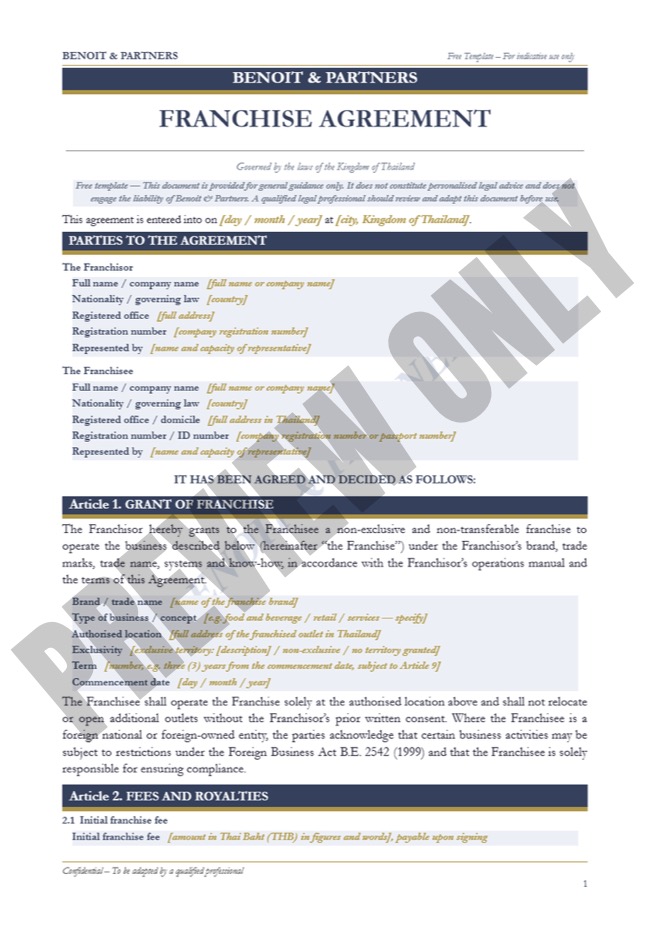
Designed for franchisors and franchisees seeking to document their relationship on a legally sound and comprehensive basis in Thailand, this template covers key legal aspects such as identification of the parties, grant of franchise rights and territorial scope, intellectual property licence, operational standards and training obligations, fees and royalties, term and renewal provisions, and compliance with applicable Thai commercial and intellectual property law.
However, some situations may require additional clauses or tailored structuring depending on the nature of the franchised business, the territorial scope of the arrangement, the level of investment involved, or the specific operational and brand standards the franchisor requires. Our legal team can assist clients with customised Franchise Agreements adapted to their specific situation within a short timeframe.
Disclaimer: This template is provided for general informational purposes only and does not constitute legal advice. While it has been prepared by legal professionals, it may not reflect your specific situation or regulatory constraints. For complex franchise arrangements or cross-border transactions, legal advice should be sought to ensure proper structuring and compliance under Thai law.
Need a Contract Tailored to Your Needs? Get a Free Consultation.
When should you use a Franchise Agreement in Thailand?
A Franchise Agreement in Thailand is the appropriate instrument when a franchisor wishes to grant a franchisee the right to operate a business under its brand, systems, and intellectual property in Thailand in exchange for fees and compliance with defined operational standards.
Thailand does not currently have dedicated franchise legislation, meaning that franchise relationships are governed primarily by the Civil and Commercial Code, the Trade Secrets Act B.E. 2545 (2002), and the Trademark Act B.E. 2534 (1991).
A well-drafted Franchise Agreement protects the franchisor’s brand and systems while giving the franchisee a clear understanding of their rights, obligations, and investment requirements.
More complex arrangements may require additional provisions covering sub-franchising rights, area development obligations, technology platform access, supply chain requirements, or the treatment of existing operations in the event of termination. Our legal team is available to assist with tailored agreements that address these dimensions comprehensively.
Without a properly drafted Franchise Agreement, both franchisor and franchisee risk significant exposure arising from unclear expectations, inadequate intellectual property protection, and disputes about the scope of the rights granted and the obligations assumed.

1. Grant of Franchise Rights
The agreement should clearly define the scope of the rights granted to the franchisee, including the specific business format, brand, and systems covered, the territory within which those rights may be exercised, and whether the grant is exclusive, non-exclusive, or semi-exclusive.
2. Intellectual Property Licence
A comprehensive licence of the franchisor's trademarks, trade names, know-how, and operating systems should be included, together with provisions governing the franchisee's permitted use, quality control obligations, and the consequences of any misuse or unauthorised exploitation of the licensed IP.
3. Fees and Royalties
The financial structure of the arrangement should be set out in full, including the initial franchise fee, ongoing royalties calculated on the basis of gross sales or a fixed periodic amount, marketing fund contributions, and any other charges payable by the franchisee to the franchisor.
4. Operational Standards and Training
The agreement should specify the operational standards the franchisee must meet, the training and support the franchisor will provide, the ongoing monitoring and audit rights of the franchisor, and the consequences of a failure to maintain the required standards.
5. Term and Renewal
The initial term of the franchise, the conditions and process for renewal, and any changes to the financial or operational terms applicable on renewal should be clearly defined.
6. Termination and Post-Termination Obligations
The grounds on which either party may terminate the agreement and the notice and cure provisions applicable to each — should be set out, together with the franchisee's obligations on termination,
Key Clauses and Essential Elements in a Franchise Agreement
A well-constructed Franchise Agreement in Thailand gives both parties a complete and workable framework for the operation of the franchised business, the protection of the franchisor’s brand, and the management of the relationship over its full duration.
It addresses the commercial, operational, and legal dimensions of the arrangement in a single integrated document that can serve as the primary reference point for both parties throughout the term.
In the absence of dedicated franchise legislation in Thailand, the Franchise Agreement carries the full weight of defining the parties’ relationship. A comprehensive and carefully drafted agreement is therefore the primary legal protection available to both franchisor and franchisee.
This document is relevant across all franchise models and sectors from food and beverage and retail to services, education, and healthcare and applies whether the franchisor is a Thai entity or a foreign brand entering the Thai market through a local franchisee.
Why customise a Franchise Agreement with a lawyer in Thailand?
A standard template of Franchise Agreement in Thailand provides a useful starting point for simple franchise arrangements, but the commercial and legal complexity of most franchise relationships requires a more carefully constructed document before the parties commit to the arrangement.
The specific nature of the franchised business, the territorial scope of the rights granted, the investment required of the franchisee, and the brand standards the franchisor needs to protect all shape what the agreement must achieve and how it should be structured.
Depending on the situation, the agreement may need to address: the interaction between the franchise rights and any existing distribution or agency arrangements in the territory; the registration of the franchisor’s trademarks in Thailand and the protection of unregistered know-how under the Trade Secrets Act; the foreign business restrictions applicable to foreign franchisors under the Foreign Business Act B.E. 2542 (1999); the withholding tax treatment of royalty payments under Thai revenue law; the structure of a master franchise arrangement and the sub-franchising rights granted thereunder; or the interaction between the franchise agreement and any lease or property arrangement for the franchised premises.
Our legal team works with franchisors and franchisees to prepare agreements that are commercially workable, legally robust, and appropriately tailored to the specific franchise model and Thai market context. The result is a document that protects both parties and provides a solid foundation for a successful long-term business relationship.
Franchise Agreement Thailand
Instant Download
Easy to Customize
Ready to Sign
Crafted by Lawyers
FAQ
What is a Franchise Agreement in Thailand?
A binding written contract through which a franchisor grants a franchisee the right to operate a business under the franchisor’s brand, systems, and intellectual property in a defined territory in Thailand, in exchange for fees and compliance with the franchisor’s operational standards.
Is there specific franchise legislation in Thailand?
Thailand does not currently have a dedicated franchise law. Franchise relationships are governed by general principles of Thai contract law under the Civil and Commercial Code, supplemented by intellectual property legislation and, where applicable, the Foreign Business Act. This makes a comprehensive contractual framework particularly important.
Does a Franchise Agreement need to be registered in Thailand?
The Franchise Agreement itself does not require registration, but the trademark licence it contains should be recorded with the Department of Intellectual Property to be enforceable against third parties. Foreign franchisors should also consider whether their activities in Thailand require compliance with the Foreign Business Act.
Can a foreign franchisor operate in Thailand directly?
The Foreign Business Act B.E. 2542 (1999) restricts the ability of foreign entities to conduct certain business activities in Thailand. Foreign franchisors typically operate through a Thai master franchisee, a joint venture, or a BOI-promoted entity, depending on the nature of the franchised business and the level of control the franchisor wishes to retain.
What are the tax implications of a franchise arrangement in Thailand?
Royalty payments made by a Thai franchisee to a foreign franchisor are subject to withholding tax under Thai revenue law. The applicable rate may be reduced under a double tax treaty between Thailand and the franchisor’s home country. The
What happens if a franchisee breaches the Franchise Agreement in Thailand?
The consequences of breach depend on the terms of the agreement. Minor breaches typically trigger a cure period during which the franchisee must remedy the non-compliance. Material breaches.
Can a franchisee sell or transfer their franchise in Thailand?
Transfer of a franchise is typically subject to the franchisor’s prior written consent and compliance with a defined transfer process. The agreement should specify the conditions for transfer approval, any transfer fee payable, and the franchisor’s right of first refusal in the event of a proposed sale.
How does the PDPA apply to a Franchise Agreement in Thailand?
Franchise operations typically involve the collection and processing of customer and employee personal data. Both the franchisor and franchisee must comply with the Personal Data Protection Act B.E. 2562 (2019), and the Franchise Agreement should address each party’s responsibilities as data controller or data processor in connection with the franchised business.