
Cryptocurrency Fraud Complaint Letter Template for Thailand
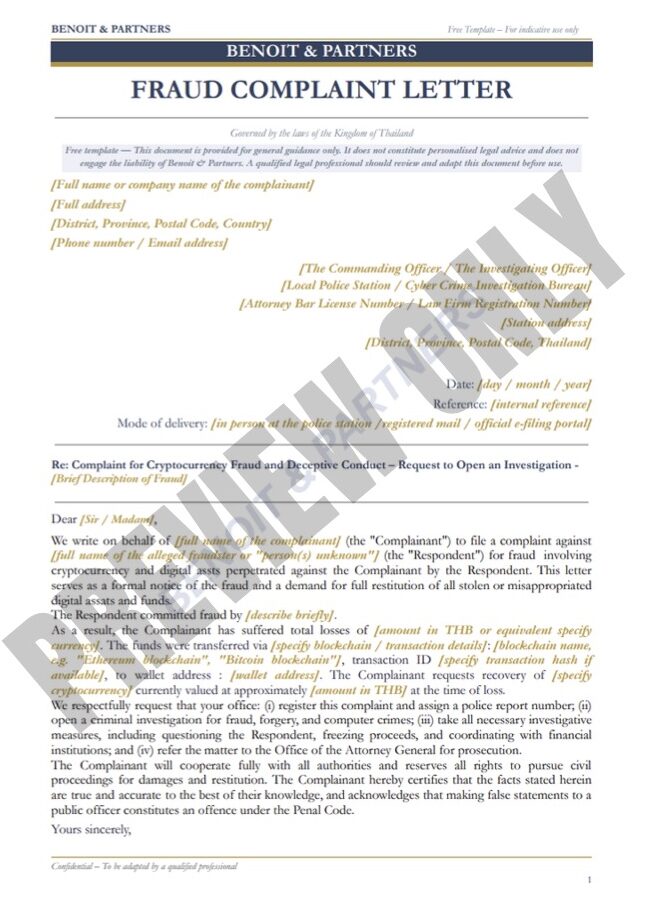
Our Cryptocurrency Fraud Complaint Letter template for Thailand is drafted and reviewed by experienced lawyers to assist individuals and businesses in reporting cryptocurrency scams, fraudulent investment schemes, fake trading platforms, and digital asset misconduct to the relevant Thai authorities.
Designed for investors, expatriates, companies, and victims of crypto-related fraud in Thailand, this template covers key legal aspects such as identification of the parties, description of the fraudulent conduct, wallet addresses, transaction history, supporting evidence, financial losses, and formal requests for investigation.
For matters involving international crypto exchanges, large financial losses, blockchain tracing, cybercrime investigations, or cross-border digital asset disputes, our legal team can prepare a customised Cryptocurrency Fraud Complaint Letter adapted to your situation within a short timeframe.
Disclaimer: This template is provided for general informational purposes only and does not constitute legal advice. While it has been prepared by legal professionals, it may not reflect your specific legal or factual circumstances. For serious financial losses, international fraud, or criminal investigations involving digital assets, legal advice should be sought to ensure proper protection and compliance under Thai law.
Need a Contract Tailored to Your Needs ? Get a Free Consultation.
When should you use a Cryptocurrency Fraud Complaint Letter in Thailand?
A Cryptocurrency Fraud Complaint Letter is used when an individual or company wishes to formally report fraudulent conduct involving cryptocurrencies, digital assets, blockchain transactions, or online investment schemes.
This document is commonly used in cases involving fake crypto investments, fraudulent exchanges, phishing scams, Ponzi schemes, wallet theft, impersonation fraud, or unauthorised digital asset transfers causing financial losses.
Under Thai law, cryptocurrency fraud may fall under the Thai Penal Code, the Computer Crime Act, and digital asset regulations supervised by the Securities and Exchange Commission of Thailand (SEC).
Without a properly drafted Cryptocurrency Fraud Complaint Letter in Thailand, authorities may lack sufficient technical details or evidence to properly assess and investigate the fraud.

1. Identification of the complainant and suspected fraudster
A Cryptocurrency Fraud Complaint Letter must clearly identify the complainant and the suspected fraudster or entity involved. This includes legal names, wallet addresses, exchange accounts, contact details, company information, and any known digital identifiers connected to the fraud.
2. Description of the cryptocurrency fraud
A Cryptocurrency Fraud Complaint Letter should clearly describe the fraudulent conduct and the digital asset transactions involved. This may include fake investment platforms, fraudulent token sales, phishing attacks, fake exchanges, wallet theft, or deceptive online trading schemes.
3. Cryptocurrency transactions and financial losses
A Cryptocurrency Fraud Complaint Letter should specify the cryptocurrencies involved, transaction amounts, wallet addresses, blockchain transaction hashes, dates of transfers, and the financial losses suffered by the complainant.
4. Supporting blockchain evidence and documentation
A Cryptocurrency Fraud Complaint Letter should include supporting evidence relevant to the allegations. This may include screenshots, blockchain transaction records, exchange statements, wallet activity, emails, chat messages, contracts, or online communications linked to the fraud.
5. Request for investigation and asset tracing
A Cryptocurrency Fraud Complaint Letter should formally request that the competent Thai authorities investigate the matter and take appropriate legal action. This may include cybercrime investigations, digital asset tracing, freezing requests, or coordination with cryptocurrency exchanges.
6. Cooperation with authorities and confidentiality
A Cryptocurrency Fraud Complaint Letter may confirm the complainant’s willingness to cooperate with investigators and provide additional technical information if required. It may also include confidentiality requests relating to financial or blockchain data.
Key clauses and additional protections in a Cryptocurrency Fraud Complaint Letter
A Cryptocurrency Fraud Complaint Letter is a key legal document used to formally report fraudulent conduct involving cryptocurrencies, digital assets, or online investment schemes to the competent authorities in Thailand. It helps present the facts of the case, identify the digital transactions involved, and support requests for investigation or asset tracing.
Under the Emergency Decree on Digital Asset Businesses B.E. 2561 (2018) and the Thai Computer Crime Act, cryptocurrency-related misconduct may be subject to criminal investigation and regulatory enforcement in Thailand. A properly drafted Cryptocurrency Fraud Complaint Letter helps authorities assess blockchain evidence, identify relevant transactions, and initiate investigative procedures.
This type of document is commonly used in cases involving fake crypto investments, online trading scams, wallet theft, fraudulent exchanges, or unauthorised digital asset transfers. While straightforward situations may rely on a standard template, more serious or international crypto fraud matters often require additional legal analysis and customised drafting depending on the blockchain evidence, cross-border transactions, or financial losses involved.
A properly customised Cryptocurrency Fraud Complaint Letter helps strengthen the complaint and better protect the interests of the complainant under Thai law.
Why customise a Cryptocurrency Fraud Complaint Letter with a lawyer in Thailand?
While a standard Cryptocurrency Fraud Complaint Letter template may be sufficient for straightforward situations, many digital asset fraud cases involve technical, financial, and international considerations that require more advanced drafting and tailored legal protections.
In practice, each cryptocurrency fraud matter presents its own legal and evidentiary complexities. International blockchain transactions, decentralised platforms, anonymous wallet structures, cross-border exchanges, or cybercrime investigations may require information and supporting arguments that a standard template does not address. Specific details may need to be included regarding wallet tracing, blockchain analysis, exchange records, digital evidence preservation, or cooperation with financial institutions and cybercrime authorities.
Tailoring a Cryptocurrency Fraud Complaint Letter also allows the complainant to better organise technical evidence, clarify the legal basis of the complaint, and anticipate procedural issues linked to international crypto transactions, large financial losses, or parallel civil proceedings, particularly important where foreign exchanges, offshore entities, or anonymous blockchain transactions are involved.
Our legal team assists investors, expatriates, companies, and victims of digital asset fraud with the preparation of customised Cryptocurrency Fraud Complaint Letters adapted to their situation, within a short timeframe and in full compliance with Thai criminal, cybercrime, and digital asset regulations.
Cryptocurrency Fraud Complaint Letter
Instant Download
Easy to Customize
Ready to Sign
Crafted by Lawyers
FAQ
What is a Cryptocurrency Fraud Complaint Letter?
A Cryptocurrency Fraud Complaint Letter is a formal document used to report crypto-related scams or digital asset fraud to Thai authorities.
Can cryptocurrency fraud be prosecuted in Thailand?
Yes. Cryptocurrency fraud may lead to criminal investigations under Thai cybercrime, fraud, and digital asset regulations.
What types of crypto fraud can be reported?
Cases may involve fake investment platforms, wallet theft, phishing scams, Ponzi schemes, fake token sales, or fraudulent exchanges.
Is blockchain evidence important in a crypto fraud complaint?
Yes. Blockchain transaction records, wallet addresses, and exchange statements are often critical evidence in crypto investigations.
Can foreign victims file a crypto fraud complaint in Thailand?
Yes. Foreign investors and expatriates may file complaints if the fraud occurred in Thailand or caused losses connected to Thailand.
Can Thai authorities trace cryptocurrency transactions?
In some situations, Thai authorities may cooperate with cybercrime specialists and exchanges to trace blockchain transactions and identify suspects.
Is legal assistance recommended for cryptocurrency fraud cases?
Yes. Legal assistance is strongly recommended due to the technical and international nature of cryptocurrency investigations.
Can victims also pursue civil claims for damages?
Yes. Victims of cryptocurrency fraud may pursue separate civil proceedings to recover financial losses in addition to criminal complaints.