
Fraud Complaint Letter Template for Thailand
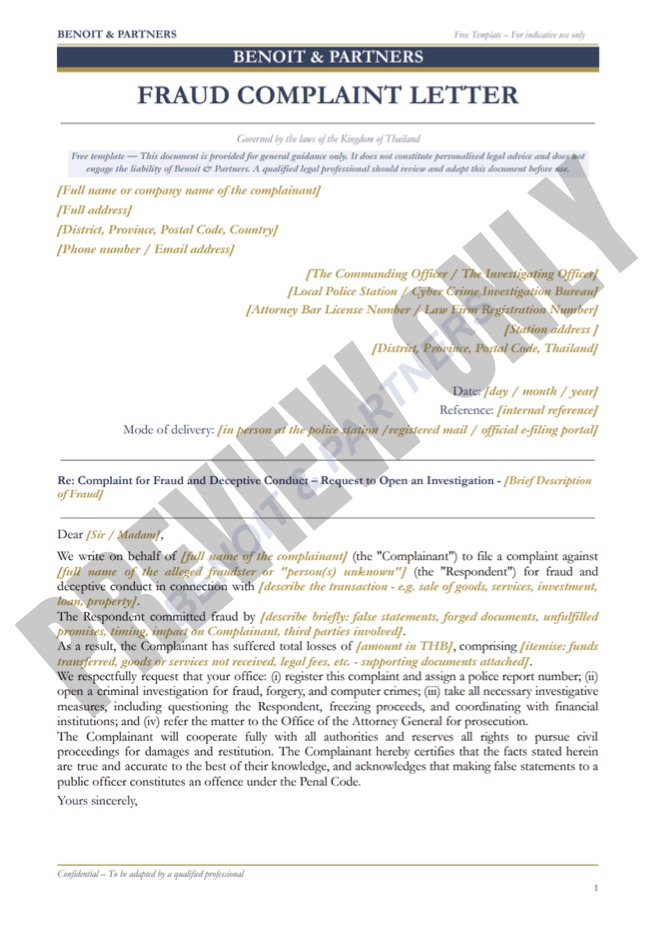
Our Fraud Complaint Letter template for Thailand is drafted and reviewed by experienced lawyers to assist individuals and businesses in reporting fraud, deceptive conduct, financial scams, or criminal misconduct to the relevant Thai authorities.
Designed for victims of fraud, investors, companies, expatriates, and foreign residents in Thailand, this template covers key legal aspects such as identification of the parties, description of the fraudulent conduct, supporting evidence, financial losses, and formal requests for investigation by the police or competent authorities.
For matters involving large financial losses, international fraud, cryptocurrency scams, forged documents, cybercrime, or complex commercial disputes, our legal team can prepare a customised Fraud Complaint Letter adapted to your situation within a short timeframe.
Disclaimer: This template is provided for general informational purposes only and does not constitute legal advice. While it has been prepared by legal professionals, it may not reflect your specific legal or factual circumstances. For criminal matters, high-value fraud cases, or cross-border investigations, legal advice should be sought to ensure proper protection and compliance under Thai law.
Need a Contract Tailored to Your Needs ? Get a Free Consultation.
When should you use a Fraud Complaint Letter in Thailand ?
A Fraud Complaint Letter is used when an individual or company wishes to formally report fraudulent conduct, deceptive practices, or financial misconduct to Thai authorities or relevant institutions.
This document is commonly used in cases involving investment fraud, online scams, forged documents, breach of trust, fake business transactions, cybercrime, or dishonest commercial conduct causing financial losses.
Under Thai law, fraud offences may fall under the Thai Penal Code, the Computer Crime Act, or other financial and commercial regulations depending on the nature of the misconduct.
Without a properly drafted Fraud Complaint Letter in Thailand, authorities may lack sufficient information or supporting evidence to effectively assess and investigate the matter.

1. Identification of the complainant and respondent
A Fraud Complaint Letter must clearly identify the complainant and the alleged fraudster or respondent. This includes full legal names, addresses, contact information, company details, and any known identification or registration information relevant to the complaint.
2. Description of the fraudulent conduct
A Fraud Complaint Letter should clearly describe the fraudulent acts, deceptive representations, or dishonest conduct giving rise to the complaint. This may include false statements, fake investments, forged documents, online scams, or misappropriation of funds.
3. Financial losses and damages suffered
A Fraud Complaint Letter should specify the financial losses or damages suffered by the complainant. This may include transferred funds, unpaid goods or services, investment losses, contractual damages, or reputational harm caused by the fraudulent conduct.
4. Supporting evidence and documentation
A Fraud Complaint Letter should include supporting evidence relevant to the allegations. This may include contracts, invoices, bank transfer records, screenshots, emails, chat messages, witness statements, or identity documents linked to the fraud.
5. Request for investigation and legal action
A Fraud Complaint Letter should formally request that the competent Thai authorities investigate the matter and take appropriate legal action. This may include criminal investigation, asset tracing, freezing measures, or referral for prosecution.
6. Confidentiality and cooperation with authorities
A Fraud Complaint Letter may confirm the complainant’s willingness to cooperate with the authorities and provide additional evidence if required. It may also include confidentiality requests where sensitive business or financial information is involved.
Key clauses and additional protections in a Fraud Complaint Letter
A Fraud Complaint Letter is a key legal document used to formally report fraudulent conduct, deceptive practices, or financial misconduct to the competent authorities in Thailand. It sets out the factual background of the complaint, identifies the parties involved, and supports the request for investigation or legal action.
Under Thai law, fraud-related offences may fall under the Thai Penal Code, the Computer Crime Act, or financial regulations depending on the nature of the misconduct. A properly drafted Fraud Complaint Letter helps authorities understand the facts of the case, assess the available evidence, and initiate appropriate investigative procedures.
This type of document is commonly used in cases involving online fraud, investment scams, forged documents, commercial deception, cybercrime, or dishonest business practices. While some situations may rely on a standard template, more serious or complex matters often require additional legal analysis and customised drafting depending on the financial losses, international elements, or criminal risks involved.
A properly customised Fraud Complaint Letter helps strengthen the complaint and better protect the interests of the complainant under Thai law.
Why customise a Fraud Complaint Letter with a lawyer in Thailand?
While a standard Fraud Complaint Letter template may be sufficient for straightforward situations, many fraud cases involve legal, financial, and evidentiary issues that require more advanced drafting and tailored legal protections.
In practice, each fraud matter presents its own factual and procedural complexities. International transactions, cryptocurrency fraud, forged corporate documents, cybercrime investigations, or cross-border financial transfers may require provisions and supporting arguments that a standard template does not address. Specific details may need to be included regarding financial tracing, documentary evidence, criminal intent, contractual relationships, or coordination with police authorities and financial institutions.
Tailoring a Fraud Complaint Letter also allows the complainant to better organise the evidence, clarify the legal basis of the complaint, and anticipate procedural issues linked to international fraud, substantial financial losses, or parallel civil proceedings, particularly important where foreign parties, online platforms, or international assets are involved.
Our legal team assists individuals, investors, expatriates, and companies with the preparation of customised Fraud Complaint Letters adapted to their situation, within a short timeframe and in full compliance with Thai criminal and commercial law.
Fraud Complain Letter Template
Instant Download
Easy to Customize
Ready to Sign
Crafted by Lawyers
FAQ
What is a Fraud Complaint Letter in Thailand?
A Fraud Complaint Letter is a formal document used to report fraudulent conduct or financial deception to Thai authorities or relevant institutions.
Can foreigners file a fraud complaint in Thailand?
Yes. Foreign individuals and companies may file fraud complaints with Thai authorities if the fraudulent conduct occurred in Thailand or caused damage within Thailand.
What types of fraud can be reported?
Fraud complaints may involve investment scams, online fraud, forged documents, fake business transactions, cybercrime, or deceptive commercial conduct.
Is supporting evidence required for a fraud complaint?
Yes. Supporting evidence such as contracts, bank records, emails, screenshots, or payment confirmations is highly important for the investigation.
Can a Fraud Complaint Letter lead to criminal prosecution?
Yes. If sufficient evidence exists, Thai authorities may open a criminal investigation and pursue prosecution under applicable laws.
Can a victim also file a civil claim for damages?
Yes. Victims of fraud may pursue separate civil proceedings to recover financial losses or damages in addition to criminal complaints.
Is legal assistance recommended for fraud cases in Thailand?
Yes. Legal assistance is strongly recommended, particularly for large financial losses, international fraud, or complex evidentiary matters.
Can fraud complaints involve cryptocurrency or online scams?
Yes. Thai authorities increasingly handle cases involving cryptocurrency fraud, online investment scams, and cybercrime activities.