
Freelance Contract in Thailand
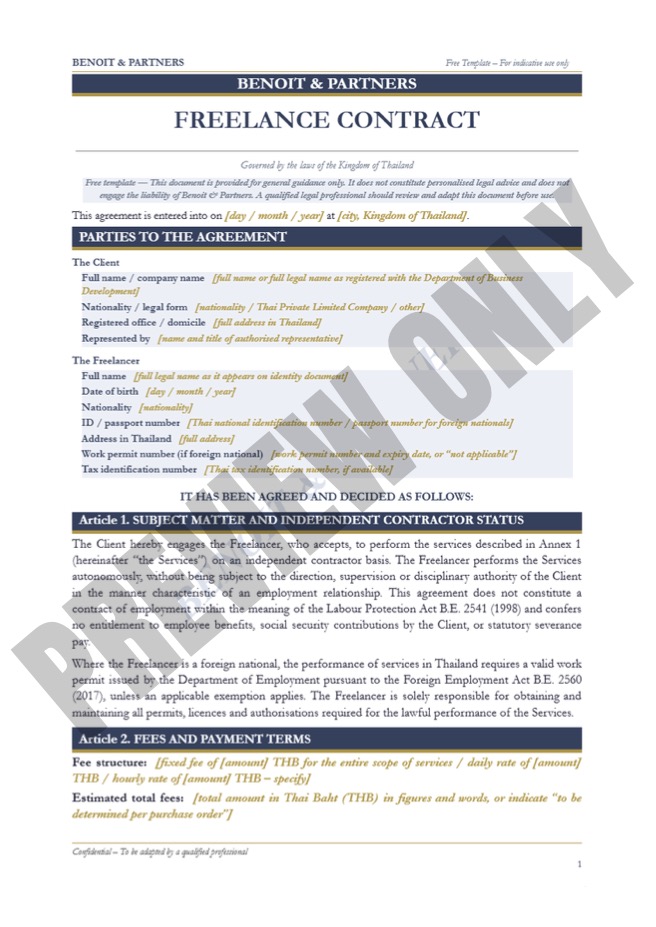
Our Freelance Contract in Thailand is drafted and reviewed by experienced lawyers to ensure compliance with Thai law and practical business use. It provides a reliable legal framework for formally documenting the engagement of a freelancer or independent contractor to provide services to a client in Thailand.
Designed for businesses and individuals seeking to engage freelance talent on a legally sound and clearly defined basis in Thailand, this template covers key legal aspects such as identification of the parties, scope of services and deliverables, fees and payment terms, intellectual property ownership, confidentiality obligations, independent contractor status, and compliance with applicable Thai civil, commercial, and labour law requirements.
However, some situations may require additional clauses or tailored structuring depending on the nature of the services, the duration and exclusivity of the engagement, the sensitivity of the information involved, or the specific deliverables and performance standards required. Our legal team can assist clients with customised Freelance Contract Thailand adapted to their specific situation within a short timeframe.
Disclaimer: This template is provided for general informational purposes only and does not constitute legal advice. While it has been prepared by legal professionals, it may not reflect your specific situation or regulatory constraints. For engagements that raise questions about employment status or involve significant intellectual property or confidentiality considerations, legal advice should be sought to ensure proper structuring and compliance under Thai law.
Need a Contract Tailored to Your Needs? Get a Free Consultation.
When should you use a Freelance Contract in Thailand?
A Freelance Contract in Thailand is the appropriate instrument whenever a business or individual engages an independent service provider to deliver defined services or outputs on a project or ongoing basis in Thailand, outside the framework of an employment relationship. Common engagements include creative and design services, software development and IT consultancy, marketing and content production, translation and language services, financial and business consultancy, and a wide range of other specialist professional services.
The distinction between a freelancer and an employee is a matter of substance under Thai law, not merely of labelling. The Labour Protection Act B.E. 2541 (1998) applies to employees and confers a range of statutory rights and protections that do not apply to independent contractors.
A well-structured Freelance Contract Thailand clearly defines the scope of the services, the deliverables expected, the fees payable, and the independent contractor status of the service provider, reducing the risk of the arrangement being recharacterised as employment and providing a clear basis for managing the relationship throughout the engagement.
More complex engagements may require additional provisions covering non-solicitation of clients or employees, restrictions on the freelancer’s ability to work for competitors, data security obligations, or the treatment of work product developed using the client’s proprietary information or tools. Our legal team is available to assist with tailored contracts that address these dimensions with precision.
Without a clearly documented Freelance Contract, disputes about scope, payment, deliverables, and intellectual property ownership are common and can be costly and difficult to resolve.

1. Scope of Services and Deliverables
The contract should include a precise description of the services the freelancer is engaged to provide and the specific deliverables they are required to produce, together with the standard to which those deliverables must conform and any technical specifications or brand guidelines that apply.
2. Fees and Payment Terms
The fee payable for the services whether as a fixed project fee, a time-based charge, or a milestone-linked payment should be stated clearly, together with the invoicing process, payment terms, and the consequences of late payment, including any interest that will accrue on overdue amounts.
3. Programme and Deadlines
The contract should specify the timetable for delivery of the services and any interim milestones, together with the process for managing delays caused by either party and the consequences of a failure to meet agreed deadlines.
4. Independent Contractor Status
The agreement should clearly confirm the freelancer's status as an independent contractor and not an employee, specifying that the freelancer is responsible for their own income tax, social security contributions, and professional expenses.
5. Intellectual Property
The ownership of all work product, deliverables, and creative outputs produced under the contract should be addressed explicitly. In most freelance engagements, the client will require full ownership of the work product on payment of the fee.
6. Confidentiality
The contract should include a comprehensive confidentiality clause requiring the freelancer to keep the client's confidential information, business data, and trade secrets secure and to use them only for the purposes of the engagement, with obligations that survive the termination of the contract.
Key Clauses and Essential Elements in a Freelance Contract
A well-constructed Freelance Contract in Thailand gives both the client and the freelancer a clear and agreed framework for the engagement defining the services to be delivered, the fees payable, the programme and deadlines, and the ownership of the work product. It provides a structured basis for managing the relationship and resolving any issues that arise during the engagement.
The legal characterisation of the engagement as an independent contractor relationship rather than employment is one of the most important functions of a well-drafted Freelance Contract Thailand.
A contract that clearly reflects the independent nature of the arrangement including the freelancer’s ability to work for other clients, their responsibility for their own tax and social security obligations, and the absence of supervision and control typical of employment reduces the risk of the relationship being treated as employment under Thai law.
This document is relevant across all sectors and categories of freelance engagement from short-term project-based assignments to longer-term retainer arrangements and applies whether the freelancer is an individual or operates through a company.
Why customise a Freelance Contract with a lawyer in Thailand?
A Freelance Contract in Thailand provides a reasonable starting point for straightforward freelance engagements, but a significant range of situations call for a more carefully considered approach before the contract is signed.
The nature of the services, the duration and exclusivity of the engagement, the value and sensitivity of the intellectual property involved, and the risk of the arrangement being recharacterised as employment all influence what the contract needs to achieve.
The contract may also need to consider: the specific criteria that distinguish an independent contractor from an employee under Thai law and the risk factors present in the particular arrangement; the interaction between the confidentiality obligations and any PDPA requirements arising from the freelancer’s access to personal data; the withholding tax treatment of payments to individual Freelance Contract Thailand under Thai revenue law; the enforceability of non-compete and non-solicitation restrictions under the Civil and Commercial Code; or the treatment of work product developed using the client’s proprietary tools, data, or pre-existing intellectual property.
Our legal team works with clients and freelancers to prepare contracts that are clearly structured, legally sound, and well-matched to the specific nature of the engagement and the parties involved.
Freelance Contract Thailand
Instant Download
Easy to Customize
Ready to Sign
Crafted by Lawyers
FAQ
What is a Freelance Contract in Thailand?
A binding written agreement through which a client engages an independent service provider to deliver defined services or outputs outside the framework of an employment relationship, setting out the scope of services, fees, deliverables, and the respective rights and obligations of both parties.
What is the difference between a freelancer and an employee in Thailand?
The distinction turns on the substance of the relationship rather than the label used in the contract. Factors considered by Thai courts include the degree of supervision and control exercised by the client, whether the service provider works exclusively for one client.
Who owns the work product created by a freelancer in Thailand?
Under Thai copyright law, the creator of a work is generally the first owner of the copyright. An assignment of intellectual property rights from the freelancer to the client must be documented in writing to be effective. The Freelance Contract should include a clear and comprehensive IP assignment clause to ensure the client obtains full ownership of all deliverables.
Is a freelancer in Thailand responsible for their own tax and social security?
Yes. As an independent contractor, a freelancer is responsible for declaring and paying their own personal income tax and, where applicable, making social security contributions. The client has no obligation to withhold or remit these amounts on the freelancer’s behalf.
Can a Freelance Contract include a non-compete clause in Thailand?
Non-compete restrictions are enforceable in Thailand, but courts will scrutinise them carefully and may refuse to enforce restrictions that are unreasonably broad in terms of scope, duration, or geographic area. Non-compete clauses should be drafted narrowly and proportionately to the client’s legitimate business interests to maximise the prospect of enforcement.
What happens if a freelancer misses a deadline in Thailand?
The consequences of a missed deadline depend on the terms of the contract. Where the contract specifies that time is of the essence or provides for liquidated damages for late delivery, the client may have an immediate right to the agreed remedy. Where no specific provision is made, the client may be entitled to claim actual losses resulting from the delay under the Civil and Commercial Code.
How is a dispute between a client and a freelancer resolved in Thailand?
Disputes are typically resolved through negotiation in the first instance, followed by the dispute resolution mechanism specified in the contract whether mediation, arbitration, or litigation in the Thai courts. For lower-value disputes, the Small Claims Court may provide a more cost-effective route to resolution.
How does the PDPA apply to a Freelance Contract in Thailand?
Where the freelancer has access to personal data belonging to the client or the client’s customers as part of the engagement, they must handle that data in accordance with the Personal Data Protection Act B.E. 2562 (2019). The contract should specify the freelancer’s obligations as a data processor and include appropriate data security and confidentiality requirements.