
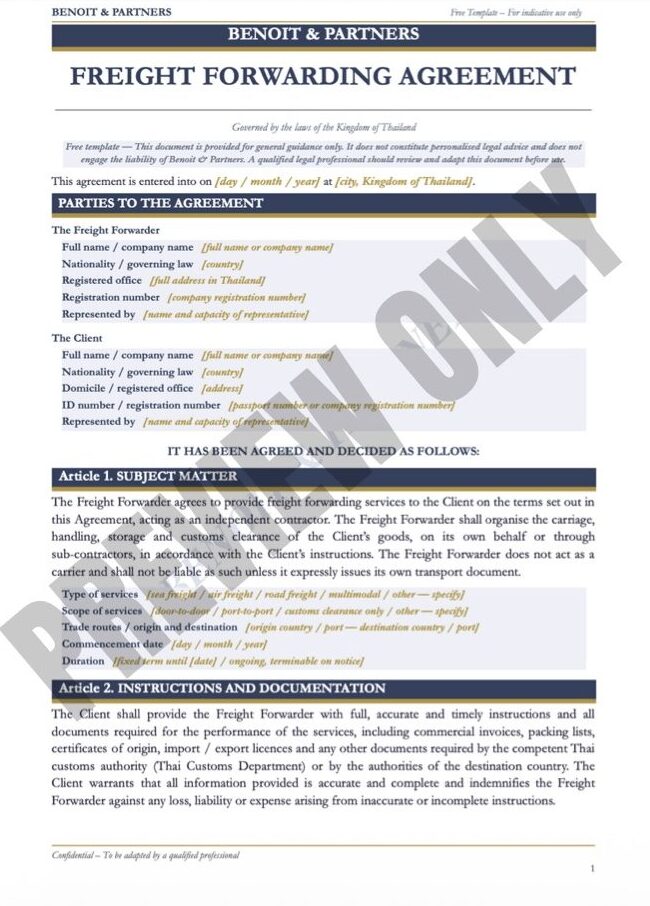
Freight Forwarding Agreement Template for Thailand
Our Freight Forwarding Agreement template for Thailand has been professionally drafted and reviewed by experienced lawyers to comply with Thai commercial law and international logistics practices. It provides a structured legal framework for businesses engaging freight forwarders to arrange the transportation and shipment of goods domestically or internationally.
Prepared for importers, exporters, manufacturers, logistics providers, distributors, and trading companies, this template regulates essential legal and operational matters including transportation arrangements, freight charges, customs coordination, delivery obligations, liability allocation, cargo handling, and dispute resolution procedures.
Certain logistics operations may require more advanced drafting or customised legal protections, particularly where international trade, multimodal transportation, customs compliance, high-value cargo, or complex supply chain arrangements are involved. In such cases, our legal team can prepare a tailored Freight Forwarding Agreement adapted to the specific requirements of the shipment and commercial relationship.
Disclaimer: This template is provided for general informational purposes only and should not be considered legal advice. Although prepared by legal professionals, it may not address all transportation, customs, regulatory, or commercial risks associated with your logistics operations. Independent legal advice is recommended for complex, international, or high-value freight forwarding arrangements under Thai law.
Need a Contract Tailored to Your Needs ? Get a Free Consultation.
When should you use a Freight Forwarding Agreement in Thailand?
A Freight Forwarding Agreement is commonly used when a business appoints a freight forwarder to organise, coordinate, and manage the transportation of goods.
This type of agreement is frequently used for import and export operations, international trade, cross-border shipments, supply chain management, warehousing services, and multimodal transportation arrangements.
Under the Thai Carriage of Goods Act B.E. 2551 (2008) and the Civil and Commercial Code, transportation and logistics services may be subject to specific obligations relating to the carriage of goods, liability limitations, and claims for loss or damage.
Without a properly drafted Freight Forwarding Agreement in Thailand, parties may face disputes regarding shipment delays, cargo damage, customs procedures, transportation costs, or liability for lost goods.

1. Identification of the parties
A Freight Forwarding Agreement must clearly identify the freight forwarder and the customer. This includes legal names, registration details, business addresses, and contact information.
2. Description of freight forwarding services
A Freight Forwarding Agreement should define the logistics services to be provided, including transportation arrangements, booking procedures, customs coordination, warehousing, and cargo handling activities.
3. Freight charges and payment terms
A Freight Forwarding Agreement should specify the fees payable for the services, invoicing procedures, payment deadlines, additional charges, and reimbursement obligations.
4. Transportation and delivery obligations
A Freight Forwarding Agreement should establish the responsibilities of each party regarding shipment schedules, delivery arrangements, documentation requirements, and transportation methods.
5. Liability and cargo claims
A Freight Forwarding Agreement should regulate liability for loss, damage, delay, or misdelivery of goods and define the procedures for filing cargo claims.
6. Customs compliance and regulatory requirements
A Freight Forwarding Agreement should address customs formalities, import and export documentation, regulatory compliance obligations, and responsibility for obtaining necessary permits or approvals.
Key clauses and additional protections in a Freight Forwarding Agreement
A Freight Forwarding Agreement is an important legal document governing the relationship between a freight forwarder and its customer. It establishes the contractual framework for the transportation and coordination of shipments while clearly defining the rights and obligations of the parties involved.
Under the Thai Carriage of Goods Act B.E. 2551 (2008) and the Civil and Commercial Code provisions relating to carriage and transportation services, logistics providers may be subject to specific obligations regarding the handling, transportation, and delivery of goods. A properly drafted Freight Forwarding Agreement helps allocate risks and reduce potential disputes arising during the logistics process.
This type of agreement is commonly used for international shipping, import-export operations, supply chain management, freight consolidation, and commercial transportation projects. While standard logistics services may rely on a general template, more complex operations often require customised provisions depending on the value of the cargo, transportation routes, customs requirements, insurance coverage, or international trade considerations.
Why customise a Freight Forwarding Agreement with a lawyer in Thailand?
Although standard freight forwarding templates may be suitable for routine shipments, many logistics operations involve legal, operational, and regulatory considerations that require more sophisticated drafting and tailored protections.
In practice, transportation arrangements frequently involve risks that generic agreements do not adequately address. Customs compliance issues, international shipping requirements, multimodal transportation, cargo insurance, liability limitations, Incoterms allocation, storage arrangements, or cross-border regulatory obligations may require provisions specifically adapted to the logistics operation.
Customising a Freight Forwarding Agreement also allows businesses and logistics providers to clearly allocate responsibilities and anticipate risks before shipments are dispatched. This is particularly important for international trade, high-value goods, sensitive cargo, regulated products, or long-term logistics partnerships.
While free templates may provide a useful starting point for basic transportation arrangements, preparing a Freight Forwarding Agreement with a lawyer in Thailand remains strongly recommended. Professional legal drafting helps ensure compliance with applicable transportation regulations, reduce liability exposure, and minimise the risk of costly disputes arising during the shipment process.
Our legal team assists importers, exporters, freight forwarders, manufacturers, and logistics companies with the preparation and review of customised Freight Forwarding Agreements adapted to their commercial operations and transportation requirements, within a short timeframe and in compliance with Thai law.
Freight Forwarding Agreement template
Instant Download
Easy to Customize
Ready to Sign
Crafted by Lawyers
FAQ
What is a Freight Forwarding Agreement?
A Freight Forwarding Agreement is a contract under which a freight forwarder arranges and coordinates the transportation of goods on behalf of a customer.
Who typically uses a Freight Forwarding Agreement?
Importers, exporters, manufacturers, distributors, logistics providers, and trading companies commonly use Freight Forwarding Agreements.
Does a freight forwarder transport the goods directly?
Not always. Freight forwarders often organise and coordinate transportation through carriers and logistics partners.
Can the agreement cover international shipments?
Yes. Freight Forwarding Agreements are commonly used for international import and export operations.
Who is responsible for customs procedures?
The agreement should clearly define whether customs formalities are handled by the freight forwarder, the customer, or a customs broker.
Does the agreement address cargo damage?
Yes. Liability provisions generally define responsibility for loss, damage, delay, or misdelivery of goods.
Is cargo insurance mandatory?
Not necessarily, but cargo insurance is often recommended depending on the value and nature of the goods being transported.
Is legal assistance recommended for Freight Forwarding Agreements?
Yes. Legal assistance is highly recommended for international trade, complex logistics operations, high-value cargo, or long-term transportation arrangements.