
House Lease Agreement Template for Thailand
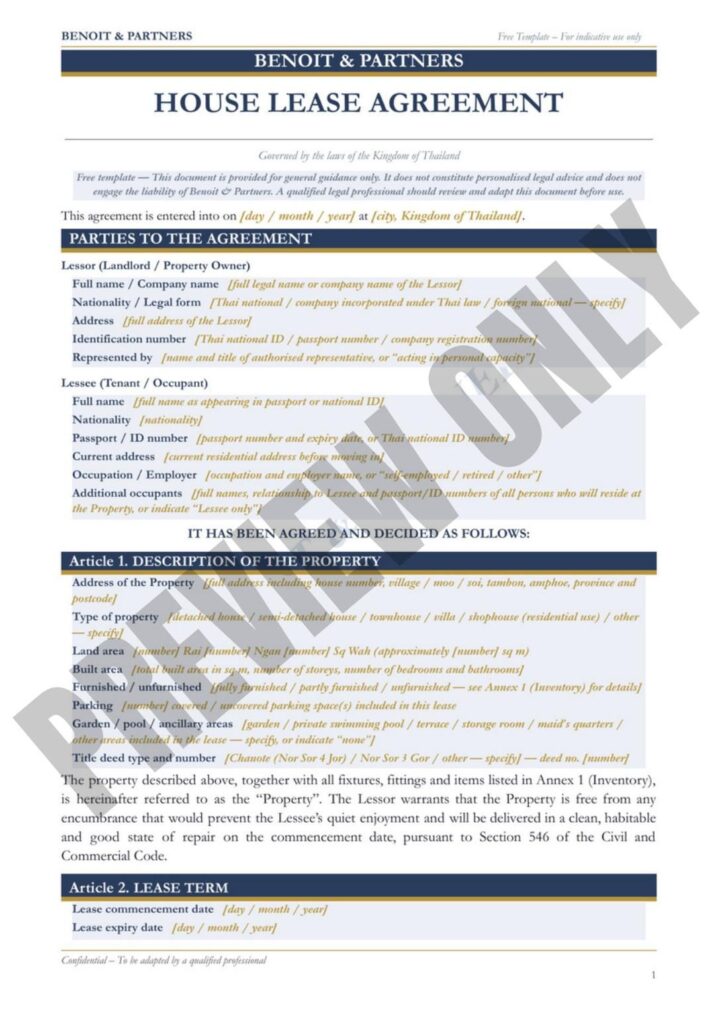
Our House Lease Agreement template for Thailand has been drafted and reviewed by qualified lawyers to ensure full compliance with Thai law. It provides a solid legal framework for formalising a residential lease between a landlord and a tenant, whether the property is a house, villa, townhouse, or similar dwelling.
Designed for both lessors and lessees, this template addresses the essential aspects of a residential tenancy: identification of the parties, detailed description of the property, rent amount and payment conditions, security deposit, obligations of each party, utilities, immigration formalities for foreign tenants, and early termination provisions.
For transactions requiring additional clauses or a more specific structure, our legal team can assist with a tailor-made agreement within a short timeframe.
Disclaimer : This template is provided for general informational purposes only and does not constitute legal advice. For complex transactions or long-term leases, professional legal advice should be sought to ensure full compliance with Thai law.
Need a Contract Tailored to Your Needs ? Get a Free Consultation.
When should you use a House Lease Agreement in Thailand?
A House Lease Agreement is the appropriate document whenever a residential property is rented out to a tenant in Thailand, whether the lessor is an individual or a legal entity. It formalises the agreed terms and protects both parties in the event of a subsequent dispute.
Under Thai law, residential leases are primarily governed by the Civil and Commercial Code, in particular the provisions relating to hire of property (Sections 537 to 574). An important practical consideration is that a lease exceeding three years must be registered at the competent Land Office to be enforceable beyond that period, pursuant to Section 538 of the Civil and Commercial Code.
A written lease agreement is particularly important where the tenancy involves a significant monthly rent, a furnished property, a foreign national tenant subject to TM30 reporting requirements, or a long-term arrangement. It allows both parties to define their respective obligations, allocate liabilities clearly, and document the condition of the property at the outset.
In more complex situations, further provisions may be needed to address subletting restrictions, property modifications, instalment deposits, or the specific obligations applicable to foreign lessors or lessees. Our legal team assists clients with customised agreements adapted to the specifics of their tenancy.
Without a properly drafted House Lease Agreement, both landlord and tenant are exposed to disputes over the condition of the property, the amount and return of the deposit, and the allocation of repair responsibilities.

1. Identification of the parties and the property
The agreement must clearly identify both the lessor and the lessee, and provide a precise description of the leased property, including its address, type, surface area, and any ancillary spaces such as a garden, swimming pool, or parking area, to avoid any ambiguity as to the subject matter of the lease.
2. Rent amount and payment conditions
The document must set out the monthly rent, the due date for each payment, the accepted payment method, and the consequences of late payment, in accordance with the provisions of the Civil and Commercial Code governing the hire of property.
3. Security deposit and conditions for return
The agreement must specify the deposit amount, the date on which it is payable, the circumstances in which deductions may be made, and the timeline within which the balance must be returned to the tenant upon termination of the lease.
4. Obligations of the lessor and the lessee
The respective maintenance obligations of each party must be clearly defined, including the allocation of minor repairs, major structural works, and the upkeep of shared or ancillary areas such as the swimming pool or garden.
5. Utilities, services, and immigration obligations
The agreement must identify which utilities are included in the rent and which are the tenant's responsibility, as well as the lessor's obligation to file the TM30 accommodation report for foreign national tenants within the prescribed timeframe.
6. Duration, renewal, and early termination
The lease term, any renewal option, the notice period required for early termination, and the financial consequences of termination without valid cause must all be clearly set out to avoid uncertainty for both parties.
Key clauses and additional protections in a House Lease Agreement
A House Lease Agreement is a fundamental legal document governing the occupation of a residential property in Thailand. It defines the conditions of the tenancy, records the state of the property at the time of handover, and provides a clear contractual basis for resolving any disagreement that may arise during or after the lease term.
Under the Civil and Commercial Code, a lessor is required to deliver the property in a habitable and clean condition on the commencement date, and to carry out all major repairs necessary to maintain the property in a fit state throughout the term, pursuant to Section 546. A properly drafted agreement clarifies the boundary between the lessor’s structural obligations and the lessee’s routine maintenance responsibilities.
This type of document is commonly used for the rental of houses, villas, and townhouses by both Thai nationals and foreign residents. While a straightforward tenancy may be adequately covered by a general template, leases of more than three years, furnished properties with a detailed inventory, or tenancies involving foreign nationals often require additional protections and customised drafting.
A well-structured House Lease Agreement helps secure the tenancy and protect the legitimate interests of both the landlord and the tenant throughout the lease term.
Why customise a House Lease Agreement with a lawyer in Thailand?
While a standard template may be sufficient for a short-term or simple residential tenancy, many lease arrangements involve legal or financial considerations that require more tailored drafting.
In practice, leases involving long terms exceeding three years, furnished properties with a comprehensive inventory, foreign national tenants, or corporate lessors may require specific provisions on registration at the Land Office, allocation of utility costs, immigration compliance, early termination consequences, or tax withholding obligations under the Revenue Code.
Our legal team assists landlords, tenants, and companies with customised lease agreements adapted to their specific circumstances, ensuring full compliance with Thai law, in many cases within a short timeframe.
A properly drafted agreement reduces the risk of future disputes, regulatory complications, and unexpected financial liability for either party.
House Lease Agreement template
Instant Download
Easy to Customize
Ready to Sign
Crafted by Lawyers
FAQ
What is a House Lease Agreement in Thailand?
A House Lease Agreement is a contract formalising the rental of a residential property between a lessor and a lessee. It records the agreed conditions of the tenancy, including the rent, deposit, duration, and obligations of each party, and is governed by the Civil and Commercial Code of Thailand.
When should it be used?
It should be used whenever a residential property is rented out in Thailand, whether between private individuals or involving a company, to document the agreed terms and protect both parties in the event of a subsequent dispute.
Does a lease need to be registered?
Leases of three years or less do not require registration. However, any lease exceeding three years must be registered at the competent Land Office to be enforceable for the full agreed term, pursuant to Section 538 of the Civil and Commercial Code. Failure to register limits enforceability to three years.
What are the tax implications for the lessor?
Rental income received by an individual lessor is subject to personal income tax in Thailand. Where the lessee is a company, withholding tax on rent must be deducted at source and remitted to the Revenue Department. Each party is advised to seek independent tax advice regarding their specific situation.
Can a foreign national lease a house in Thailand?
Yes. Foreign nationals may rent residential property in Thailand without restriction. However, the lessor is legally required to file a TM30 accommodation report with the Immigration Bureau within twenty-four hours of the foreign tenant’s arrival, pursuant to the Immigration Act B.E. 2522 (1979).
Do I need a lawyer?
For a short-term lease of an unfurnished property between two private individuals, a standard template may be adequate. For longer tenancies, furnished properties, foreign tenants, or corporate lessors, professional legal assistance is strongly recommended to ensure compliance with Thai law and to protect your interests.
What happens if no written lease is signed?
Without a written agreement, neither party has reliable documentary evidence of the agreed conditions, which significantly increases the risk of disputes over the rent, the deposit, repair responsibilities, or the notice period required for termination.
How does the PDPA apply?
Where the lease involves the exchange of personal data — such as copies of identification documents, passports, or visa records — both parties must comply with the Personal Data Protection Act B.E. 2562 (2019), including appropriate data handling and confidentiality measures