
Our House Reservation Agreement Template for Thailand
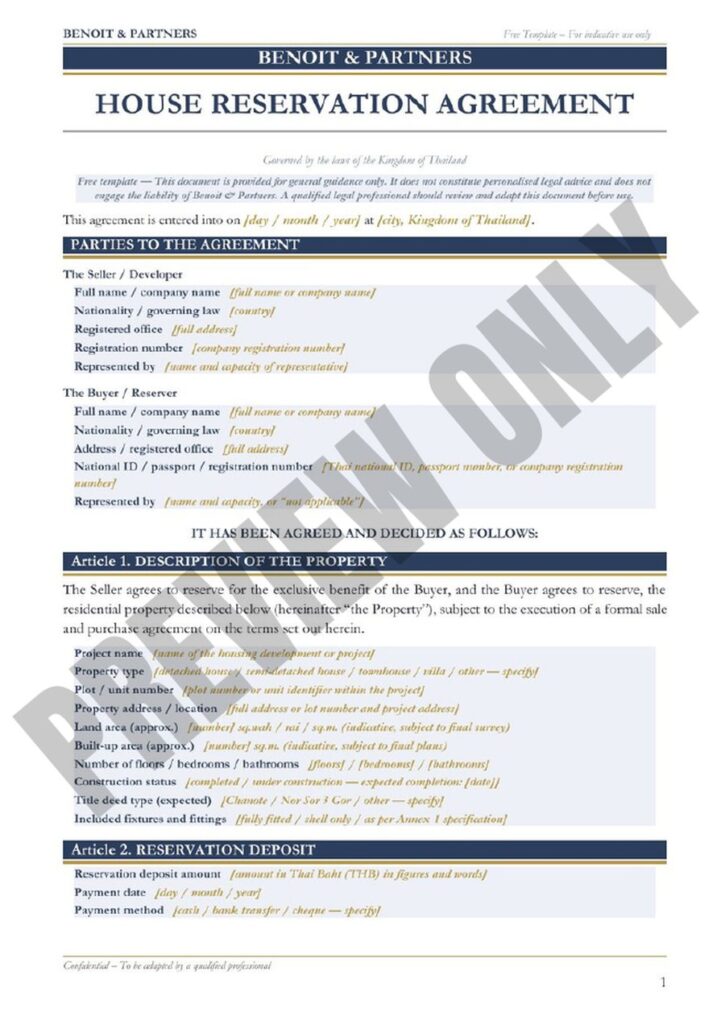
Our House Reservation Agreement template for Thailand has been drafted and reviewed by experienced lawyers to ensure compliance with Thai law. It provides a reliable legal framework for formalising the reservation of a residential property between a seller and a buyer, covering the key aspects of the transaction: identification of the parties, property description, reservation deposit, reservation period, purchase price structure, and allocation of transfer costs.
Designed for individuals, developers, and investors, this template addresses the essential legal and financial terms required at the reservation stage. For transactions requiring additional clauses or tailored structuring, our legal team can assist with a fully customised agreement within a short timeframe.
Disclaimer: This template is provided for general informational purposes only and does not constitute legal advice. For complex transactions, consulting a qualified lawyer is recommended.
Need a Contract Tailored to Your Needs ? Get a Free Consultation.
When should you use a House Reservation Agreement in Thailand?
A House Reservation Agreement is used when the parties wish to formalise their preliminary understanding before signing the definitive sale and purchase agreement. It allows the buyer to reserve the property on an exclusive basis for an agreed period, in exchange for the payment of a deposit, and sets out the essential terms of the future transaction.
Under Thai law, real estate transactions are governed by the Civil and Commercial Code as well as the Building Control Act B.E. 2522 (1979). For developers, the Real Estate Business Act B.E. 2543 (2000) and the Consumer Protection Act B.E. 2522 (1979) also apply.
This document becomes particularly important when the transaction involves a property under construction, a foreign buyer, or a purchase price structured in several instalments. It captures the parties’ agreement at an early stage and establishes the consequences of a potential withdrawal by either side.
In more complex transactions, additional clauses may be required regarding the intended ownership structure, financing arrangements, tax obligations at the date of transfer, or construction completion guarantees. Our legal team assists clients with customised Reservation Agreements tailored to their specific circumstances.
Without a properly drafted House Reservation Agreement in Thailand, the parties expose themselves to disputes over the agreed terms, financial losses in the event of a party’s default, and enforcement difficulties under Thai property law.

1. Identification of the parties and the property
The agreement must clearly identify the seller (or developer) and the buyer, and describe the reserved property in sufficient detail: property type, floor area, location, plot number, construction status, and expected type of title deed.
2. Reservation deposit
The document must specify the deposit amount, payment date and method, and the conditions applicable in the event of non-performance by either party — full refund or forfeiture as liquidated damages.
3. Purchase price and payment structure
The agreement must set out the total purchase price, the allocation of the deposit against that price, any instalment payments during the construction period, and the balance payable at the Land Department on the transfer date.
4. Obligations of the parties
Each party must confirm their respective commitments: for the seller, the exclusive reservation of the property and the disclosure of all material information; for the buyer, good faith negotiation and execution of the definitive agreement within the agreed timeframe.
5. Reservation period and execution of the sale and purchase agreement
The agreement must specify the duration of the reservation period, the long-stop date for signing the Sale and Purchase Agreement, and the consequences of the expiry of that period on the rights of each party.
6. Transfer costs, taxation, and governing law
The agreement must address the allocation of costs payable at the Land Department, transfer fee, specific business tax or stamp duty, withholding tax, as well as the obligations applicable to foreign buyers under the Thai Land Code.
Key clauses and additional protections in a House Reservation Agreement
A House Reservation Agreement is a central legal document governing the period preceding the definitive sale of a property in Thailand. It determines the rights and obligations of each party, establishes the regime applicable in the event of default, and lays the groundwork for the transfer of title.
Under Thai law, the transfer of a title deed takes place at the competent Land Department office and is subject to specific formalities, particularly for foreign buyers subject to the ownership restrictions set out in the Land Code B.E. 2497. A well-drafted reservation agreement anticipates these constraints and protects both parties through to completion.
This type of document is commonly used in new residential developments, villas, detached houses, and private party transactions. While a standard template may be sufficient for straightforward transactions, deals involving bank financing, a specific ownership structure, or a foreign buyer often require additional clauses and dedicated legal support.
Why customise a House Reservation Agreement with a lawyer in Thailand?
While a standard House Reservation Agreement template may be sufficient for simple transactions, many property deals in Thailand raise legal, financial, and regulatory issues that require more advanced drafting and tailored protections.
In practice, each reservation has its own risk profile. The buyer’s status (foreign individual, Thai company, foreign-majority-owned entity), the nature of the property (land with house, off-plan, existing property), or the financing arrangements may require provisions not found in a generic template.
Depending on the situation, specific clauses may be added relating to the intended ownership structure, construction completion guarantees for off-plan properties, detailed conditions for deposit forfeiture or refund, allocation of transfer taxes and duties, compliance with land ownership restrictions applicable to foreign nationals, or dispute resolution procedures.
Tailoring a House Reservation Agreement allows the parties to better allocate responsibilities and anticipate risks arising from the transaction. This is particularly important for high-value acquisitions, off-plan developments, or transactions involving foreign nationals.
Our legal team assists sellers, buyers, and developers with the preparation of customised Reservation Agreements adapted to their specific situation. In most cases, a tailored agreement can be prepared within a short timeframe while ensuring compliance with Thai property and commercial law.
A properly drafted agreement significantly reduces the risk of future disputes, complications at the Land Department, and unforeseen financial exposure linked to the conditions of the transaction.
House Reservation Agreement template
Instant Download
Easy to Customize
Ready to Sign
Crafted by Lawyers
FAQ
What is a House Reservation Agreement in Thailand?
A House Reservation Agreement formalises the preliminary understanding between a seller and a buyer regarding the key terms of a future transaction, prior to the signing of the definitive sale and purchase agreement. It is governed by the Thai Civil and Commercial Code and is binding on both parties for the duration of the agreed reservation period.
When should it be used?
It should be used whenever the parties wish to secure a property transaction while negotiations are still ongoing — particularly for off-plan properties, high-value acquisitions, or when the buyer requires time to arrange financing or determine their ownership structure.
Is the reservation deposit refundable?
This depends on the terms negotiated in the agreement. As a general rule, if the buyer withdraws without valid justification, the deposit is forfeited to the seller as liquidated damages. If the seller is responsible for the failure to proceed, the deposit must be refunded within the period specified in the agreement.
Can a foreign national sign a House Reservation Agreement in Thailand?
Yes. A foreign national may sign a reservation agreement, provided the intended ownership structure complies with Thai law. The Land Code B.E. 2497 generally prohibits foreigners from owning land outright; alternative structures — such as a long-term lease, condominium freehold, or Thai company — may be considered depending on the circumstances.
What are the tax implications at the time of transfer?
Several taxes are payable at the Land Department on the transfer date: a transfer fee (2% of the appraised value), specific business tax or stamp duty, and withholding tax. The allocation of these costs between the parties is freely negotiable and should be clearly set out in the agreement.
Do I need a lawyer?
For straightforward transactions between well-informed parties, a standard template may be sufficient. For complex deals, off-plan purchases, or acquisitions involving foreign buyers, legal assistance is strongly recommended to ensure the agreement is valid and enforceable under Thai law.
What happens if no reservation agreement is signed?
Without a formalised document, verbally or informally agreed terms may be difficult to prove and enforce. This exposes the parties to disputes over the deposit amount, agreed timelines, and respective obligations in the event of default.
Does the PDPA apply?
If the transaction involves the exchange of personal data between the parties — identity details, contact information, identification documents — both parties must comply with the Personal Data Protection Act B.E. 2562 (2019), including applicable confidentiality and data processing requirements.