
Interior Design Contract in Thailand
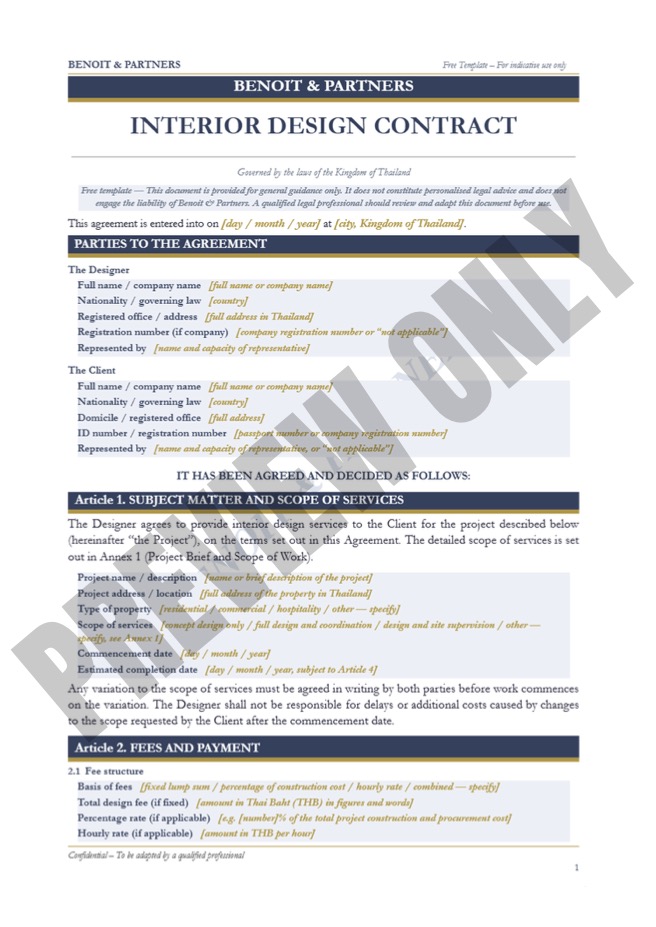
Our Interior Design Contract in Thailand is drafted and reviewed by experienced lawyers to ensure compliance with Thai law and practical business use. It provides a reliable legal framework for formally documenting the engagement of an interior designer and the scope of design services to be provided in connection with a residential or commercial project in Thailand.
Designed for property owners, developers, and businesses seeking to engage an interior designer on a legally sound and clearly defined basis in Thailand, this template covers key legal aspects such as identification of the parties, scope of interior design services, fees and payment structure, programme and deliverables, procurement responsibilities, intellectual property ownership, and compliance with applicable Thai civil and commercial law.
However, some situations may require additional clauses or tailored structuring depending on the scale and nature of the project, the designer’s involvement in procurement and fit-out supervision, the budget and timeline constraints of the client, or the specific deliverables required for a particular property type. Our legal team can assist clients with customised Interior Design Contracts adapted to their specific situation within a short timeframe.
Disclaimer: This template is provided for general informational purposes only and does not constitute legal advice. While it has been prepared by legal professionals, it may not reflect your specific situation or regulatory constraints. For high-value or complex interior design projects, legal advice should be sought to ensure proper structuring and compliance under Thai law.
Need a Contract Tailored to Your Needs? Get a Free Consultation.
When should you use an Interior Design Contract in Thailand?
An Interior Design Contract in Thailand is the appropriate instrument whenever a client engages an interior designer to provide professional design services for a residential or commercial space in Thailand. The scope of the appointment may range from concept development and space planning through to detailed design, specification of materials and furnishings, procurement management, and supervision of fit-out works.
Interior design services in Thailand are not subject to dedicated professional licensing requirements in the same way as architectural services, but interior designers frequently work alongside licensed architects and engineers on projects that involve structural or building services elements.
A well-structured Interior Design Contract gives both the client and the designer a shared and documented understanding of the project brief, the design process, the programme for delivery, and the fee payable at each stage.
More involved projects may require additional provisions covering the designer’s role as procurement agent, the basis on which supplier and contractor quotes are obtained and approved, the designer’s mark-up on procured items, or the treatment of defective work by contractors engaged through the designer’s recommendation. Our legal team is available to assist with tailored contracts that reflect the full scope of the designer’s involvement.
Without a clearly documented Interior Design Contract, disagreements about scope, fees, and design ownership are a frequent source of difficulty that can damage the client-designer relationship and delay the completion of the project.

1. Scope of Services
The contract should set out a clear and stage-by-stage description of the interior design services to be provided, identifying the specific activities and deliverables within each phase.
2. Fees and Payment Structure
The designer's fee whether calculated as a fixed project fee, as a percentage of the fit-out cost, or on a hybrid basis should be stated clearly, together with the payment schedule linked to project milestone.
3. Procurement and Designer's Mark-Up
Where the designer is responsible for procuring furniture, materials, or fittings on the client's behalf, the contract should specify whether the designer acts as agent or principal.
4. Programme and Client Approvals
The contract should specify the programme for delivery of each design stage, the timeframe within which the client is required to provide feedback and approvals, and the consequences of client-caused delays on the designer's programme and fee entitlement.
5. Intellectual Property
The ownership of design concepts, drawings, mood boards, and other creative outputs should be addressed explicitly.
6. Changes and Additional Services
The contract should include a clear mechanism for managing scope changes and additional services requested by the client, setting out the process for agreeing the fee and programme impact before additional work is undertaken, to avoid disputes about what was within the original scope.
Key Clauses and Essential Elements in an Interior Design Contract
A well-prepared Interior Design Contract in Thailand gives both the client and the designer a clear and agreed foundation for the project defining the services to be provided, the fees payable, the programme for delivery, and the process for managing changes and approvals throughout the design and fit-out process.
Under Thai civil law, the designer owes the client a duty to exercise reasonable skill and care in the delivery of their services.
A well-structured contract builds on this baseline to establish more specific project obligations, deliverables, and accountability mechanisms tailored to the nature and scale of the engagement.
This document is relevant across all categories of interior design project from private residential apartments and villas to hotel fit-outs, retail environments, and commercial office spaces and applies whether the designer is an individual practitioner or a design studio.
Why customise an Interior Design Contract with a lawyer in Thailand?
A standard template of Interior Design Contract in Thailand provides a reasonable starting point for a straightforward residential project, but many interior design engagements involve dimensions that require a more carefully structured approach before the appointment is formalised.
The scale and complexity of the project, the extent of the designer’s procurement role, the client’s expectations regarding design ownership, and the involvement of contractors and suppliers all shape what the contract needs to achieve.
Depending on the context, the contract may also cover: the interaction between the interior designer’s appointment and the appointments of the architect and other design consultants; the designer’s liability for procurement decisions and the suitability of materials and products specified; the treatment of bespoke items commissioned for the project that cannot be returned or resold; the VAT treatment of design fees and procured items under Thai revenue law; or the specific requirements of a hotel operator or retail brand regarding design standards and approval processes.
Our legal team works with clients and designers to prepare interior design contracts that are clearly structured, commercially fair, and well-matched to the specific project and the parties involved.
Interior Design Contract Thailand
Instant Download
Easy to Customize
Ready to Sign
Crafted by Lawyers
FAQ
What is an Interior Design Contract in Thailand?
A formal written agreement through which a client engages an interior designer to provide professional design services for a residential or commercial space, setting out the scope of services, fees, programme, deliverables, and the respective rights and obligations of both parties.
Is interior design a regulated profession in Thailand?
Interior design is not subject to the same professional licensing requirements as architecture in Thailand. However, where an interior design project involves structural work or building services that require a licensed professional, those elements must be carried out or overseen by an appropriately licensed architect or engineer.
Who owns the interior design concepts and drawings in Thailand?
Ownership of the intellectual property in design concepts and drawings depends on the terms of the contract. Without an express provision, the designer is likely to retain copyright in the creative works produced. The contract should address this point clearly to avoid disputes about the client’s right to use the designs.
What happens if the client changes the brief after the contract is signed in Thailand?
Changes to the agreed brief after contract execution typically entitle the designer to additional fees and, where the changes affect the programme, additional time. The contract should establish a clear change management process that requires the client to approve the fee and programme impact of any change before additional work is undertaken.
Can an interior designer in Thailand act as procurement agent for the client?
Yes. Many interior designers in Thailand manage the procurement of furniture, materials, and fittings on their clients’ behalf. The contract should specify whether the designer acts as agent or principal in this capacity.
What recourse does a client have if the designer delivers substandard work in Thailand?
Where the designer fails to meet the standard of reasonable professional skill and care required under the contract, the client may have a claim for breach of contract and, depending on the loss suffered, a right to damages under the Civil and Commercial Code. The contract should include clear provisions about the designer’s obligation to remedy deficient work within a defined period.
How are disputes between a client and an interior designer resolved in Thailand?
Disputes are typically resolved through negotiation in the first instance, and if unsuccessful, through the dispute resolution mechanism specified in the contract whether mediation, arbitration, or litigation in the Thai courts. A tiered process is generally recommended as it encourages early resolution at lower cost.
How does the PDPA apply to an Interior Design Contract in Thailand?
Interior design projects may involve the processing of personal data relating to the client and occupants of the property. Both parties must comply with the Personal Data Protection Act B.E. 2562 (2019) in relation to any personal data processed in connection with the project, and the contract should address each party’s data protection responsibilities where relevant.