
IP Non-Competition Agreement in Thailand
Our IP Non-Competition Agreement in Thailand is drafted and reviewed by experienced lawyers to ensure compliance with Thai law and practical business use. It provides a reliable legal framework for protecting a business’s intellectual property assets and preventing a counterparty whether an employee, contractor, or business partner — from engaging in competing activities that could exploit those assets.
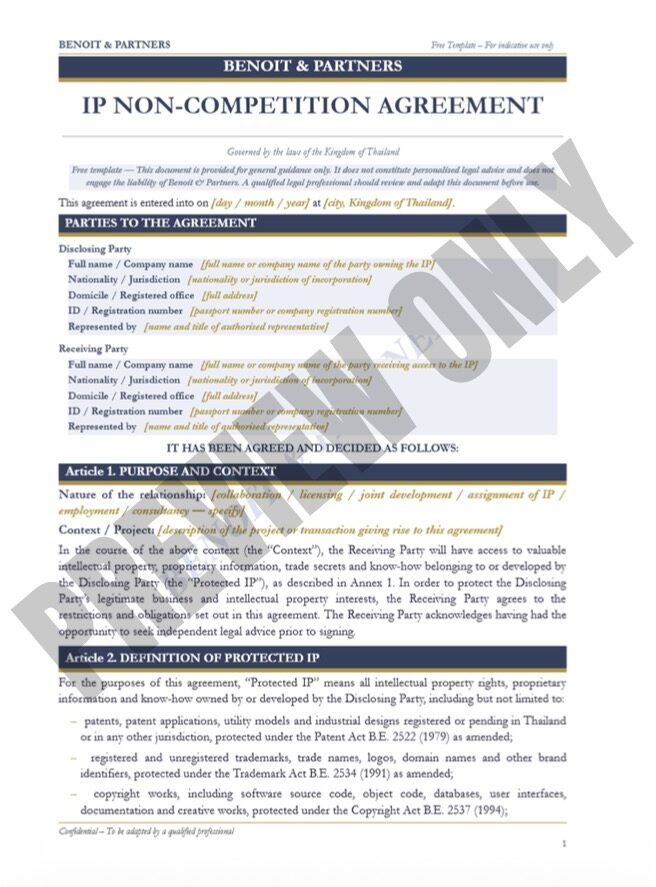
Designed for employers, businesses, and commercial partners seeking to protect their intellectual property and competitive position in Thailand, this template covers key legal aspects such as identification of the parties, the scope of the intellectual property being protected, the definition of competing activities, the geographical and temporal scope of the non-competition restriction, the consideration provided in exchange for the restriction, and compliance with the requirements of Thai employment law, the Civil and Commercial Code, and applicable intellectual property legislation.
However, some situations may require additional clauses or tailored structuring depending on the nature of the intellectual property involved, the seniority and role of the restricted party, the relevant market and competitive landscape, or the specific activities the business wishes to prevent. Our legal team can assist clients with customised IP Non-Competition Agreements adapted to their specific situation within a short timeframe.
Disclaimer: This template is provided for general informational purposes only and does not constitute legal advice. While it has been prepared by legal professionals, it may not reflect your specific situation or regulatory constraints. Given the complex enforceability considerations that apply to non-competition restrictions under Thai law, legal advice should be sought to ensure proper structuring and maximum enforceability.
Need a Contract Tailored to Your Needs? Get a Free Consultation.
When should you use an IP Non-Competition Agreement in Thailand?
An IP Non-Competition Agreement in Thailand is the appropriate instrument when a business wishes to protect its intellectual property assets including trade secrets, proprietary technology, customer data, and know-how by preventing a counterparty from using those assets in the course of a competing business or activity.
Thai law does not contain a specific statute governing non-competition agreements in all contexts. In the employment context, non-competition restrictions are assessed under the general principles of Thai contract law and must satisfy the requirements of reasonableness in scope, duration, and geography to be enforceable.
The intellectual property dimension of the agreement adds a further layer of complexity. A restriction designed to protect trade secrets or proprietary know-how operates differently from one aimed at preventing direct market competition, and the agreement must be structured to address both dimensions coherently and in a manner that the Thai courts would be prepared to uphold.
More complex arrangements such as those involving multiple categories of IP, cross-border restrictions, or the interaction between a non-competition clause and a broader commercial agreement require a carefully tailored approach that takes account of the specific IP assets at risk and the commercial context in which the restriction is to operate.
Without a properly drafted IP Non-Competition Agreement, a business may find that its most valuable assets are inadequately protected and that a departing employee or exiting partner is free to exploit proprietary information in a directly competing venture.

1. Identification of the Parties
The agreement should clearly identify the party whose IP is being protected and the party accepting the restriction, including their full legal names, registered addresses where applicable, and the capacity in which each party is entering into the agreement.
2. Definition of the Protected IP
The intellectual property assets that the agreement is designed to protect should be defined with precision whether that is specific trade secrets, proprietary software, customer databases, technical know-how, or other categories of confidential business information.
3. Scope of the Non-Competition Restriction
The activities that the restricted party is prohibited from engaging in should be defined clearly, identifying the specific business activities, market segments, or customer categories that are off-limits during the restriction period.
4. Geographical Scope
The geographic area within which the restriction applies should be clearly defined and proportionate to the actual market in which the business operates. An overly broad geographical restriction particularly one that extends to regions where the business has no material presence is at heightened risk of being set aside by a Thai court.
5. Duration of the Restriction
The period for which the restriction applies should be stated and must be reasonable in light of the nature of the IP being protected and the competitive landscape.
6. Consideration
The agreement should identify the consideration provided to the restricted party in exchange for accepting the restriction. In the employment context, this is typically a specific payment or benefit distinct from ordinary remuneration. Adequate consideration is an important factor in the enforceability assessment.
Key Clauses and Essential Elements in an IP Non-Competition Agreement
A well-constructed IP Non-Competition Agreement in Thailand gives the business clear and enforceable protection for its intellectual property assets, while defining the restricted party’s obligations with sufficient precision to withstand scrutiny before the Thai courts. It balances the legitimate commercial interests of the business against the rights of the restricted party in a way that maximises the prospects of enforcement.
Thai courts approach non-competition restrictions with close attention to proportionality. A restriction that is clearly defined, limited to what is genuinely necessary to protect the business’s IP interests, and supported by adequate consideration is significantly more likely to be upheld than one that is broadly drafted or one-sided in its effect.
This document is relevant across a wide range of commercial relationships from senior employment arrangements to technology licensing agreements and business sales and the appropriate scope and structure of the restriction will vary significantly depending on the nature of the IP being protected and the relationship between the parties.
Why customise an IP Non-Competition Agreement with a lawyer in Thailand?
A standard IP Non-Competition Agreement in Thailand template is inadequate for most IP non-competition situations, given the complex enforceability considerations that apply under Thai law and the significant commercial consequences of a restriction that fails to hold up when challenged.
The specific IP assets at risk, the nature of the competitive threat, and the relationship between the parties all influence how the restriction should be framed and what supporting provisions are needed to maximise its legal effect.
In certain cases, the agreement may need to address: the interaction between the non-competition restriction and a separate confidentiality or non-solicitation obligation; the specific requirements for enforceability under Thai employment law where the restricted party is an employee; the treatment of IP created by the restricted party during the course of the relationship and its ownership after termination; the interaction between the agreement and any applicable collective bargaining arrangements; or the cross-border implications where the restricted party operates in multiple jurisdictions.
Our legal team works with businesses across all sectors to prepare IP Non-Competition Agreements that are precisely calibrated to the specific IP assets and competitive risks involved, legally robust under Thai law, and structured to withstand challenge if the restriction is ever contested.
IP Non-Competition Agreement Thailand
Instant Download
Easy to Customize
Ready to Sign
Crafted by Lawyers
FAQ
What is an IP Non-Competition Agreement in Thailand?
A contract through which one party agrees not to engage in specified competing activities that could exploit another party’s intellectual property assets, for a defined period and within a defined geographic area, in exchange for agreed consideration.
Are non-competition agreements enforceable in Thailand?
Yes, but enforceability depends on the reasonableness of the restriction. Thai courts will assess whether the scope, duration, and geographic reach of the restriction are proportionate to the legitimate business interest being protected. Overly broad restrictions are at risk of being reduced or set aside entirely.
How long can a non-competition restriction last in Thailand?
There is no statutory maximum, but Thai courts have generally been cautious about enforcing restrictions exceeding one to two years in the employment context. Longer periods may be more defensible in commercial arrangements, particularly where significant consideration is provided and valuable IP is genuinely at risk.
Does a non-competition agreement need to be supported by consideration in Thailand?
Yes. A non-competition restriction must be supported by adequate consideration to be enforceable. In the employment context, a specific payment or benefit distinct from the employee’s ordinary salary is the most reliable form of consideration for a post-termination restriction.
Can an employer enforce a non-competition clause against a former employee in Thailand?
Yes, provided the restriction satisfies the requirements of reasonableness and is supported by consideration. The employer must also be able to demonstrate a legitimate business interest in the IP being protected that justifies the imposition of the restriction.
What remedies are available for breach of a non-competition agreement in Thailand?
The protected party may seek injunctive relief to restrain the breach, damages to compensate for the loss caused, and, where the agreement includes a liquidated damages clause, the agreed sum. Applications for urgent interim injunctions can be made to the Thai courts where the breach is causing or threatens to cause immediate harm.
How does an IP Non-Competition Agreement interact with a confidentiality agreement in Thailand?
The two documents serve complementary but distinct purposes. A confidentiality agreement protects specific confidential information from disclosure, while a non-competition agreement restricts the restricted party from engaging in competing activities more broadly. Both are typically used together where IP protection is a priority.
How does the PDPA apply to an IP Non-Competition Agreement in Thailand?
Where the agreement references personal data such as customer lists or employee information as part of the definition of the protected IP, it must be handled in accordance with the Personal Data Protection Act B.E. 2562 (2019). The agreement should address the treatment of personal data on termination, including the obligation to return or destroy data containing personal information.