
Job Application Form Thailand
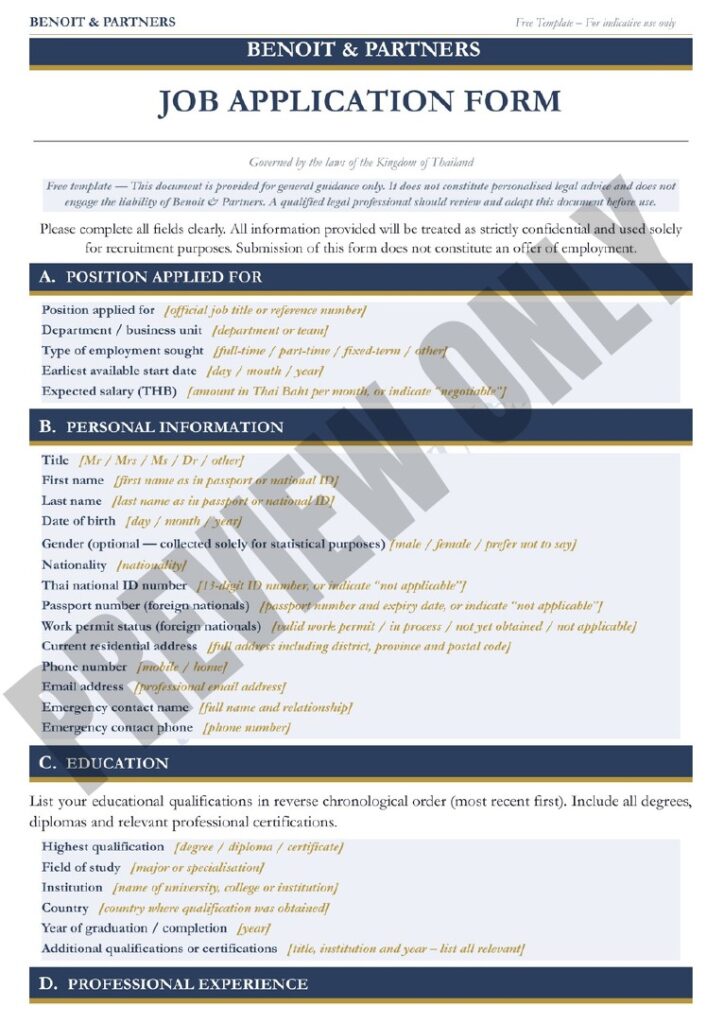
Our Job Application Form in Thailand template is drafted and reviewed by experienced lawyers to ensure compliance with Thai labour law and practical business use. It provides a reliable legal framework for standard recruitment processes in Thailand.
Designed for employers, HR departments, and companies involved in hiring, this template covers key legal aspects such as collection of applicant information, educational background, work experience, references, consent to background checks, and regulatory compliance under Thai law.
However, some recruitment processes may require additional clauses or tailored structuring depending on the nature of the position, industry-specific requirements, or data protection considerations. Our legal team can assist clients with customised Job Application Forms adapted to their needs within a short timeframe.
Disclaimer: This template is provided for general informational purposes only and does not constitute legal advice. While it has been prepared by legal professionals, it may not reflect your specific situation or regulatory constraints. For complex recruitment processes or sensitive positions, legal advice should be sought to ensure proper structuring and compliance under Thai law.
Need a Contract Tailored to Your Needs? Get a Free Consultation.
When should you use a Job Application Form in Thailand ?
A Job Application Form is used whenever an employer in Thailand collects information from candidates applying for a position. This situation commonly arises in private sector recruitment, public tender processes, executive hiring, seasonal employment, and any structured recruitment process involving multiple applicants.
Under Thai law, the collection of personal data from job applicants is governed by the Personal Data Protection Act B.E. 2562 (2019) (PDPA), which requires employers to obtain informed consent before collecting, storing, or processing any personal information. The Labour Protection Act B.E. 2541 (1998) also establishes the general framework governing employment relationships in Thailand.
This document becomes particularly important when the recruitment process involves sensitive personal data, background checks, medical information, or positions requiring security clearance. It allows the employer to collect relevant information in a structured and legally compliant manner, while protecting the rights of applicants.
In more complex recruitment processes, additional clauses may be required regarding consent to background checks, data retention policies, anti-discrimination compliance, and obligations under the PDPA. Our legal team assists clients with the preparation of customised Job Application Forms tailored to their recruitment process in order to provide stronger legal protection and ensure compliance with Thai law.
Without a properly drafted Job Application Form, employers expose themselves to disputes over data collection, regulatory sanctions under the PDPA, and potential claims of discriminatory hiring practices under Thai labour law.

1. Identification of the parties and company
The form must clearly identify the applicant and the position applied for, including full legal name, contact details, nationality, Thai national ID or passport number, and the job title and department targeted within the company.
2. Educational background and qualifications
The form must specify the applicant's academic qualifications, professional certifications, and any licences required for the position, including the institutions attended, dates of graduation, and fields of study.
3. Work experience and employment history
The form must clearly detail the applicant's previous employment, including employer names, positions held, dates of employment, and reasons for leaving, to enable proper assessment by the hiring company.
4. Representations and warranties
References and representations protect the employer by confirming the accuracy of information provided, the applicant's authorisation to share third-party contact details, and the absence of misrepresentation or omission in the application.
5. Consent to data collection and background checks
Consent must be obtained before collecting and processing personal data, in compliance with the PDPA B.E. 2562 (2019). The form must specify the purpose of data collection and the applicant's rights regarding background checks and data retention.
6. Anti-discrimination and regulatory compliance
The form must comply with Thai labour law and avoid questions related to protected characteristics. It must also address work permit requirements for foreign nationals under the Foreign Employment Act B.E. 2551 (2008).
Key clauses and additional protections in a Job Application Form Thailand
A Job Application Form is a key document governing the collection of applicant information during a recruitment process in Thailand. It defines the information collected, the purpose of its use, and ensures compliance with Thai labour and data protection law.
Under the PDPA B.E. 2562 (2019), employers must obtain explicit consent from applicants before collecting and processing their personal data. A properly drafted Job Application Form helps structure the recruitment process and reduce legal risks for the employer.
This type of document is commonly used across all industries in Thailand, from small businesses to large corporations, for permanent positions, fixed-term contracts, and internship placements. While standard recruitment processes may rely on a general template, more complex hiring situations often require additional legal protections and customised clauses depending on the nature of the position and the risks involved.
A properly customised Job Application Form helps secure the recruitment process and better protect the interests of both the employer and the applicant.
Why customise a Job Application Form with a lawyer in Thailand?
While a standard Job Application Form template may be sufficient for straightforward recruitment processes, many hiring situations involve legal, regulatory, and data protection considerations requiring more advanced drafting and tailored protections.
In practice, each recruitment process has its own structure and level of risk. The nature of the position, the sensitivity of personal data collected, background check requirements, or the involvement of foreign nationals may require provisions that are not included in a standard template.
Depending on the position, specific clauses may be added relating to consent to criminal background checks, medical examination requirements, work permit and visa status for foreign applicants, data retention and deletion policies under the PDPA, anti-discrimination and equal opportunity statements, confidentiality obligations regarding the recruitment process, references and prior employment verification, or compliance with industry-specific regulations.
Tailoring a Job Application Form also allows employers to better manage legal risks and ensure the recruitment process is structured, compliant, and defensible in the event of a dispute. This is particularly important for senior positions, roles involving access to sensitive information, regulated industries, or the recruitment of foreign nationals.
Our legal team assists employers, HR departments, and companies with the preparation and review of customised Job Application Forms adapted to their recruitment needs and commercial objectives. In many cases, tailored forms can be prepared within a short timeframe while ensuring compliance with Thai labour and data protection laws.
A properly drafted form not only helps structure the recruitment process, but also reduces the risk of regulatory sanctions, disputes, and unexpected liabilities.
Job Application Form template
Instant Download
Easy to Customize
Ready to Sign
Crafted by Lawyers
FAQ
What is a Job Application Form in Thailand?
A Job Application Form is a document used by employers to collect standardised information from candidates applying for a position. In Thailand, it must comply with the PDPA B.E. 2562 (2019) and the Labour Protection Act B.E. 2541 (1998).
Is a Job Application Form legally required in Thailand?
There is no strict legal obligation to use a Job Application Form, but it is strongly recommended. It structures the recruitment process, ensures PDPA-compliant data collection, and protects the employer in the event of a hiring dispute.
What personal data can an employer collect on a Job Application Form in Thailand?
Employers may collect information directly relevant to the position, such as identity details, educational background, work experience, and references. Sensitive data — including health information, criminal records, or biometric data — requires explicit consent under the PDPA.
Does the PDPA apply to job application forms in Thailand?
Yes. The PDPA B.E. 2562 (2019) applies to all personal data collected during the recruitment process. Employers must obtain informed consent, clearly state the purpose of data collection, and ensure proper data retention and deletion policies are in place.
Can an employer conduct background checks in Thailand?
Yes, but only with the explicit written consent of the applicant. Background checks covering criminal records, credit history, or prior employment must be disclosed in the application form, and the results must be handled in accordance with the PDPA.
Do I need a lawyer to draft a Job Application Form in Thailand?
For standard positions, a general template may be sufficient. For senior roles, regulated industries, or positions involving sensitive data, legal assistance is recommended to ensure full compliance with Thai labour law and the PDPA.
Can a Job Application Form be used for foreign nationals in Thailand?
Yes, but additional information may be required regarding the applicant’s work permit status and visa eligibility. Employers hiring foreign nationals must also comply with the Foreign Employment Act B.E. 2551 (2008) and applicable work permit regulations.
How long can an employer retain job application data in Thailand?
Under the PDPA, personal data must not be retained longer than necessary for the purpose for which it was collected. Employers should define a clear data retention policy and delete or anonymise applicant data once the recruitment process is concluded.