
Land Brokerage Agreement in Thailand
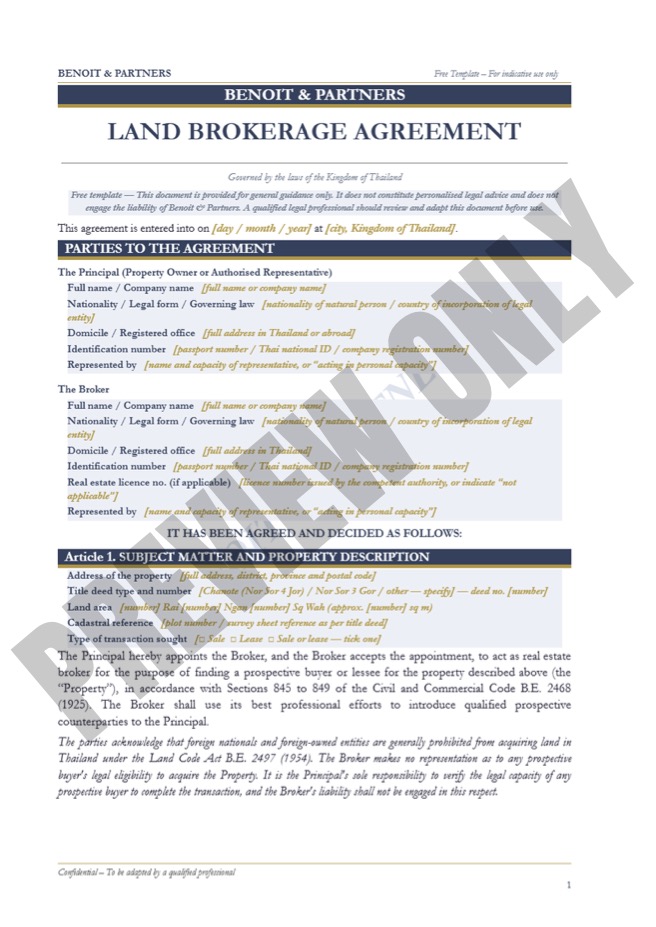
Our Land Brokerage Agreement in Thailand is drafted and reviewed by experienced lawyers to ensure compliance with Thai law and practical business use. It provides a reliable legal framework for formally engaging a broker to market and facilitate the sale or purchase of land in Thailand in exchange for a commission.
Designed for landowners, investors, and brokerage firms seeking to formalise the terms of a land brokerage engagement in Thailand, this template covers key legal aspects such as identification of the parties, the scope of the broker’s mandate, the description and title status of the land, commission structure and payment triggers, and compliance with the Civil and Commercial Code provisions governing brokerage contracts.
However, some situations may require additional clauses or tailored structuring depending on the title classification of the land, the involvement of foreign buyers, the existence of zoning or land-use restrictions, or the presence of multiple co-owners. Our legal team can assist clients with customised Land Brokerage Agreements adapted to their specific situation within a short timeframe.
Disclaimer: This template is provided for general informational purposes only and does not constitute legal advice. While it has been prepared by legal professionals, it may not reflect your specific situation or regulatory constraints. For large land parcels or transactions involving title complexities, legal advice should be sought to ensure proper structuring and compliance under Thai land law.
Need a Contract Tailored to Your Needs? Get a Free Consultation.
When should you use a Land Brokerage Agreement in Thailand?
A Land Brokerage Agreement in Thailand becomes the appropriate instrument when a landowner wishes to formally engage a broker to identify a buyer for a parcel of land in Thailand, in exchange for a commission payable on successful completion of the sale. It is relevant to agricultural land, undeveloped plots, and land earmarked for commercial or residential development.
Land transactions in Thailand are subject to particular legal considerations beyond those applicable to general real estate, given the strict restrictions on foreign land ownership under the Land Code and the variety of title classifications — including Chanote, Nor Sor 3 Gor, and Nor Sor 3 that carry different levels of legal certainty and registered rights. A broker engaged to market land must operate within this framework, and the brokerage agreement should reflect the particular characteristics of the land being sold.
Formalising the brokerage engagement in writing carries clear advantages. It defines the scope of the broker’s authority, sets out the commission structure and the event that triggers payment, and protects the landowner against ambiguity where multiple brokers or intermediaries may be involved in introducing prospective buyers, which is common in land transactions involving rural or undeveloped parcels.
More complex engagements may require additional provisions addressing the verification of land title and boundaries prior to marketing, the treatment of land held jointly by multiple co-owners, restrictions on the sale of land to foreign buyers, or specific commission arrangements for large parcels sold in subdivided lots. Our legal team is available to assist with tailored agreements that address these dimensions appropriately.
Proceeding without a written brokerage agreement is particularly risky in land transactions, where informal introductions by multiple local intermediaries are common and disputes over who is entitled to commission frequently arise in the absence of clear documentation.

1. Identification of the Parties
The agreement should state the full name and contact details of the landowner and the broker, together with confirmation of the broker's relevant licensing or registration status where applicable.
2. Description and Title Status of the Land
The agreement should identify the land precisely by reference to its title deed type and number, location, and area, and should record the current title classification, which has significant implications for the marketability and legal certainty of the land being sold.
3. Asking Price and Scope of the Mandate
The agreement should state the price the landowner is seeking and confirm whether the broker's mandate extends to negotiating on the owner's behalf or is limited to introducing prospective buyers for the owner to negotiate with directly.
4. Exclusivity
The agreement should specify whether the mandate is exclusive or non-exclusive and, if exclusive, the duration of the exclusivity period and the consequences should the owner sell the land directly or through another broker during that period.
5. Commission Structure
The agreement should set out the commission rate or amount and the specific event that triggers payment, typically the execution of a sale and purchase agreement or the completion of the land transfer at the Land Office with a buyer introduced by the broker.
6. Title Verification
Given the variety of land title classifications in Thailand, the agreement should address whether the broker or the owner is responsible for confirming the current and accurate title status before marketing begins, reducing the risk of disputes with a buyer after a sale has been agreed.
Key Clauses and Essential Elements in a Land Brokerage Agreement
A well-drafted Land Brokerage Agreement in Thailand gives the landowner and the broker a precise and shared understanding of the land being marketed, the broker’s authority, and the specific circumstances in which commission becomes payable. Given the particular legal characteristics of land transactions in Thailand, the agreement should reflect both the commercial terms of the engagement and the legal status of the land itself.
Under the Civil and Commercial Code, a broker’s entitlement to commission depends on their efforts having been the effective cause of the eventual sale being concluded. For land transactions, this entitlement is often complicated by the involvement of multiple local brokers and informal introducers, making clear documentation especially important.
This document is relevant to a wide range of land brokerage engagements in Thailand — from small residential plots to large agricultural or development parcels and the core structure remains consistent, though specific provisions relating to title verification and foreign buyer restrictions will vary according to the nature of the land.
Why customise a Land Brokerage Agreement with a lawyer in Thailand?
A standard template of Land Brokerage Agreement in Thailand is appropriate for straightforward single-parcel mandates, but several factors specific to land transactions call for a more carefully tailored agreement.
The title classification of the land, the involvement of multiple co-owners or informal local intermediaries, and the potential involvement of foreign buyers all significantly affect what the agreement needs to address.
Depending on the situation, the agreement may need to cover: the verification and disclosure of the land’s title classification and any registered encumbrances; the allocation of responsibility between multiple co-owners where the land is held jointly; specific provisions addressing the legal restrictions applicable to foreign buyers seeking to acquire an interest in the land; or the treatment of subdivided sales where a large parcel is being sold in multiple lots to different buyers.
Our legal team works with landowners and brokerage firms to prepare agreements that are clear, properly tailored to the specific land and title situation, and aligned with Thai land and brokerage law, reducing the risk of disputes when a sale is eventually concluded.
Land Brokerage Agreement Thailand
Instant Download
Easy to Customize
Ready to Sign
Crafted by Lawyers
FAQ
What is a Land Brokerage Agreement in Thailand?
A written contract through which a landowner engages a broker to identify a buyer for a parcel of land, setting out the scope of the mandate, the land’s description and title status, the commission payable, and the circumstances triggering that payment.
Does the type of land title affect a brokerage agreement in Thailand?
Yes. Land in Thailand may be held under different title classifications — including Chanote, Nor Sor 3 Gor, and Nor Sor 3 each carrying different levels of registered rights and legal certainty. The brokerage agreement should accurately reflect the actual title status to avoid disputes with prospective buyers.
Can a broker assist with the sale of land to a foreign buyer in Thailand?
A broker may introduce foreign buyers, but foreign individuals are generally restricted from owning land directly under the Land Code. Brokers and owners should be aware of the legal structures commonly used by foreign buyers, such as long-term leasehold arrangements, when marketing land to international purchasers.
Who typically pays the broker's commission in a land sale in Thailand? Commission
Commission is most commonly paid by the seller, although this is a matter for negotiation between the parties and should be clearly stated in the brokerage agreement to avoid any ambiguity.
What happens if land is co-owned by multiple people in Thailand?
Where land is held jointly, all co-owners with a registered interest typically need to consent to and participate in the sale. The brokerage agreement should identify all co-owners and confirm that the broker has been properly authorised to act on behalf of the entire ownership group.
Is a land survey required before a brokerage engagement begins in Thailand?
While not always legally required at the brokerage stage, a current land survey is strongly advisable to confirm boundaries and area, particularly for older title deeds where boundary markers may have shifted or been disputed by neighbouring landowners over time.
What is the risk of using multiple informal brokers for a land sale in Thailand?
Engaging multiple informal local intermediaries without written agreements frequently leads to disputes over who is entitled to commission once a sale is concluded, as several parties may claim to have introduced the eventual buyer. A written agreement with a defined commission trigger significantly reduces this risk.
How does the PDPA apply to a Land Brokerage Agreement in Thailand?
The agreement and the brokerage process involve personal data relating to the landowner and prospective buyers. Under the Personal Data Protection Act B.E. 2562 (2019), this data must be used only for purposes connected with the brokerage mandate and handled securely by the broker and any parties involved in the transaction.