
Land Sale Agreement Template for Thailand
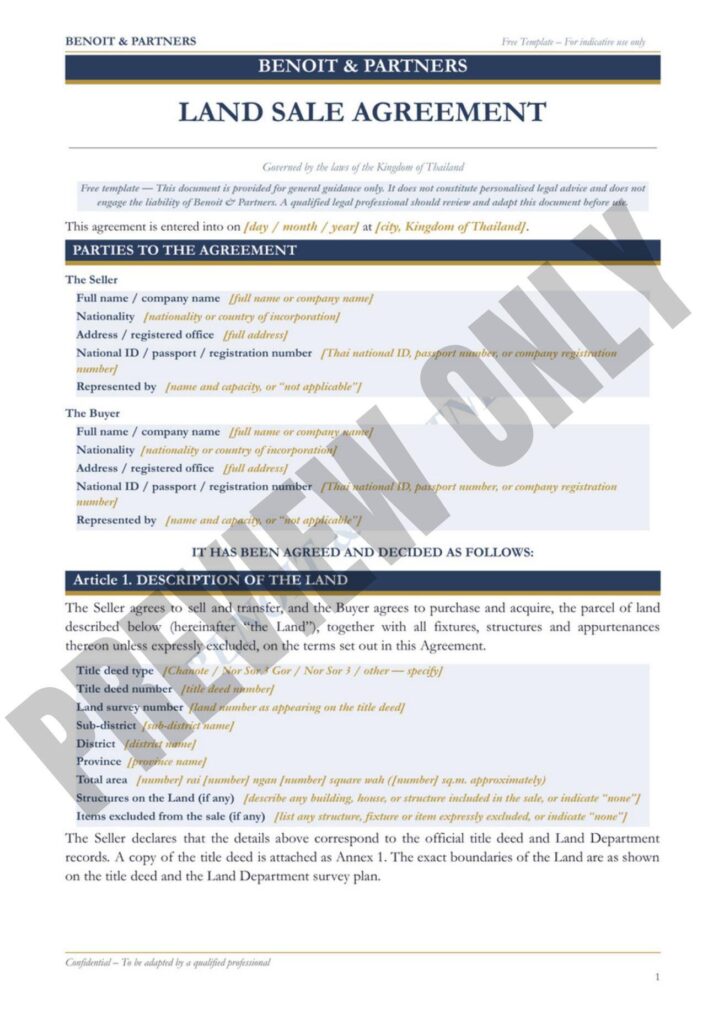
Our Land Sale Agreement Thailand template has been prepared and reviewed by qualified lawyers to ensure full compliance with Thai property law and the practical requirements of land purchase transactions. It provides a solid legal basis for buyers and sellers formalising the transfer of land ownership in Thailand.
Designed for individual buyers, companies, and investors seeking to document a land sale, this template addresses the essential legal provisions: identification of the parties, description of the land and title deed, purchase price and payment terms, seller’s warranties, transfer costs, and regulatory compliance under Thai law. For transactions involving foreign buyers, complex title situations, or significant land areas, our legal team can assist with fully customised Land Sale Agreements within a short timeframe.
Disclaimer : This template is provided for general informational purposes only and does not constitute legal advice. Although prepared by legal professionals, it may not address your specific circumstances or regulatory requirements. For complex transactions, professional legal advice should be sought prior to execution.
Need a Contract Tailored to Your Needs ? Get a Free Consultation.
When should you use a Land Sale Agreement in Thailand?
A Land Sale Agreement is required whenever a seller agrees to transfer ownership of a parcel of land to a buyer in exchange for a purchase price. Under Section 456 of the Civil and Commercial Code, the sale of land must be made in writing and registered at the competent Land Department office to be valid and enforceable, making a properly drafted agreement an essential first step in any land transaction.
This document is used across a wide range of property transactions in Thailand: the purchase of vacant land for development, the acquisition of land with existing structures, transfers between private individuals, and corporate acquisitions of land through eligible Thai entities. It is equally relevant where the transaction involves conditions precedent such as title verification, financing, or regulatory approvals.
The agreement is particularly important given the complexity of land ownership in Thailand. Title deed types vary, from a full Chanote to a Nor Sor 3 Gor, and each carries different legal implications. Encumbrances, servitudes, zoning restrictions, and foreign ownership limitations must all be carefully addressed before any transaction is finalised.
For transactions involving foreign buyers, BOI-promoted entities, or land subject to specific zoning or agricultural classifications, additional provisions are required. Our legal team advises buyers and sellers on structuring land sale agreements that reflect the specific characteristics of each transaction.
Without a properly executed Land Sale Agreement, both parties risk significant legal and financial exposure arising from disputed title, undisclosed encumbrances, or the unenforceability of the transaction under Thai property law.

1. Identification of the parties and description of the land
The agreement must identify the seller and buyer, including their nationality, registration details, and authorised representatives, and provide a precise description of the land, including its title deed type and number, survey number, location, and total area.
2. Purchase price, deposit and payment terms
The agreement must set out the total purchase price, the deposit amount and payment date, the balance payable at transfer, and the accepted payment method. It must also address the consequences of default by either party in line with the Civil and Commercial Code.
3. Conditions precedent and long-stop date
The agreement must specify the conditions that must be satisfied before the sale can be completed, including title verification, financing, and any required government approvals, together with a long-stop date and the consequences of non-satisfaction.
4. Seller's warranties and known encumbrances
The seller must warrant clear and unencumbered title, the absence of pending legal proceedings, payment of all land taxes, and compliance with applicable zoning regulations. Any known encumbrances or servitudes must be expressly disclosed.
5. Foreign ownership and regulatory compliance
Where the buyer is a foreign national or foreign-owned entity, the agreement must address Thai land ownership restrictions under the Land Code and confirm the buyer's eligible basis for acquisition, supported by appropriate evidence where required.
6. Transfer costs, possession and risk
The agreement must allocate responsibility for transfer fee, specific business tax, withholding tax, and stamp duty, and specify the date of physical possession and the point at which risk passes from seller to buyer.
Key clauses and additional protections in a Land Sale Agreement
A Land Sale Agreement is a central legal document governing the transfer of land ownership in Thailand. It defines the rights and obligations of the buyer and seller, establishes the conditions for completing the transaction, and ensures compliance with Thai property law throughout the process.
Under Section 456 of the Civil and Commercial Code, land transfers must be made in writing and registered at the Land Department to be legally valid. A properly drafted agreement protects both parties against disputes over price, title, encumbrances, and the allocation of transaction costs.
This type of agreement is used across a wide range of land transactions in Thailand, from small residential plots to large commercial or agricultural parcels. While a standard template may be adequate for straightforward sales between Thai nationals, transactions involving foreign buyers, complex title structures, or significant financial commitments typically require additional provisions and careful legal structuring.
A properly customised Land Sale Agreement provides stronger legal protection and helps both parties anticipate the risks inherent in a property transaction under Thai law.
Why customise a Land Sale Agreement with a lawyer in Thailand?
While a standard Land Sale Agreement template may be suitable for simple transactions, many land sales in Thailand involve legal, financial, and regulatory considerations that require more advanced drafting and tailored protections.
In practice, each transaction carries its own risk profile. Factors such as the title deed type, the presence of structures on the land, zoning classifications, foreign ownership restrictions, and the financing arrangements of the buyer can significantly affect the legal framework required.
Depending on the transaction, specific provisions may be needed covering title due diligence and encumbrance clearance, conditions precedent and termination rights, deposit protection and escrow arrangements, foreign ownership eligibility and BOI land-holding permissions, allocation of transfer fees and tax obligations, representations regarding zoning and permitted use, possession and risk transfer mechanics, or dispute resolution procedures tailored to the parties involved.
Customising a Land Sale Agreement allows both parties to allocate responsibilities clearly and anticipate risks specific to their transaction. This is particularly important for high-value acquisitions, land with existing structures, or purchases involving foreign nationals or corporate buyers.
Our legal team assists buyers, sellers, and corporate clients with the preparation of land sale agreements adapted to their specific situation. In most cases, a fully customised agreement can be delivered within a short timeframe while ensuring compliance with Thai property and tax law.
A properly drafted agreement reduces the risk of disputes, title defects, regulatory non-compliance, and unexpected financial liabilities arising from an insufficiently documented land transaction.
Land Sale Agreement template
Instant Download
Easy to Customize
Ready to Sign
Crafted by Lawyers
FAQ
What is a Land Sale Agreement in Thailand?
A Land Sale Agreement is a legally binding contract by which a seller transfers ownership of a parcel of land to a buyer in exchange for an agreed purchase price. Under Section 456 of the Civil and Commercial Code, the agreement must be in writing and the transfer must be registered at the Land Department to be valid and enforceable.
When should this agreement be used?
It should be used whenever land is being sold in Thailand, whether vacant or with existing structures, regardless of whether the parties are individuals or corporate entities. It is required both for straightforward sales and for transactions subject to conditions precedent such as financing or title verification.
Can a foreign national purchase land in Thailand?
Generally, foreign nationals and foreign-majority-owned companies are prohibited from owning land in Thailand under the Land Code. Exceptions exist for certain BOI-promoted entities and specific investment thresholds. Foreign buyers should obtain independent legal advice before entering into any land purchase agreement.
What title deed types exist in Thailand?
The main title deed types are the Chanote (Nor Sor 4 Jor), which provides full ownership rights and is the most secure, and the Nor Sor 3 Gor and Nor Sor 3, which offer lesser levels of certainty. The type of title deed significantly affects the legal risks of the transaction and should be verified at the Land Department before signing.
What taxes and fees apply to a land sale in Thailand?
Land sales in Thailand are subject to a transfer fee of 2% of the appraised value, withholding tax calculated on a progressive scale, and either specific business tax at 3.3% or stamp duty at 0.5% depending on how long the seller has held the land. The allocation of these costs between buyer and seller should be clearly set out in the agreement.
What happens to the deposit if the sale does not proceed?
If the buyer fails to complete without valid justification, the deposit is forfeited to the seller. If the seller fails to transfer title without valid justification, the seller must refund double the deposit amount to the buyer, in accordance with the Civil and Commercial Code.
Do I need a lawyer for a land purchase in Thailand?
For straightforward sales between Thai nationals involving a Chanote title, a standard template may be sufficient. For transactions involving foreign parties, complex title situations, significant land areas, or substantial purchase prices, legal assistance is strongly recommended to protect both parties and ensure regulatory compliance.
What happens if the Land Department refuses to register the transfer?
If registration is refused due to a title defect or the buyer’s ineligibility to hold land under Thai law, the agreement must clearly address the consequences — including the treatment of the deposit and any claims for damages. This makes careful pre-transaction due diligence and clear contractual provisions essential.