
Lease Agreement Template in Thailand
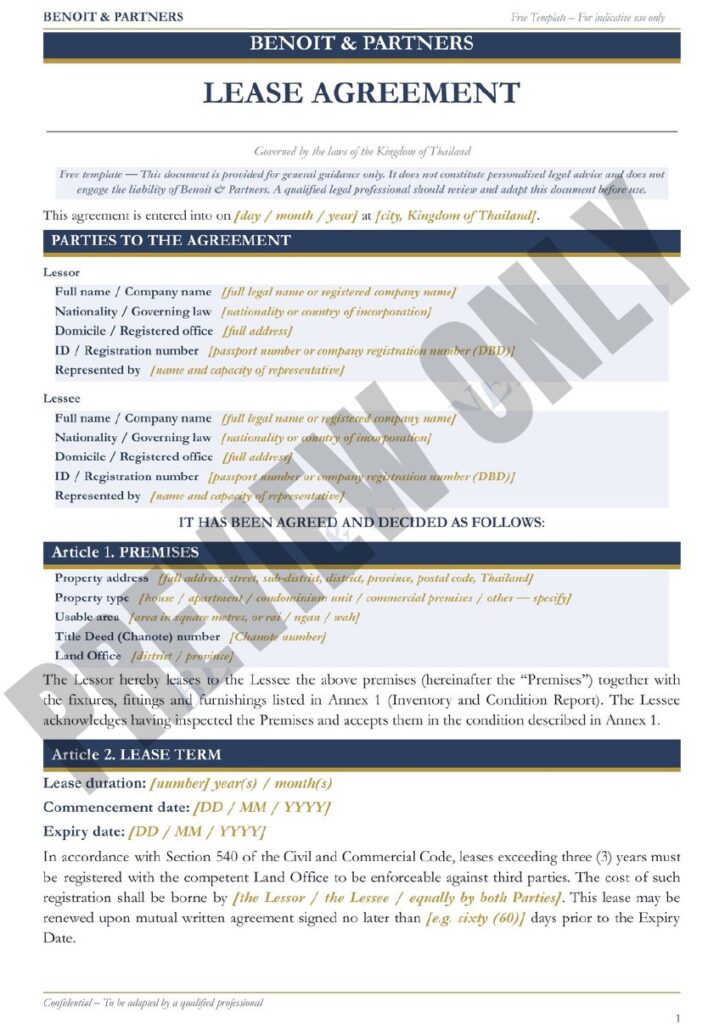
Our Lease Agreement template in Thailand is drafted and reviewed by experienced lawyers to ensure compliance with Thai law and practical business use. It provides a reliable legal framework for standard property rental transactions in Thailand.
Designed for landlords, tenants, and companies involved in the leasing of residential or commercial property, this template covers key legal aspects such as description of the leased premises, rental terms, payment conditions, obligations of the parties, security deposit, and regulatory compliance under Thai law.
However, some transactions may require additional clauses or tailored structuring depending on the nature of the property, foreign ownership restrictions, tax considerations, or commercial risks. Our legal team can assist clients with customised Lease Agreements adapted to their transaction within a short timeframe.
Disclaimer: This template is provided for general informational purposes only and does not constitute legal advice. While it has been prepared by legal professionals, it may not reflect your specific situation or regulatory constraints. For complex or high-value transactions, legal advice should be sought to ensure proper structuring and compliance under Thai law.
Need a Contract Tailored to Your Needs? Get a Free Consultation.
When should you use a Lease Agreement in Thailand?
A Lease Agreement is used whenever a landlord grants a tenant the right to occupy and use a property in Thailand in exchange for rental payments. This situation commonly arises in residential rentals, commercial leases, office space arrangements, industrial property leasing, and long-term land use agreements.
Under Thai law, lease agreements are governed by the Civil and Commercial Code, notably Sections 537 to 571, which regulate the rights and obligations of landlords and tenants, including delivery of the premises, maintenance obligations, and conditions for termination.
This agreement becomes particularly important when the transaction involves significant financial value, long-term occupation, commercial use, foreign tenants, or complex payment structures. It allows the parties to clearly define the terms of the tenancy, including rent amount, payment schedule, permitted use, maintenance responsibilities, and conditions for early termination.
In more complex transactions, additional clauses may be required regarding subletting rights, fit-out works, reinstatement obligations, tax liabilities, stamp duty, dispute resolution, or compliance with foreign business regulations. Our legal team assists clients with the preparation of customised Lease Agreements tailored to their transaction in order to provide stronger legal protection and ensure compliance with Thai law.
In practice, this agreement is also crucial when due diligence has been conducted on the property, as it formalises the allocation of risks identified during the review process.
Without a properly drafted Lease Agreement, parties expose themselves to disputes over rent, maintenance, deposit refund, regulatory issues, and potential unenforceability of the agreement under Thai property law.

1. Identification of the parties and company
A Lease Agreement must clearly identify the landlord and the tenant, including their full legal names, registration details, and addresses, as well as a precise description of the leased premises and its title deed number.
2. Description of the leased premises and permitted use
The agreement must specify the nature of the property, its surface area, condition at handover, and the permitted use authorised by the landlord, whether residential, commercial, or industrial.
3. Rental amount and payment terms
The agreement must define the monthly rent, applicable VAT, payment method, due date, and late payment consequences in accordance with the Civil and Commercial Code.
4. Security deposit and representations
The agreement must specify the security deposit amount, conditions for its retention or refund, and confirm the condition of the premises and the landlord's right to lease the property.
5. Duration, renewal and early termination
The agreement must define the lease term, renewal conditions, notice periods, early termination rights, and registration requirements.
6. Tax, stamp duty and regulatory compliance
The agreement must address stamp duty, VAT and withholding tax on rental income, and compliance with Land Department registration requirements under Thai law.
Key clauses and additional protections in a Lease Agreement
In practice, the clauses that most frequently give rise to disputes in Thailand are not the ones parties think about at signing — they are the ones that were left out or poorly drafted.
Security deposit disputes are among the most common issues encountered by landlords and tenants in Thailand. A well-drafted agreement should specify not only the deposit amount but also the precise conditions under which it may be retained, the timeframe for refund, and the standard of evidence required to justify any deduction — provisions that a generic template rarely addresses adequately.
Subletting and assignment clauses are another frequent source of conflict, particularly in commercial leases. Under Section 544 of the CCC, a tenant may not sublet without the landlord’s consent unless the agreement expressly provides otherwise. Where subletting is anticipated, the conditions must be clearly defined from the outset.
Finally, early termination provisions — including notice periods, break clauses, and financial penalties — are often the most contested aspect of a lease in litigation. Thai courts will interpret ambiguous termination clauses strictly, and the absence of a clear mechanism frequently results in prolonged and costly disputes.
Why customise a Lease Agreement with a lawyer in Thailand?
While a standard Lease Agreement template may be sufficient for simple short-term rentals, many leases involve legal, financial, and regulatory considerations that require more advanced drafting and tailored protections.
In practice, each transaction has its own structure and level of risk. Foreign tenant involvement, commercial use of the premises, fit-out works, subletting arrangements, or long-term occupation may require provisions that a standard template does not adequately address. Depending on the situation, a customised Lease Agreement may need to include:
- Rent review mechanisms and indexation clauses
- Subletting and assignment rights under Section 544 of the CCC
- Fit-out works, reinstatement obligations, and liability allocation
- Security deposit terms and refund conditions under Section 560 of the CCC
- Early termination rights, notice periods, and penalties
- Stamp duty at 0.1% of total rental value under the Thai Revenue Code
- VAT at 7% and withholding tax on rental income where applicable
- PDPA compliance under the Personal Data Protection Act B.E. 2562
- Dispute resolution procedures, including arbitration clauses enforceable under Section 14 of the Thai Arbitration Act
- Compliance with foreign business restrictions under applicable Thai regulations
Tailoring a Lease Agreement allows the parties to better allocate responsibilities and anticipate risks identified during negotiations or legal review — particularly important for high-value commercial leases, long-term agreements, regulated premises, or transactions involving foreign nationals or companies.
Our legal team assists landlords, tenants, and companies with the preparation of customised Lease Agreement Templates adapted to their transaction structure and commercial objectives, within a short timeframe and in full compliance with Thai property and commercial law.
Lease Agreement Template Thailand
Instant Download
Easy to Customize
Ready to Sign
Crafted by Lawyers
FAQ
What is a Lease Agreement in Thailand?
A Lease Agreement is a contract by which a landlord grants a tenant the right to occupy and use a property in exchange for rental payments. In Thailand, it is governed by the Civil and Commercial Code (Sections 537 to 571) and must be registered with the Land Department if it exceeds three years.
Is a Lease Agreement Template legally binding in Thailand?
Yes. A Lease Agreement is legally binding upon signature by both parties. However, leases exceeding three years must be registered with the Land Department to be enforceable against third parties, in accordance with the Civil and Commercial Code.
Does a Lease Agreement need to be registered in Thailand?
Only leases exceeding three years are required to be registered with the Land Department to be enforceable against third parties. Leases of three years or less are binding between the parties without registration, though registration is always recommended for greater legal protection.
What are the stamp duty obligations for a Lease Agreement in Thailand?
Lease agreements in Thailand are subject to stamp duty under the Thai Revenue Code, calculated at 0.1% of the total rental value over the lease term. Stamp duty must be paid within 15 days of execution to avoid penalties and surcharges.
Can a foreigner sign a Lease Agreement in Thailand?
Yes. Foreign nationals and foreign companies can enter into Lease Agreements in Thailand. However, foreigners cannot own land in Thailand and may only lease it. Long-term leases of up to 30 years are permitted and must be registered with the Land Department.
Do I need a lawyer to draft a Lease Agreement Template in Thailand?
For simple short-term rentals, a standard template may be sufficient. For commercial leases, long-term agreements, high-value properties, or transactions involving foreign parties, legal assistance is strongly recommended to ensure compliance with Thai law and protect the parties’ interests.
What happens if the tenant fails to pay rent in Thailand?
Under the Civil and Commercial Code, the landlord may terminate the lease and seek compensation for unpaid rent and damages. A well-drafted Lease Agreement should include specific provisions on late payment penalties, notice periods, and the landlord’s right to terminate in case of persistent default.
How does the PDPA apply to Lease Agreements in Thailand?
If the agreement involves the exchange of personal data between the parties — such as identification documents or contact details — both parties must comply with the Personal Data Protection Act B.E. 2562 (2019). The agreement should include appropriate confidentiality and data processing provisions to ensure full compliance.