
Leasehold Agreement in Thailand
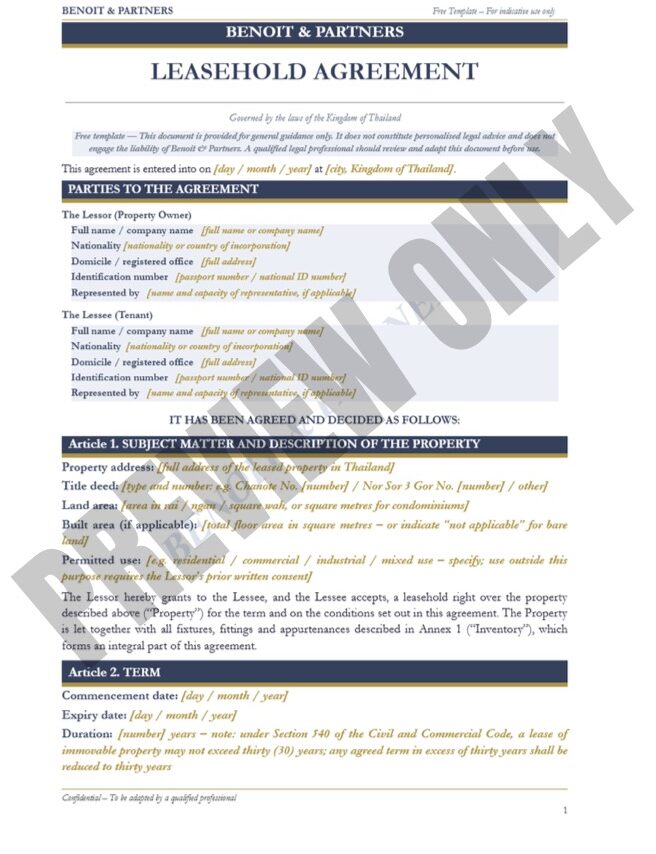
Our Leasehold Agreement Thailand is drafted and reviewed by experienced lawyers to ensure compliance with Thai law and practical business use. It provides a reliable legal framework for formally documenting a long-term leasehold arrangement over land or property in Thailand between a lessor and a lessee.
Designed for property owners, investors, and individuals — including foreign nationals — seeking to formally document a long-term leasehold interest in Thailand, this template covers key legal aspects such as identification of the parties, description of the leased property, lease term and renewal arrangements, rent and payment terms, registration requirements, and compliance with the Civil and Commercial Code provisions governing leases of immovable property.
However, some situations may require additional clauses or tailored structuring depending on the length of the lease term, whether the lessee is a foreign individual or entity, the inclusion of renewal or purchase options, or the treatment of improvements made to the property during the lease. Our legal team can assist clients with customised Leasehold Agreements adapted to their specific situation within a short timeframe.
Disclaimer: This template is provided for general informational purposes only and does not constitute legal advice. While it has been prepared by legal professionals, it may not reflect your specific situation or regulatory constraints. For long-term leases or arrangements involving foreign lessees, legal advice should be sought to ensure proper structuring and compliance under Thai property law.
Need a Contract Tailored to Your Needs? Get a Free Consultation.
When should you use a Leasehold Agreement in Thailand?
A Leasehold Agreement in Thailand is the appropriate instrument when a property owner wishes to grant another party the right to occupy and use land or property for an extended period in exchange for rent, without transferring ownership of the underlying asset. Leasehold structures are particularly significant in Thailand as a means by which foreign nationals can secure long-term rights over land, given the restrictions that generally prevent direct foreign land ownership.
Leases of immovable property in Thailand are governed by the Civil and Commercial Code, which limits the maximum term of a lease to thirty years, renewable for further periods upon expiry, and requires that any lease exceeding three years be registered at the competent Land Office to be enforceable for its full term against third parties. Leases not properly registered are generally only enforceable for a maximum of three years, regardless of the term stated in the agreement.
Documenting the arrangement through a properly structured leasehold agreement carries substantial practical advantages. It provides legal certainty as to the term, rent, and respective obligations of the parties, and critically ensures that the lease can be registered to secure its enforceability for the full agreed duration, which is essential for any leasehold arrangement intended to provide long-term security of tenure.
More complex arrangements may require additional provisions addressing renewal options and their enforceability under Thai law, the treatment of structures or improvements built by the lessee during the term, assignment and subletting rights, or the interaction between the leasehold and any superstructure ownership the lessee may hold over buildings constructed on the leased land. Our legal team is available to assist with tailored agreements that address these dimensions with care.
Entering into a long-term occupation arrangement without a properly drafted and registered leasehold agreement significantly undermines the security the arrangement is intended to provide, particularly for foreign lessees relying on the lease as their primary means of securing long-term rights over Thai land.

1. Identification of the Parties
The agreement should state the full names, addresses, and identification or company registration details of both the lessor and the lessee, together with confirmation of the lessor's ownership of the property being leased.
2. Description of the Leased Property
The agreement should precisely identify the land or property being leased, referencing the title deed number, location, and area, and should specify whether the lease covers the land alone or includes any existing structures.
3. Lease Term and Registration
The agreement should state the agreed lease term, not exceeding thirty years under Thai law, and confirm the parties' obligation to register the lease at the competent Land Office where the term exceeds three years, specifying which party bears the registration costs and fees.
4. Rent and Payment Terms
The agreement should state the rent payable, whether as a lump sum paid upfront, an annual or periodic payment, or a combination of both, together with the payment schedule and the consequences of late or non-payment.
5. Renewal Options
Where the parties intend for the lease to be renewable, the agreement should set out the terms of any renewal option, while recognising that under Thai law a promise to renew is generally treated as a personal obligation between the original parties rather than a right that automatically binds successors in title.
6. Improvements and Structures
The agreement should address the lessee's rights, if any, to construct buildings or make improvements on the leased land, and should specify the ownership and treatment of any such structures upon expiry or termination of the lease.
Key Clauses and Essential Elements in a Leasehold Agreement
A well-drafted Leasehold Agreement in Thailand gives both the lessor and the lessee a clear and legally robust framework governing the use and occupation of the property throughout the lease term. It defines the respective rights and obligations of the parties and, critically, ensures the agreement meets the formal requirements necessary for registration and full legal enforceability.
Under the Civil and Commercial Code, a lease exceeding three years must be made in writing and registered at the Land Office to be enforceable for its full term. A properly structured agreement is drafted with this registration requirement in mind from the outset, avoiding the common pitfall of an unregistered long-term lease being reduced to a three-year enforceability ceiling.
This document is relevant across a wide range of leasehold arrangements in Thailand from residential land leases secured by foreign nationals to commercial and agricultural leasehold structures and the core structure remains consistent, though specific provisions relating to renewal, improvements, and registration will vary according to the term and purpose of the lease.
Why customise a Leasehold Agreement with a lawyer in Thailand?
A standard template of Leasehold Agreement in Thailand is suitable for simple, shorter-term leases, but long-term leasehold arrangements particularly those involving foreign lessees call for a carefully tailored agreement given the legal complexities involved.
The length of the lease term, the nationality of the lessee, and the presence of renewal options or planned improvements all significantly shape what the agreement needs to address and how the lessee’s long-term interests can best be protected under Thai law.
Depending on the situation, the agreement may need to address: the enforceability of renewal options and the practical and legal mechanisms available to strengthen a lessee’s renewal expectations; the structuring of superstructure ownership where the lessee intends to build on the leased land; the registration process and associated costs at the Land Office; the treatment of the leasehold interest in the event of the lessor’s death or transfer of the underlying land; or specific protections for foreign lessees relying on the lease as a long-term substitute for land ownership.
Our legal team works with landowners and lessees, including foreign nationals, to prepare leasehold agreements that are legally robust, properly structured for registration, and tailored to provide the maximum security available under Thai property law.
Leasehold Agreement Thailand
Instant Download
Easy to Customize
Ready to Sign
Crafted by Lawyers
FAQ
What is a Leasehold Agreement in Thailand?
A written contract granting a lessee the right to occupy and use land or property for an agreed term in exchange for rent, without transferring ownership, structured to comply with the registration and enforceability requirements of the Civil and Commercial Code.
What is the maximum lease term allowed in Thailand?
Under the Civil and Commercial Code, a lease of immovable property may not exceed thirty years. Leases may be renewed upon expiry, but each renewal is subject to the same thirty-year statutory ceiling and its own registration requirements.
Is registration required for a long-term lease in Thailand?
Yes. Any lease with a term exceeding three years must be registered at the competent Land Office to be enforceable for its full agreed duration against third parties. An unregistered lease exceeding three years is generally only enforceable for a maximum of three years.
Can foreign nationals lease land in Thailand?
Yes. Long-term leasehold arrangements are a common and legally recognised means by which foreign nationals secure rights over Thai land, given the general restrictions on direct foreign land ownership. A properly structured and registered lease provides meaningful long-term security.
Are renewal options in a Thai lease legally enforceable?
Thai courts have generally treated a promise to renew a lease as a personal contractual obligation between the original parties, rather than a right that automatically transfers to successors in title or binds a new owner of the property. Lessees relying on renewal expectations should seek specific legal advice on how to strengthen this protection.
What happens to buildings constructed by a lessee on leased land in Thailand?
This depends on the terms of the lease. The agreement should specify whether any structures built by the lessee become the property of the landowner upon expiry, whether the lessee is entitled to compensation, or whether the lessee retains separate ownership of the superstructure during the lease term.
Can a leasehold interest in Thailand be sold or transferred?
A leasehold interest may generally be assigned or the property sublet only where the lease agreement permits this and, typically, only with the lessor’s consent. The agreement should clearly address the conditions under which assignment or subletting is allowed.
How does the PDPA apply to a Leasehold Agreement in Thailand?
The agreement contains personal data relating to both the lessor and the lessee. Under the Personal Data Protection Act B.E. 2562 (2019), this information should be used only for purposes connected with the lease and its registration, and stored securely by both parties.