
Leave of Absence Request Letter Thailand
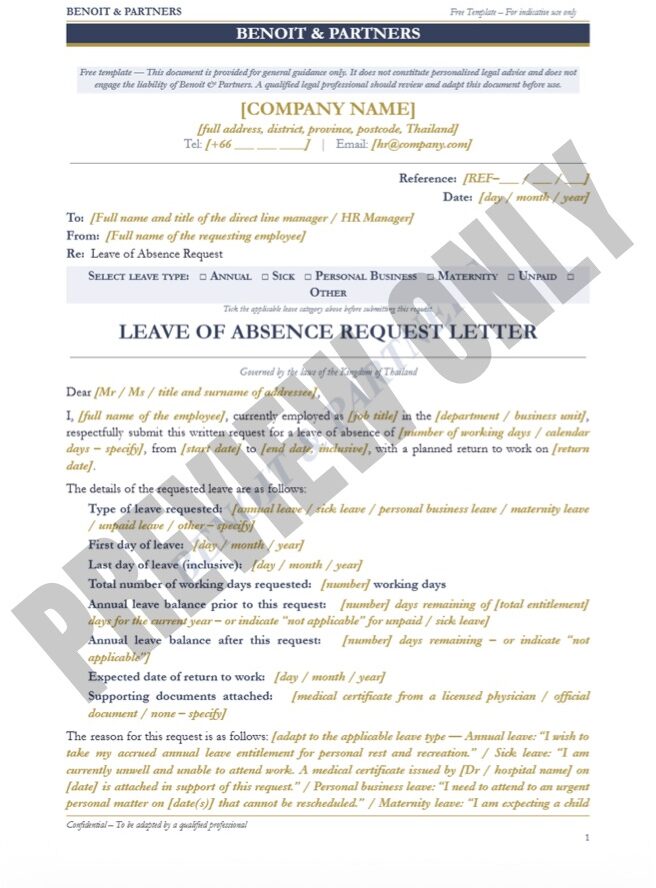
Our Leave of Absence Request Letter in Thailand is drafted and reviewed by experienced lawyers to ensure compliance with Thai law and practical business use. It provides a reliable legal framework for formally requesting or granting a period of leave from employment in Thailand.
Designed for employees, executives, and individuals seeking to formally request a leave of absence from their employer in Thailand, this template covers key legal aspects such as identification of the parties, duration and type of leave, conditions applicable during the leave period, return to work arrangements, and compliance with applicable Thai employment and labour regulations.
However, some situations may require additional clauses or tailored structuring depending on the seniority of the position, the terms of the existing employment contract, the nature and grounds of the leave requested, or the specific circumstances surrounding the absence. Our legal team can assist clients with customised Leave of Absence documents adapted to their specific situation within a short timeframe.
Disclaimer: This template is provided for general informational purposes only and does not constitute legal advice. While it has been prepared by legal professionals, it may not reflect your specific situation or regulatory constraints. For complex or senior-level employment situations, legal advice should be sought to ensure proper structuring and compliance under Thai employment law.
Need a Contract Tailored to Your Needs? Get a Free Consultation.
When should you use a Leave of Absence document in Thailand?
A Leave of Absence document in Thailand is used whenever an employee wishes to formally request, or an employer wishes to formally grant, a period of absence from work beyond standard annual leave entitlements in Thailand. This situation commonly arises in connection with personal or family circumstances, medical conditions, parental responsibilities, educational pursuits, or other exceptional situations requiring an extended period away from work.
Under Thai law, employment relationships and leave entitlements are primarily governed by the Labour Protection Act B.E. 2541 (1998) and its amendments, which establish minimum statutory leave entitlements including annual leave, sick leave, maternity leave, and leave for certain personal matters. Where an employee requires leave beyond these statutory entitlements, the terms of any additional leave must be agreed between the parties and documented in writing.
This document becomes particularly important when an employee wishes to formally place their leave request on record, confirm the agreed duration and conditions of the absence, and establish a clear framework for the return to work. It allows both parties to clearly set out the terms of the leave, address the treatment of remuneration and benefits during the absence, and confirm the employee’s right to return to their position upon completion of the leave period.
In more complex situations, additional considerations may arise regarding the interaction between the leave of absence and existing contractual provisions, the treatment of accruing benefits and entitlements during the leave period, applicable social security implications, or the circumstances in which the leave is being requested. Our legal team assists clients with the preparation of customised Leave of Absence documents tailored to their specific employment situation and objectives under Thai employment law.
In practice, a formal written leave of absence agreement also provides both parties with documentary evidence of the agreed terms, which may be relevant in the context of any subsequent employment dispute or negotiation regarding the employee’s entitlements upon return.

1. Identification of the Parties
The document must clearly identify the employee requesting or taking the leave and the employer granting it, including the employee's full name, current position, department, and the date on which the document is issued.
2. Type and Grounds of Leave
The document must specify the type of leave being requested or granted and the grounds on which it is based, whether personal, medical, parental, educational, or otherwise, to provide a clear basis for the agreed absence and any conditions attached to it.
3. Duration of Leave
The document must set out the agreed start and end dates of the leave period, including any provisions for extension or early return, to provide both parties with a clear timeline for the absence and the expected return to work date.
4. Treatment of Remuneration and Benefits
The document must address the treatment of the employee's salary and other benefits during the leave period, specifying whether the leave is paid or unpaid, and confirming the status of any ongoing benefit entitlements such as health insurance, provident fund contributions, and social security during the absence.
5. Return to Work Arrangements
The document must confirm the employee's right to return to their position or an equivalent role upon completion of the leave period, and set out any conditions or procedures applicable to the return to work, including any requirement to provide advance notice of the intended return date.
6. Conditions During the Leave Period
The document should set out any conditions applicable to the employee during the leave period, including any restrictions on taking up alternative employment, obligations to remain contactable in specified circumstances, and the continued application of confidentiality and other post-termination obligations.
Key Clauses and Essential Elements in a Leave of Absence Request Letter
A Leave of Absence Request Letter is a key professional instrument formally setting out the terms on which an employee will be absent from work for an extended period in Thailand. It provides both parties with a clear and well-structured framework for managing the absence and ensures that the agreed terms are formally documented in accordance with good employment practice.
Under the Labour Protection Act, any agreed variation of employment terms, including arrangements for an extended period of absence, should be documented in writing to provide clarity and avoid future disputes. A properly drafted Leave of Absence document helps establish this framework in a professional and legally appropriate manner.
This type of document is commonly used by employees at all levels of seniority, including executives, managers, technical specialists, and professional staff, in both local and international companies operating in Thailand.
While standard situations may rely on a general template, more complex leave arrangements often require tailored content depending on the grounds for the absence and the specific terms of the existing employment arrangement.
Why customise a Leave of Absence Request Letter with a lawyer in Thailand?
While a standard Leave of Absence Thailand may be sufficient for straightforward absence situations, some employment circumstances involve legal, contractual, and strategic considerations requiring more careful drafting and a tailored approach.
In practice, each leave of absence has its own context and level of sensitivity. Extended medical leave, parental leave arrangements beyond statutory entitlements, leave granted in the context of a broader employment negotiation, or absences involving senior executives or foreign nationals may all require a more carefully structured approach than a standard template provides.
Depending on the situation, specific considerations may arise relating to the interaction between the leave of absence and statutory leave entitlements under the Labour Protection Act, the treatment of accruing annual leave and other benefits during the absence period, social security contribution obligations during unpaid leave, the enforceability of conditions imposed during the leave period, the employee’s right to return to their original or an equivalent position, provident fund contribution arrangements during the absence, PDPA compliance in respect of personal data included in the document, or the strategic approach to the leave arrangement in the context of a broader employment relationship or negotiation.
Tailoring a Leave of Absence Thailand document also allows both parties to address potential areas of uncertainty in advance, ensure that the agreed terms are clearly and accurately recorded, and create a solid framework for managing both the absence and the return to work. This is particularly important for senior employees, foreign nationals, or situations where the leave of absence forms part of a broader arrangement regarding the terms of the employment relationship.
Our legal team assists employees, executives, and companies with the preparation and review of customised Leave of Absence documents for Thailand adapted to their specific employment situation and objectives. In many cases, tailored documents can be prepared within a short timeframe while ensuring full compliance with Thai labour and employment law.
Leave of Absence Request Letter Thailand
Instant Download
Easy to Customize
Ready to Sign
Crafted by Lawyers
FAQ
What is a Leave of Absence in Thailand?
A formally agreed period of absence from work beyond an employee’s standard statutory leave entitlements, the terms of which are documented in writing and agreed between the employee and the employer, covering the duration, treatment of remuneration and benefits, and return to work arrangements.
What statutory leave entitlements does an employee have in Thailand?
Under the Labour Protection Act, employees in Thailand are entitled to a minimum of six days of annual leave per year after one year of continuous service, sick leave of up to thirty working days per year, maternity leave of up to ninety eight days, and leave for certain personal matters including sterilisation and military service. Any leave beyond these statutory entitlements must be agreed contractually.
Is a leave of absence paid or unpaid in Thailand?
This depends on the type of leave and the terms agreed between the parties. Statutory leave entitlements are generally paid in accordance with the Labour Protection Act. Leave beyond statutory entitlements may be paid or unpaid depending on the employer’s policy and any agreement reached with the employee.
Can an employer refuse a leave of absence request in Thailand?
For statutory leave entitlements, the employer cannot refuse the employee’s right to take the leave, although the timing may be subject to reasonable operational requirements. For leave beyond statutory entitlements, the employer has greater discretion, although a refusal in circumstances that amount to constructive dismissal may give rise to a legal claim.
Does an employee have the right to return to their position after a leave of absence in Thailand?
This depends on the terms of the leave agreement. A properly drafted Leave of Absence document should confirm the employee’s right to return to their original position or an equivalent role, to avoid disputes about the employee’s position upon return.
What are the social security implications of unpaid leave in Thailand?
During a period of unpaid leave, social security contribution obligations may be affected depending on the duration of the absence and the applicable regulations. Both the employee and the employer should consider these implications when agreeing the terms of the leave.
Can a leave of absence be extended in Thailand?
Yes, provided that both parties agree to the extension and the revised terms are documented in writing. A properly drafted Leave of Absence document should include provisions addressing the process for requesting and agreeing an extension of the leave period.
How does the PDPA apply to a Leave of Absence document in Thailand?
Where the document contains personal data such as the employee’s medical information or other sensitive personal details, both parties should handle that data in accordance with the Personal Data Protection Act B.E. 2562 (2019), ensuring that it is used only for the purpose of managing the leave arrangement and handled with appropriate confidentiality.