
Letter of Guarantee Thailand
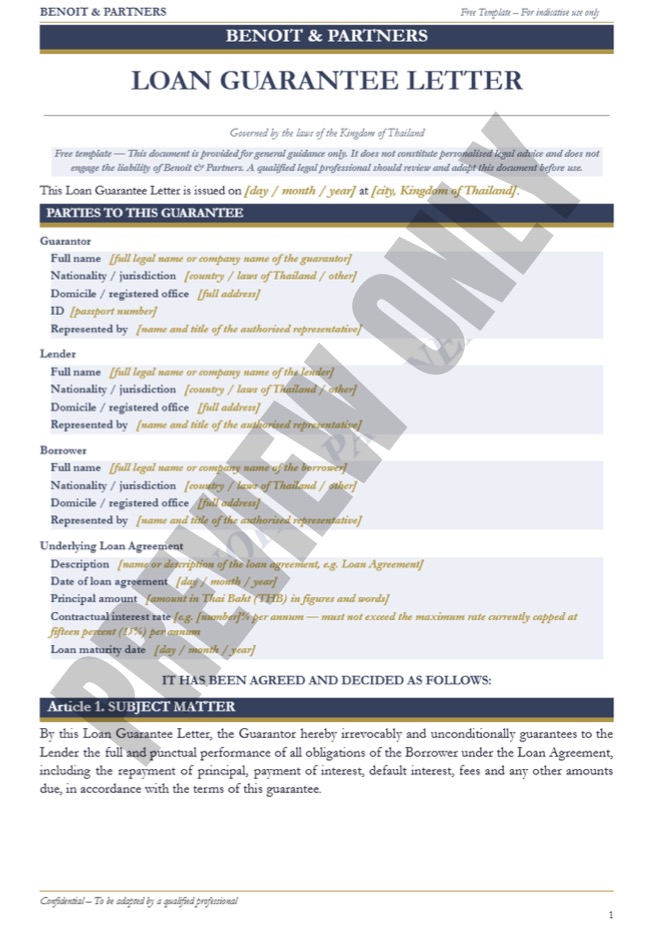
Our Letter of Guarantee for Thailand is drafted and reviewed by experienced lawyers to ensure compliance with Thai law and practical business use. It provides a reliable legal framework for standard guarantee transactions between individuals or companies in Thailand.
Designed for guarantors, creditors, and companies involved in personal or commercial guarantee arrangements in Thailand, this template covers key legal aspects such as identification of the parties, scope and extent of the guarantee, guaranteed obligations, conditions for enforcement, duration of the guarantee, and regulatory compliance under Thai law.
However, some transactions may require additional clauses or tailored structuring depending on the nature of the guaranteed obligation, foreign guarantor or creditor involvement, tax considerations, or commercial risks. Our legal team can assist clients with customised Letters of Guarantee adapted to their transaction within a short timeframe.
Disclaimer: This template is provided for general informational purposes only and does not constitute legal advice. While it has been prepared by legal professionals, it may not reflect your specific situation or regulatory constraints. For complex or high-value transactions, legal advice should be sought to ensure proper structuring and compliance under Thai law.
Need a Contract Tailored to Your Needs? Get a Free Consultation.
When should you use a Letter of Guarantee in Thailand?
A Letter of Guarantee is used whenever a third party — the guarantor — commits to fulfilling the obligations of a principal debtor towards a creditor in the event that the debtor fails to perform. This situation commonly arises in commercial lending arrangements, real estate transactions, construction and supply contracts, employment agreements, and cross-border business dealings where additional security is required.
Under Thai law, guarantees are governed by the Civil and Commercial Code B.E. 2468 (1925), notably Sections 680 to 701, which regulate the rights and obligations of guarantors and creditors, including the conditions for enforcement, the guarantor’s right of recourse against the principal debtor, and the extent of the guarantor’s liability. A guarantee must be made in writing and signed by the guarantor to be enforceable under Thai law.
This document becomes particularly important when the transaction involves significant financial value, foreign parties, complex underlying obligations, or situations where the creditor requires additional comfort beyond the primary debtor’s covenant. It allows the parties to clearly define the scope of the guarantee, the guaranteed amount, the conditions for calling on the guarantee, and any limitations on the guarantor’s liability.
In more complex transactions, additional clauses may be required regarding the guarantor’s right of recourse, limitations on liability, conditions precedent to enforcement, the interaction between the guarantee and any other security provided, or compliance with Bank of Thailand regulations on guarantees provided by or to foreign entities. Our legal team assists clients with the preparation of customised Letters of Guarantee tailored to their transaction in order to provide stronger legal protection and ensure compliance with Thai law.
In practice, this document is also crucial when the guarantee is provided by a company, as it must be authorised by the appropriate corporate bodies and may require specific formalities depending on the guarantor’s constitution and applicable regulations.
Without a properly drafted Letter of Guarantee, parties expose themselves to disputes over the scope of the guarantee, conditions for enforcement, liability limits, and potential unenforceability of the guarantee under Thai law.

1. Identification of the Parties
The document must clearly identify the guarantor, the principal debtor, and the creditor, including their full legal names, registration details, and addresses, as well as the capacity in which each party enters into the guarantee arrangement.
2. Description of the Guaranteed Obligation
The document must specify the nature and extent of the underlying obligation being guaranteed, including the relevant contract or agreement, the guaranteed amount, and the currency in which the guarantee is denominated.
3. Scope and Extent of the Guarantee
The document must define whether the guarantee is a full or partial guarantee, whether it is a demand guarantee or a conditional guarantee, and whether the guarantor's liability is joint and several with the principal debtor or limited to a secondary obligation arising upon default.
4. Conditions for Enforcement
The document must set out the conditions under which the creditor may call on the guarantee, including any notice requirements, the evidence of default required, and any limitations on the creditor's right to enforce directly against the guarantor without first proceeding against the principal debtor.
5. Duration and Expiry
The document must specify the duration of the guarantee, including its start date, expiry date or event, and the procedure for release of the guarantor upon satisfaction of the guaranteed obligation or expiry of the guarantee period.
6. Guarantor's Right of Recourse
The document must address the guarantor's right to seek reimbursement from the principal debtor following any payment made under the guarantee, in accordance with Sections 693 to 701 of the Civil and Commercial Code.
Key Clauses and Essential Elements in a Letter of Guarantee
A Letter of Guarantee is a key legal document governing the commitment of a guarantor to answer for the obligations of a principal debtor in Thailand. It defines the rights and obligations of the guarantor and the creditor while ensuring compliance with Thai civil and commercial law.
Under the Civil and Commercial Code, a guarantee must be in writing and signed by the guarantor to be valid and enforceable. A properly drafted Letter of Guarantee helps secure the underlying transaction and reduce legal risk for all parties involved.
This type of document is commonly used in private and commercial lending, real estate and construction transactions, supply and service agreements, employment arrangements, and cross-border commercial dealings.
While standard transactions may rely on a general template, more complex arrangements often require additional legal protections and customised clauses depending on the nature of the guaranteed obligation and the risks involved.
Why customise a Letter of Guarantee with a lawyer in Thailand?
While a standard Letter of Guarantee template for Thailand may be sufficient for simple guarantee arrangements, many guarantees involve legal, financial, and regulatory considerations requiring more advanced drafting and tailored protections.
In practice, each transaction has its own structure and level of risk. Foreign guarantor or creditor involvement, corporate guarantee requirements, complex underlying obligations, or multi-party security arrangements may require provisions that are not included in a standard template.
Depending on the transaction, specific clauses may be added relating to the scope and cap on the guarantor’s liability, conditions precedent to enforcement and notice requirements, the interaction between the guarantee and other security instruments such as mortgages or pledges, the guarantor’s waiver of rights under Sections 688 to 692 of the Civil and Commercial Code, foreign exchange and repatriation considerations for cross-border guarantees, withholding tax implications on guarantee fees or payments, stamp duty obligations under the Thai Revenue Code, PDPA compliance where personal data is exchanged, dispute resolution procedures and governing law, or compliance with Bank of Thailand regulations on guarantees provided by or to foreign entities.
Tailoring a Letter of Guarantee also allows the parties to better allocate risks, anticipate enforcement scenarios, and ensure that the guarantee is properly structured and enforceable under Thai law. This is particularly important for high-value commercial transactions, cross-border arrangements, regulated industries, or situations involving corporate guarantors subject to specific constitutional or regulatory requirements.
Our legal team assists creditors, guarantors, and companies with the preparation and review of customised Letters of Guarantee for Thailand adapted to their transaction structure and commercial objectives. In many cases, tailored documents can be prepared within a short timeframe while ensuring compliance with Thai civil, commercial, and tax law.
A properly drafted Letter of Guarantee not only helps secure the underlying transaction, but also reduces the risk of future disputes, enforcement difficulties, and unexpected liabilities for all parties involved.
Letter of Guarantee Thailand
Instant Download
Easy to Customize
Ready to Sign
Crafted by Lawyers
FAQ
What is a Letter of Guarantee in Thailand?
A Letter of Guarantee is a written commitment by which a guarantor undertakes to fulfil the obligations of a principal debtor towards a creditor in the event of the debtor’s default. In Thailand, it is governed by the Civil and Commercial Code, Sections 680 to 701, and must be made in writing and signed by the guarantor to be enforceable.
Is a Letter of Guarantee legally binding in Thailand?
Yes. A Letter of Guarantee is legally binding upon signature by the guarantor, provided it is made in writing in accordance with Section 680 of the Civil and Commercial Code. A guarantee made orally or without the guarantor’s signature is not enforceable under Thai law.
Can a foreigner act as guarantor under a Thai Letter of Guarantee?
Yes. Foreign nationals and foreign companies can act as guarantors under a Letter of Guarantee governed by Thai law. However, cross-border guarantee arrangements may be subject to Bank of Thailand reporting requirements and foreign exchange regulations, and guarantee fees paid to foreign guarantors may be subject to withholding tax under Thai law.
What is the extent of a guarantor's liability under Thai law?
Under the Civil and Commercial Code, a guarantor’s liability is generally co-extensive with that of the principal debtor, meaning it covers the principal debt, interest, damages, and costs of enforcement. However, the parties may contractually limit the guarantor’s liability to a specified maximum amount. A guarantor who has paid the creditor is subrogated to the creditor’s rights against the principal debtor.
Does a Letter of Guarantee need to be registered in Thailand?
A Letter of Guarantee itself does not generally require registration. However, if the guarantee is connected to a security interest over immovable property, such as a mortgage, that security must be registered with the Land Department to be enforceable against third parties. Stamp duty must be paid within 15 days of execution.
What are the stamp duty obligations for a Letter of Guarantee in Thailand?
Letters of Guarantee in Thailand are subject to stamp duty under the Thai Revenue Code. The applicable rate depends on the nature of the guaranteed obligation. Stamp duty must be paid within 15 days of execution to avoid penalties and surcharges.
What happens if the principal debtor defaults and the guarantor is called upon?
Under the Civil and Commercial Code, the creditor may demand performance from the guarantor upon the principal debtor’s default, subject to any conditions set out in the Letter of Guarantee. The guarantor may raise certain defences available to the principal debtor. Following payment, the guarantor has a right of recourse against the principal debtor for all amounts paid, together with interest and costs.
Can a creditor proceed directly against the guarantor without first pursuing the principal debtor?
Under Thai law, a guarantor may require the creditor to first exhaust its remedies against the principal debtor before proceeding against the guarantor, unless the guarantor has expressly waived this right in the Letter of Guarantee. Whether such a waiver is included is a key drafting consideration that should be carefully reviewed.