
Letter of Warning to Employee in Thailand
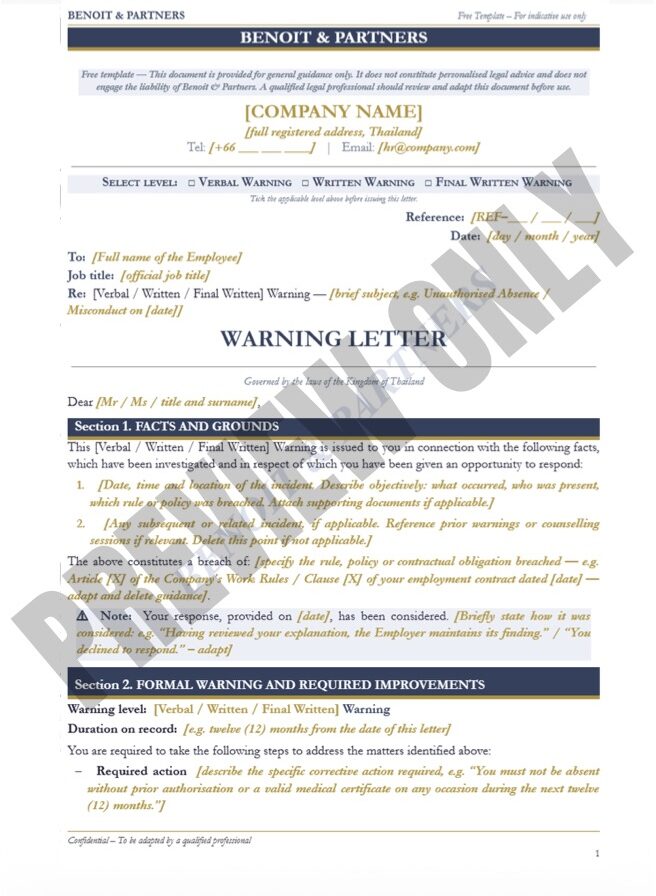
Our Letter of Warning to Employee in Thailand is drafted and reviewed by experienced lawyers to ensure compliance with Thai law and practical business use. It provides a reliable legal framework for formally notifying an employee of a performance or conduct issue, and for creating the documentary record necessary to support any subsequent disciplinary action under Thai employment law.
Designed for employers, HR departments, and companies managing employee performance or conduct issues in Thailand, this template covers key legal aspects such as identification of the parties, description of the conduct or performance issue, the required improvement or corrective action, the consequences of continued non-compliance, and compliance with the Labour Protection Act and other applicable Thai employment regulations.
However, some situations may require additional clauses or tailored structuring depending on the nature of the issue, the seniority of the employee, the sector of activity, the terms of the employment contract or work rules, or the specific disciplinary procedure applicable in the workplace. Our legal team can assist clients with customised Letters of Warning adapted to their specific situation within a short timeframe.
Disclaimer: This template is provided for general informational purposes only and does not constitute legal advice. While it has been prepared by legal professionals, it may not reflect your specific situation or regulatory constraints. For complex or senior-level disciplinary matters, legal advice should be sought to ensure proper structuring and compliance under Thai employment law.
Need a Contract Tailored to Your Needs? Get a Free Consultation.
When should you use a Letter of Warning to Employee in Thailand?
A Letter of Warning to Employee in Thailand is used whenever an employer wishes to formally notify an employee that their conduct, performance, or behaviour has fallen below the required standard, and to place them on notice that continued failure to meet expectations may result in further disciplinary action, including termination of employment. This situation commonly arises in performance management processes, disciplinary proceedings following misconduct, repeated absences or lateness, failure to comply with workplace policies, or any other situation where the employer needs to formally document a concern about the employee’s conduct or performance.
Under Thai law, employment relationships and disciplinary procedures are governed by the Labour Protection Act B.E. 2541 (1998) and its amendments, as well as by the employer’s work rules registered with the Department of Labour Protection and Welfare. Employers with ten or more employees are required to maintain written work rules setting out disciplinary procedures, and disciplinary action taken in accordance with those rules is essential to support any subsequent termination for cause without severance pay under Section 119 of the Labour Protection Act.
This document is key in a progressive disciplinary process, as it formally records the employer’s concerns, the employee’s awareness, and the chance to improve before further action. It clearly sets out the issue, expected standards, required improvements, timeframe, and consequences if performance does not improve.
In more complex cases, provisions may cover the link with internal work rules, the appropriate level of warning, the employee’s right to respond, involvement of representatives or unions, and situations involving potential criminal liability. Our legal team drafts customised Letters of Warning tailored to each disciplinary case and Thai employment law requirements.
In practice, issuing a properly drafted Letter of Warning is a critical step in building a defensible disciplinary record, as it demonstrates that the employer followed a fair and procedurally compliant process before taking any further action, which is essential to resist claims for unfair dismissal before the Labour Court.

1. Identification of the Parties
The letter must clearly identify the employer and the employee, including the employer's full legal name, the employee's full name, position, department, and employee identification details, and the name and title of the authorised representative issuing the warning on behalf of the employer.
2. Description of the Conduct or Performance Issue
The letter must clearly describe the conduct or performance issue, including relevant dates, any prior informal discussions, and the specific policy, work rule, or performance standard that has been breached.
3. Level of Warning
The letter must state the warning level—first, second, or final written warning—in line with the employer’s work rules and disciplinary framework.
4. Required Improvement and Corrective Action
The letter must clearly set out the specific improvement or corrective action required from the employee, the standard of conduct or performance that must be achieved, and the timeframe within which the required improvement must be demonstrated.
5. Opportunity to Respond
The letter should provide the employee with a formal opportunity to respond to the allegations set out in the warning, whether in writing or at a meeting with the employer, and confirm the procedure and deadline for doing so, in accordance with principles of procedural fairness and the employer's work rules.
6. Consequences of Continued Non-Compliance
The letter must clearly state the consequences of any continued failure to meet the required standard, including the possibility of a further warning, suspension, or termination of employment, and confirm whether any further breach may result in dismissal without notice or severance pay under Section 119 of the Labour Protection Act.
Key Clauses and Essential Elements in a Letter of Warning to Employee
A Letter of Warning to Employee is a key disciplinary document formally recording an employer’s concerns about an employee’s conduct or performance in Thailand. It sets out the nature of the issue, the required improvement, and the consequences of continued non-compliance, in accordance with the Labour Protection Act and the employer’s registered work rules.
Under the Labour Protection Act and applicable work rules, a formal written warning is typically a prerequisite before an employer can justify termination for cause without severance pay in respect of performance or conduct issues that do not amount to gross misconduct. A properly drafted Letter of Warning helps build a defensible disciplinary record and reduces the risk of successful unfair dismissal claims.
This type of document is used across all sectors and categories of employment in Thailand for a wide range of performance and conduct issues.
While standard situations may rely on a general template, more complex disciplinary matters often require additional provisions depending on the nature of the issue and the employer’s specific disciplinary framework.
Why customise a Letter of Warning to Employee with a lawyer in Thailand?
While a standard Letter of Warning Thailand may be sufficient for straightforward disciplinary situations, many performance and conduct issues involve legal, procedural, and strategic considerations requiring more careful drafting and tailored protections.
In practice, each disciplinary situation has its own structure and level of risk. The nature of the conduct or performance issue, the employee’s seniority and length of service, the terms of the employment contract and work rules, and the potential exposure to Labour Court proceedings all affect how the warning should be drafted and what it should contain.
Tailoring a Letter of Warning also allows the employer to clearly document the disciplinary concern, ensure procedural compliance, and build a defensible record for any subsequent termination. This is particularly important for senior employee disciplinary matters, situations involving allegations of serious misconduct, or cases where the employee has a history of challenging disciplinary decisions.
Our legal team assists employers, HR departments, and companies with the preparation and review of customised Letters of Warning for Thailand adapted to their specific disciplinary situation and risk profile. In many cases, tailored letters can be prepared within a short timeframe while ensuring full compliance with Thai labour law and minimising exposure to unfair dismissal claims.
A properly drafted Letter of Warning not only ensures procedural compliance, but also strengthens the employer’s legal position and reduces the risk of successful Labour Court claims arising from a subsequent termination for cause.
Letter of Warning to Employee Thailand
Instant Download
Easy to Customize
Ready to Sign
Crafted by Lawyers
FAQ
What is a Letter of Warning to Employee in Thailand?
A formal written document by which an employer notifies an employee of a conduct or performance issue, requires improvement within a specified timeframe, and warns of the consequences of continued non-compliance. An essential part of a fair and legally compliant disciplinary process under Thai employment law.
Is a Letter of Warning legally required before termination in Thailand?
Not always, but strongly recommended. For terminations based on performance or conduct issues that do not amount to gross misconduct under Section 119 of the Labour Protection Act, a prior written warning is essential to demonstrate that the employer followed a fair process and to resist claims for unfair dismissal.
How many warnings are required before termination in Thailand?
Thai law does not prescribe a specific number of warnings. The employer’s registered work rules govern the applicable disciplinary procedure. In practice, a progressive approach involving at least one formal written warning before termination for non-gross misconduct is strongly recommended.
Can an employee refuse to sign a Letter of Warning in Thailand?
Yes. An employee may refuse to sign the acknowledgement of receipt. In such cases, the employer should document the refusal, have a witness sign confirming delivery, and retain proof of the employee’s receipt of the letter to maintain the validity of the disciplinary record.
Does a Letter of Warning entitle an employee to respond in Thailand?
Yes. Procedural fairness requires that the employee be given an opportunity to respond to the allegations before or after the warning is issued, depending on the employer’s work rules. Failure to provide this opportunity may undermine the validity of the disciplinary process.
How long does a warning remain valid in Thailand?
The validity period of a warning is typically determined by the employer’s registered work rules. In the absence of a specific provision, a warning is generally considered relevant for a reasonable period, commonly six to twelve months, after which it may no longer be relied upon to justify further disciplinary action.
Can a Letter of Warning be issued for poor performance as well as misconduct in Thailand?
Yes. A Letter of Warning may be issued for both conduct and performance issues, provided the specific concern is clearly identified, the required improvement is clearly defined, and the consequences of continued failure are clearly stated in accordance with the employer’s work rules.
How does the PDPA apply to a Letter of Warning in Thailand?
Personal data processed in connection with the disciplinary process, including performance records and investigation documents, must be handled in accordance with the Personal Data Protection Act B.E. 2562 (2019). Appropriate data handling procedures should be followed throughout the disciplinary process.