
Long-Term Land Lease Agreement in Thailand
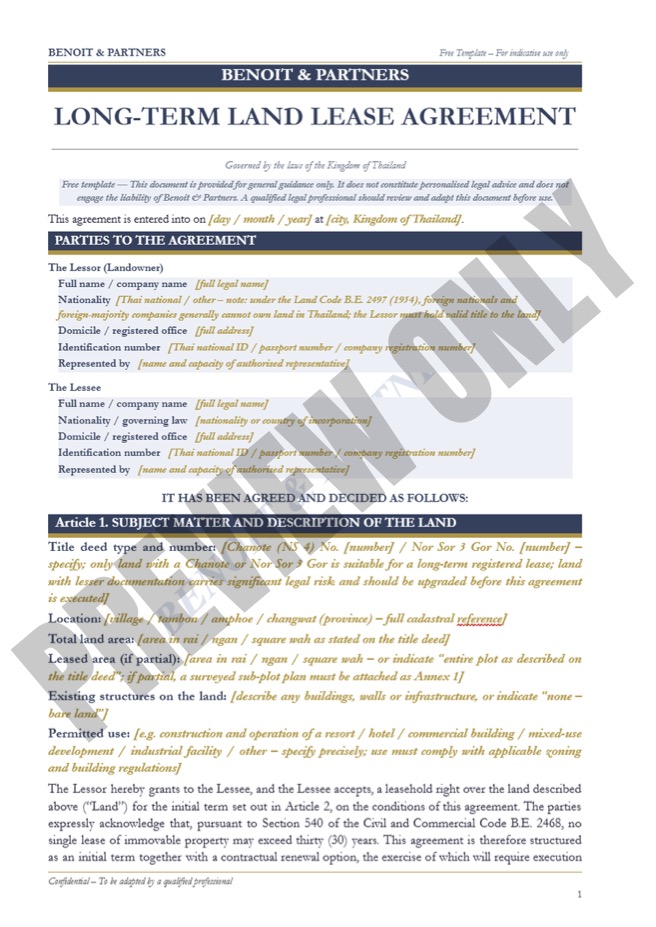
Our Long-Term Land Lease Agreement in Thailand is drafted and reviewed by experienced lawyers to ensure compliance with Thai law and practical business use. It provides a reliable legal framework for formally setting out the terms of an extended land lease arrangement between a landowner and a tenant in Thailand.
Designed for landowners, developers, and investors seeking to establish a long-term leasing arrangement over land in Thailand, this template covers key legal aspects such as identification of the parties and the land, the lease term and renewal mechanism, registration requirements, and compliance with applicable provisions of the Thai Civil and Commercial Code governing extended lease arrangements.
However, some situations may require additional clauses or tailored structuring depending on the intended development of the land, the involvement of foreign investors, financing arrangements secured against the leasehold interest, or the structuring of renewal rights. Our legal team can assist clients with customised Long-Term Land Lease Agreements adapted to their specific situation within a short timeframe.
Disclaimer: This template is provided for general informational purposes only and does not constitute legal advice. While it has been prepared by legal professionals, it may not reflect your specific situation or regulatory constraints. For significant long-term land transactions, legal advice should be sought to ensure proper structuring and compliance under Thai property law.
Need a Contract Tailored to Your Needs? Get a Free Consultation.
When should you use a Long-Term Land Lease Agreement in Thailand?
A Long-Term Land Lease Agreement in Thailand is required whenever a landowner agrees to lease land to a tenant for an extended period, typically approaching the statutory maximum, in order to support significant investment, development, or long-term occupation of the land.
Under Thai law, the Civil and Commercial Code sets a maximum lease term of thirty years for land leases, and any lease exceeding three years must be registered at the competent Land Office to be enforceable for its full duration against third parties.
This document is especially important where the tenant intends to undertake substantial development, construction, or investment on the land, since the extended commitment requires a more comprehensive allocation of risk between the parties than a short-term arrangement.
For long-term leases involving foreign investors, BOI-promoted projects, or arrangements where the leasehold interest may be used as security for financing, additional structuring is often necessary to address renewal mechanisms and the treatment of improvements.
Without a properly executed Long-Term Land Lease Agreement, both landowner and tenant risk significant legal and financial exposure arising from disputes over renewal rights, registration status, or the treatment of investment made on the land.

1. Identification of the Parties and the Land
The agreement should identify the landowner and tenant by full name and address, and describe the land precisely by reference to its title deed number, location, and area.
2. Lease Term and Renewal Mechanism
Given the statutory thirty-year maximum, the agreement should clearly state the initial term and set out any agreed mechanism for renewal, recognising that renewal commitments beyond the statutory limit are not directly enforceable and require separate registration upon renewal.
3. Rent and Periodic Review
The agreement should specify the rent payable and include a mechanism for periodic review over the extended term, such as fixed increases or indexation, to account for changing market conditions.
4. Permitted Use and Development Rights
A clear statement of the permitted use of the land and any development rights granted to the tenant, including any restrictions on the nature or scale of construction.
5. Treatment of Improvements
Given the scale of investment typical in long-term leases, the agreement should address in detail the ownership and treatment of buildings and improvements both during the term and upon its expiry.
6. Registration and Associated Costs
The agreement should set out the parties' respective obligations regarding registration at the Land Office, including responsibility for registration fees and any applicable taxes.
Key Clauses and Essential Elements in a Long-Term Land Lease Agreement
A Long-Term Land Lease Agreement in Thailand is a central legal document governing an extended relationship between a landowner and a tenant in Thailand. Given the length of the commitment involved, it must address a broader range of contingencies than a standard short-term lease.
Under the Civil and Commercial Code, leases exceeding three years must be registered at the Land Office to be enforceable for their full duration. A properly drafted long-term agreement reduces legal uncertainty over an extended period and protects both parties against disputes over interpretation or performance.
In addition to defining the lease term and rental conditions, a comprehensive Long-Term Land Lease Agreement should address matters such as rent adjustment mechanisms, maintenance obligations, construction rights, ownership of improvements, transfer restrictions, inheritance issues, renewal options, and termination procedures.
Why customise a Long-Term Land Lease Agreement with a lawyer in Thailand?
While a standard template of Long-Term Land Lease Agreement in Thailand may serve simple short-term arrangements, long-term land leases involve financial, legal, and regulatory considerations that require more advanced drafting and tailored protections given the extended duration involved.
In practice, each long-term lease carries its own risk profile. Factors such as the scale of intended development, the involvement of foreign investors, financing requirements, and the treatment of renewal rights can significantly affect the legal framework required.
Depending on the transaction, specific provisions may be needed covering structured renewal mechanisms, mortgage or security arrangements over the leasehold interest, compensation formulas for early termination, or tailored dispute resolution procedures suited to a long-term relationship.
Customising a Long-Term Land Lease Agreement allows the parties to allocate responsibilities clearly and anticipate risks specific to an extended commitment. This is particularly important for development projects, BOI-promoted investments, or arrangements involving significant capital expenditure.
Our legal team assists landowners, developers, and investors with the preparation of long-term land lease agreements adapted to their particular situation, ensuring compliance with Thai property and investment law.
Long-Term Land Lease Agreement Thailand
Instant Download
Easy to Customize
Ready to Sign
Crafted by Lawyers
FAQ
What is a Long-Term Land Lease Agreement in Thailand?
A contract under which a landowner grants a tenant the right to use land for an extended period, typically approaching the statutory maximum, in exchange for rent, with detailed provisions addressing development, renewal, and the treatment of improvements.
What is the maximum term for a long-term land lease in Thailand?
The Civil and Commercial Code sets a maximum lease term of thirty years. Leases for longer periods are not enforceable beyond this limit, although the parties may agree to renew the lease for a further period upon expiry.
Can a long-term land lease be renewed beyond thirty years in Thailand?
A renewal commitment can be included in the original agreement, but Thai law does not generally permit pre-registration of a renewal beyond the initial thirty-year term. Each renewal typically requires fresh registration at the Land Office.
Can a long-term leasehold interest be used as security for financing in Thailand? A
A registered leasehold interest can, in principle, be used as security for financing, subject to the lender’s assessment of the remaining lease term and the specific provisions of the lease agreement regarding assignment and mortgage.
Who bears the cost of registering a long-term land lease in Thailand?
Responsibility for registration fees and taxes is a matter of negotiation between the parties and should be clearly allocated in the lease agreement, though Thai practice commonly splits these costs or assigns them to the tenant.
What happens to buildings constructed by the tenant when a long-term lease expires in Thailand?
The treatment of buildings and improvements at the end of the term depends entirely on the provisions of the lease agreement. Some agreements provide for the structures to revert to the landowner, while others provide for compensation or removal.
Can foreign investors hold long-term land leases in Thailand?
Yes. Long-term leasing is a common and lawful structure for foreign investors seeking long-term land use rights in Thailand, given the restrictions on direct foreign land ownership, subject to the statutory maximum term and registration requirements.
How does the PDPA apply to a Long-Term Land Lease Agreement in Thailand?
Where the agreement contains personal data relating to the landowner, tenant, or their representatives, the parties must handle that data in accordance with the Personal Data Protection Act B.E. 2562 (2019), using it only for purposes connected with the lease.