
Minutes of Meeting in Thailand
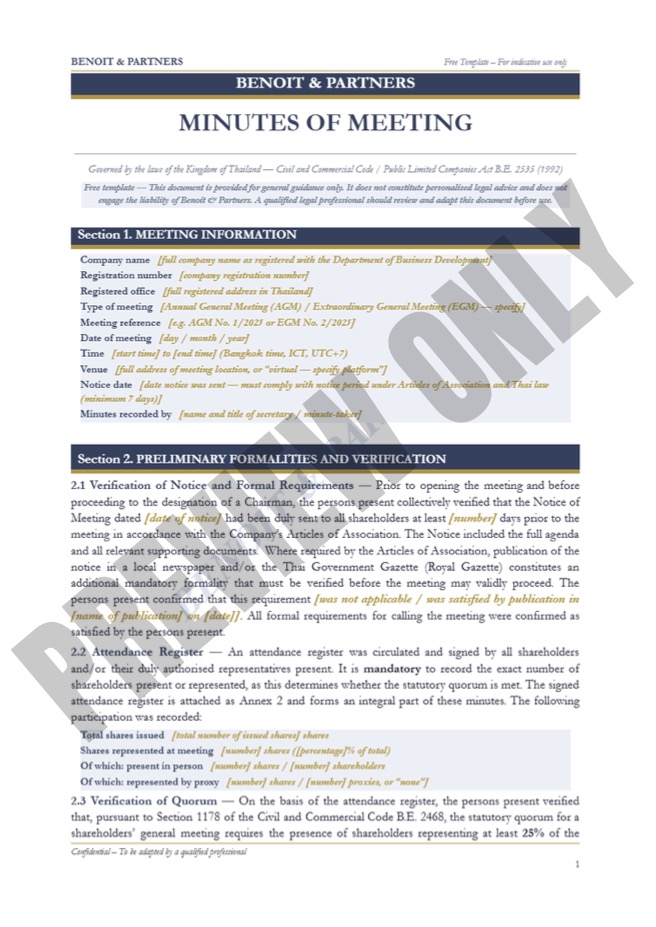
Our Minutes of Meeting in Thailand is drafted and reviewed by experienced lawyers to ensure compliance with Thai law and practical business use. It provides a reliable legal framework for formally recording the proceedings, decisions, and resolutions of corporate, shareholder, or board meetings in Thailand.
Designed for companies, directors, and corporate secretaries seeking to maintain accurate and legally compliant records of meetings held in Thailand, this template covers key legal aspects such as identification of the meeting and attendees, the agenda items discussed, resolutions passed, voting results, and compliance with the record-keeping requirements set out in the Civil and Commercial Code and the Public Limited Companies Act, where applicable.
However, some situations may require additional clauses or tailored structuring depending on the type of meeting being held, the nature of the resolutions passed, applicable quorum and voting requirements, or specific provisions in the company’s articles of association. Our legal team can assist clients with customised a Minutes of Meeting adapted to their specific situation within a short timeframe.
Disclaimer: This template is provided for general informational purposes only and does not constitute legal advice. While it has been prepared by legal professionals, it may not reflect your specific situation or regulatory constraints. For meetings involving significant corporate resolutions or regulatory filings, legal advice should be sought to ensure proper structuring and compliance under Thai corporate law.
Need a Contract Tailored to Your Needs? Get a Free Consultation.
When should you use Minutes of Meeting in Thailand?
Minutes of Meeting in Thailand are required whenever a Thai company holds a formal meeting of its shareholders, board of directors, or other constituted corporate body, in order to create an official and legally recognised record of the proceedings. Common occasions include annual general meetings, extraordinary general meetings, regular board meetings, and meetings convened to approve specific corporate actions such as capital increases, the appointment of directors, or the approval of financial statements.
Under the Civil and Commercial Code, companies are required to maintain accurate records of shareholder and board resolutions, and certain resolutions such as those amending the articles of association or approving a change in registered capital must be evidenced by properly recorded minutes in order to support subsequent filings with the Department of Business Development.
A properly prepared set of minutes provides essential evidence of what was decided, by whom, and on what basis, protecting the company and its directors against later disputes about the validity or content of a resolution. It also forms a critical part of the documentary trail required for many regulatory filings and corporate transactions.
Failing to keep accurate minutes exposes a company to significant practical and legal risk, including difficulty in proving the validity of past resolutions, complications in subsequent corporate filings, and potential challenges to the legitimacy of decisions taken at the relevant meeting.

1. Meeting Identification
The minutes should identify the type of meeting, the company name and registration number, the date, time, and venue of the meeting, and the meeting number or reference where applicable.
2. Attendance Record
A complete record of those present, including directors, shareholders, proxies, and any invited persons, together with confirmation that the requisite quorum was met, is essential to the validity of the meeting.
3. Chairperson and Secretary
The minutes should record the name of the person chairing the meeting and the person acting as secretary or minute-taker, confirming their authority to act in those roles.
4. Agenda Items
Each item of business considered at the meeting should be listed in the order discussed, providing a clear structure for the substantive content of the minutes.
5. Discussion Summary
A concise summary of the key points raised in discussion of each agenda item should be recorded, sufficient to provide context for the resolution ultimately passed without descending into an unnecessarily detailed transcript.
6. Resolutions and Voting Results
Each resolution put to the meeting should be recorded precisely, together with the voting result, including the number of votes in favour, against, and abstaining, where applicable.
Key Clauses and Essential Elements in Minutes of Meeting
Properly drafted Minutes of Meeting in Thailand provide a clear, accurate, and legally reliable record of what transpired at a corporate meeting, ensuring that the company has the documentary evidence needed to support its decisions and to comply with applicable filing and record-keeping obligations.
Under Thai corporate law, certain types of resolution must be supported by properly executed minutes before they can be relied upon for regulatory filings or third-party transactions.
The accuracy and completeness of the minutes are therefore directly relevant to the legal effectiveness of the decisions they record.
This document is used across all types of Thai corporate entities from limited companies to public companies and its content will vary depending on whether it records a board meeting, a shareholders’ meeting, or a meeting of a specific committee.
Why customise Minutes of Meeting with a lawyer in Thailand?
A standard template of Minutes of Meeting in Thailand is suitable for routine board or shareholder meetings, but certain situations call for more careful drafting to ensure the minutes withstand later scrutiny.
Meetings involving significant corporate actions such as capital restructuring, mergers, the removal of a director, or resolutions affecting minority shareholder rights, require minutes that are precise, legally robust, and properly aligned with the company’s articles of association and the requirements of the Civil and Commercial Code.
Depending on the situation, the minutes may need to address specific quorum and voting threshold requirements applicable to particular resolutions, the proper recording of dissenting votes or objections, the interaction with simultaneous regulatory filings, or the certification requirements for minutes intended to be submitted to third parties such as banks or government authorities.
Our legal team works with companies and corporate secretaries to prepare minutes that are accurate, properly structured, and capable of supporting the full range of corporate and regulatory purposes for which they may be required.
Minutes of Meeting Thailand
Instant Download
Easy to Customize
Ready to Sign
Crafted by Lawyers
FAQ
What are Minutes of Meeting in Thailand?
A formal written record of the proceedings, discussions, and resolutions of a corporate meeting, prepared to provide legal evidence of what was decided and to support subsequent corporate filings and actions.
Are companies in Thailand legally required to keep Minutes of Meeting?
Yes. Under the Civil and Commercial Code, companies are required to maintain records of shareholder and board resolutions, and certain corporate actions cannot be validly completed or registered without properly recorded minutes.
How long must Minutes of Meeting be retained in Thailand?
Companies are generally expected to retain corporate records, including minutes, for the lifetime of the company, as they may be required to evidence historical resolutions at any point during the company’s existence.
Who is authorised to sign Minutes of Meeting in Thailand?
The minutes are typically signed by the chairperson of the meeting and may also be certified by the company secretary or another authorised signatory, depending on the company’s internal practices and articles of association.
Can Minutes of Meeting be held and signed electronically in Thailand?
Yes, subject to the company’s internal policies and applicable electronic transactions law, provided the electronic record can be reliably attributed to the signatory and retained in an accessible format.
What happens if Minutes of Meeting are inaccurate or incomplete in Thailand?
Inaccurate or incomplete minutes can undermine the legal validity of the resolutions they purport to record, create difficulties with subsequent regulatory filings, and expose the company and its directors to challenges from shareholders or third parties.
Must Minutes of Meeting be filed with a government authority in Thailand?
Minutes themselves are not always filed directly, but certain resolutions recorded in the minutes such as changes to registered capital or amendments to the articles of association must be supported by minutes when the corresponding filing is submitted to the Department of Business Development.
How does the PDPA apply to Minutes of Meeting in Thailand?
Where the minutes record personal data of attendees, directors, or shareholders, the company must ensure that such data is handled, stored, and disclosed in accordance with the Personal Data Protection Act B.E. 2562 (2019).