
Money Receipt in Thailand
Our Money Receipt in Thailand is drafted and reviewed by experienced lawyers to ensure compliance with Thai law and practical business use. It provides a reliable legal framework for formally acknowledging the receipt of a payment from one party to another in Thailand, creating a clear and legally sound record of the transaction.
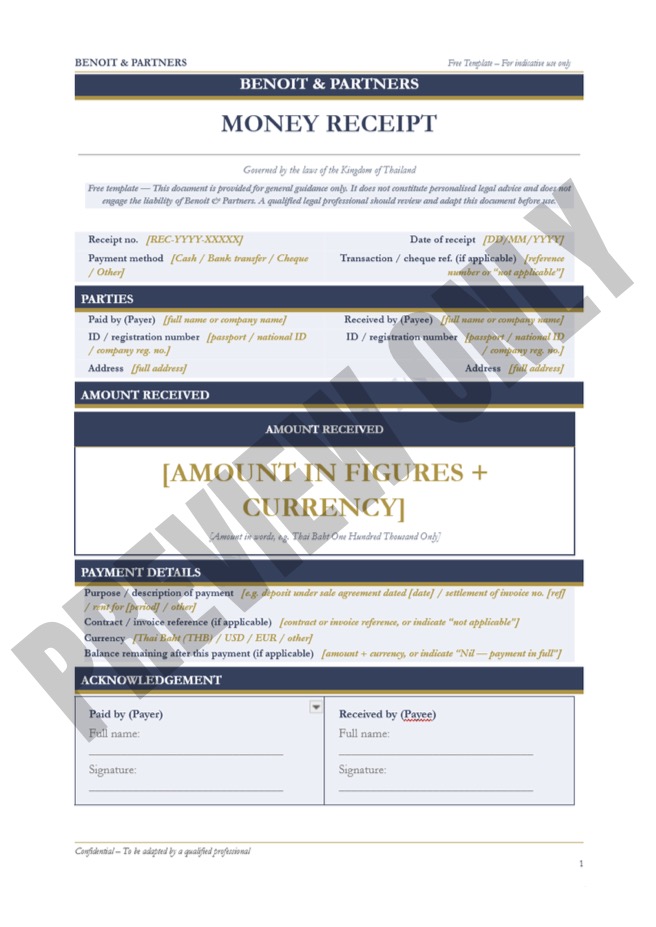
Designed for businesses, landlords, service providers, and individuals seeking to document the receipt of funds in Thailand, this template covers key legal aspects such as identification of the parties, the amount received, the date and method of payment, the purpose or basis of the payment, and compliance with applicable Thai commercial and tax documentation requirements.
However, some situations may require additional clauses or tailored structuring depending on the nature of the underlying transaction, the tax status of the parties, the currency of the payment, or the specific documentation requirements of the relevant authority or counterparty. Our legal team can assist clients with customised Money Receipts adapted to their specific situation within a short timeframe.
Disclaimer: This template is provided for general informational purposes only and does not constitute legal advice. While it has been prepared by legal professionals, it may not reflect your specific situation or regulatory constraints. For transactions involving significant sums, cross-border payments, or regulated activities, legal advice should be sought to ensure proper documentation and compliance under Thai law.
Need a Contract Tailored to Your Needs? Get a Free Consultation.
When should you use a Money Receipt in Thailand?
A Money Receipt in Thailand is the appropriate document whenever one party receives a payment from another and wishes to create a formal and documented record of that receipt. Common situations include the receipt of rent under a lease agreement, payment for goods supplied or services rendered, a deposit paid in advance of a contract, a loan repayment, or any other cash or non-cash transfer between parties in a commercial or personal context.
Thai commercial law and tax regulations impose documentation requirements on a range of payment transactions. For VAT-registered businesses, the issuance of a tax invoice is required for taxable supplies, and a receipt forms part of the documentation chain that supports the business’s tax compliance obligations.
Issuing a formal written receipt carries clear practical advantages for both parties. The payer receives documented confirmation that their payment has been received, protecting them against any future claim that the payment was not made. The recipient creates a clear record of the funds received, which supports accurate accounting and facilitates the reconciliation of payments against outstanding obligations.
More complex payment situations may require additional elements in the receipt, such as a reference to the underlying contract, a breakdown of the amounts received across multiple payment heads, or confirmation of the outstanding balance remaining after the payment. Our legal team is available to assist with tailored receipts that address these requirements accurately and completely.
Without a properly issued receipt, both the payer and the recipient are exposed to the risk of future disputes about whether a payment was made, when it was made, and what it was intended to cover.

1. Identification of the Parties
The receipt should clearly state the full name and contact details of the party issuing the receipt and the party making the payment, together with any relevant account or reference numbers that link the receipt to the underlying transaction.
2. Amount Received
The total amount received should be stated in both figures and words to eliminate any risk of error or dispute. Where the payment is made in a foreign currency, the equivalent amount in Thai Baht at the applicable exchange rate should also be noted.
3. Date of Receipt
The date on which the payment was received should be stated precisely, as this is the reference point for accounting, tax, and legal purposes and may be critical in any subsequent dispute about the timing of payment.
4. Method of Payment
The receipt should specify how the payment was made whether by cash, bank transfer, cheque, credit card, or other electronic means.
5. Purpose of the Payment
A clear description of what the payment relates to whether rent for a specified period, payment for identified goods or services, repayment of a loan instalment, or another defined obligation.
6. Outstanding Balance
Where the payment forms part of a series of instalments or does not discharge the full amount owed, the receipt should note the total amount due, the amount received, and the balance remaining, providing a clear running record of the payment position.
Key Clauses and Essential Elements in a Money Receipt
A well-prepared Money Receipt in Thailand provides both parties with a clear, accurate, and complete record of the payment transaction.
It identifies the parties involved, specifies the amount and date of payment, describes the purpose for which the payment was made, and confirms the method by which it was received.
Under Thai tax law, receipts and payment records form part of the documentary basis on which a business’s tax obligations are assessed. A properly issued receipt that accurately records the relevant details of the transaction is an important element of good accounting practice and supports compliance with applicable reporting requirements.
This document is relevant across all categories of payment from individual consumer transactions to large commercial settlements and is applicable whether the payment is made in Thai Baht or in a foreign currency, by cash, bank transfer, cheque, or electronic means.
Why customise a Money Receipt with a lawyer in Thailand?
A standard Money Receipt template in Thailand is adequate for routine payment transactions, but a range of situations call for a more carefully structured document to ensure that the record is legally accurate and complete.
The nature of the underlying transaction, the tax status of the parties, and the regulatory context in which the payment is made all influence what the receipt needs to contain. A receipt that forms part of a series of instalment payments, documents a foreign currency transaction, or relates to a regulated activity such as a property lease or financial service may require additional content and specific legal language.
In some cases, additional provisions may be required to address: the VAT treatment of the payment and the interaction with the supplier’s tax invoice obligations; the withholding tax implications for the payer; the currency conversion methodology and the applicable exchange rate; the interaction between the receipt and the terms of the underlying contract; or PDPA considerations arising from the personal data contained in the receipt.
Our legal team works with businesses and individuals to prepare money receipts that are accurate, complete, and consistent with the applicable tax and legal requirements. The result is a document that both parties can rely on with confidence as a definitive record of the payment.
Money Receipt Thailand
Instant Download
Easy to Customize
Ready to Sign
Crafted by Lawyers
FAQ
What is a Money Receipt in Thailand?
A formal written document issued by the recipient of a payment that confirms the amount received, the date of receipt, the method of payment, and the purpose for which the payment was made, creating a clear and documented record of the transaction for both parties.
Is a Money Receipt legally required in Thailand?
Thai law does not impose a universal requirement to issue a receipt for every payment, but VAT-registered businesses are required to issue a tax invoice for taxable supplies, and a receipt forms part of the documentation chain supporting tax compliance. For non-VAT transactions, issuing a receipt is strongly advisable as a matter of good commercial practice.
What is the difference between a Money Receipt and a Tax Invoice in Thailand?
A tax invoice is a statutory document issued by a VAT-registered business that records the supply of taxable goods or services and forms the basis of the recipient’s VAT input credit claim. A money receipt acknowledges the receipt of payment and may or may not coincide with the issuance of a tax invoice depending on the timing of payment relative to supply.
Should a Money Receipt be issued for cash payments in Thailand?
Yes. A receipt for a cash payment is particularly important as cash transactions leave no independent payment trail. A properly issued receipt is the primary evidence that a cash payment was made and is especially valuable if the transaction is later disputed.
How should a Money Receipt record a payment made in foreign currency in Thailand?
Where a payment is received in a foreign currency, the receipt should state the amount in the original currency and, where relevant, the equivalent amount in Thai Baht at the applicable exchange rate, together with the source of that rate. This ensures clarity for accounting and tax purposes.
Can a Money Receipt be issued electronically in Thailand?
Yes, provided the parties have agreed to accept electronic documents and the receipt is issued in a format that can be reliably stored and retrieved. Electronic receipts should include all the same information as a paper receipt and should be accompanied by a delivery confirmation where possible.
What are the withholding tax implications of issuing a Money Receipt in Thailand?
Where the payment documented in the receipt is subject to withholding tax — for example, payments for services rendered by a company the payer is required to withhold the applicable rate of tax at source and to issue a withholding tax certificate to the recipient. The receipt should be consistent with the withholding tax documentation.
How does the PDPA apply to a Money Receipt in Thailand?
Where the receipt contains personal data such as the name and address of an individual payer that data must be handled in accordance with the Personal Data Protection Act B.E. 2562 (2019), stored securely, and used only for the purpose of recording and documenting the payment transaction.