
Motorcycle Sales Agreement in Thailand
Our Motorcycle Sales Agreement in Thailand is drafted and reviewed by experienced lawyers to ensure compliance with Thai law and practical business use. It provides a reliable legal framework for formally documenting the sale and purchase of a motorcycle between a seller and a buyer in Thailand.
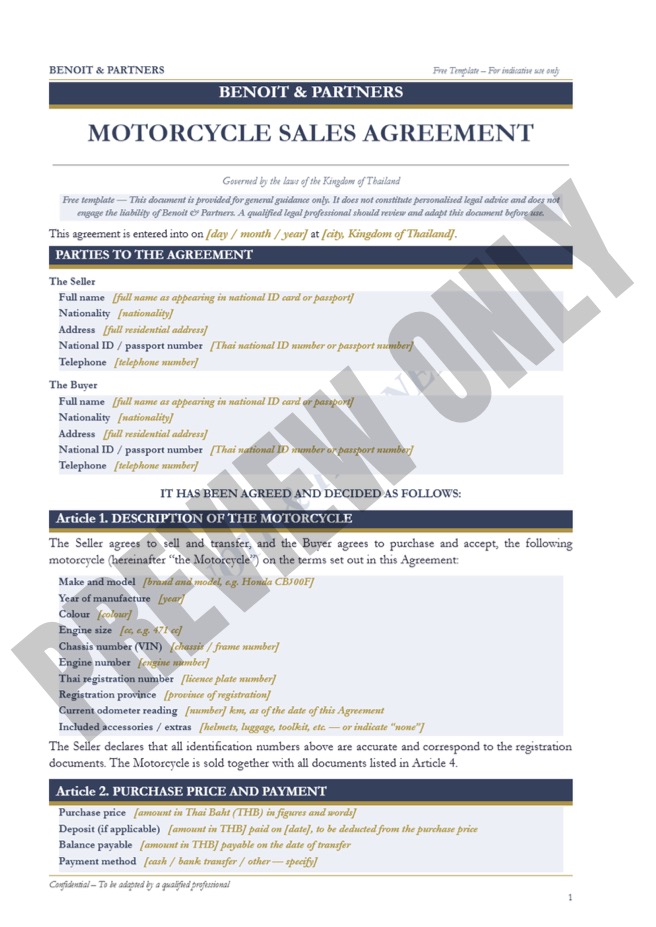
Designed for individuals, dealers, and businesses seeking to formally document the transfer of ownership of a motorcycle in Thailand, this template covers key legal aspects such as identification of the parties, description and specification of the vehicle, purchase price and payment terms, transfer of ownership and registration obligations, and compliance with applicable Thai civil law and Land Transport Department requirements.
However, some situations may require additional clauses or tailored structuring depending on whether the motorcycle is new or used, the existence of any outstanding finance or lien, the involvement of a dealer or intermediary, or the specific warranty and condition representations being made. Our legal team can assist clients with customised Motorcycle Sales Agreements adapted to their specific situation within a short timeframe.
Disclaimer: This template is provided for general informational purposes only and does not constitute legal advice. While it has been prepared by legal professionals, it may not reflect your specific situation or regulatory constraints. For high-value transactions or vehicles subject to existing finance, legal advice should be sought to ensure proper structuring and compliance under Thai law.
Need a Contract Tailored to Your Needs? Get a Free Consultation.
When should you use a Motorcycle Sales Agreement in Thailand?
A Motorcycle Sales Agreement in Thailand is the appropriate instrument whenever ownership of a motorcycle is being transferred from a seller to a buyer in Thailand, whether the transaction involves a new vehicle sold by a dealer or a used motorcycle sold between private individuals.
Thai law governs the sale of movable property, including motor vehicles, primarily through the Civil and Commercial Code, which sets out the general rules on transfer of ownership, risk, and warranty against defects. Motorcycle ownership and registration in Thailand are separately regulated by the Land Transport Department, which requires the transfer of the vehicle’s registration book (the “Lem Tabian”) to reflect the change of ownership.
Documenting the sale in a formal written agreement carries clear practical advantages. It creates an unambiguous record of the agreed price, the condition of the vehicle at the point of sale, and the responsibilities of each party in completing the registration transfer — protecting both the buyer against undisclosed defects and the seller against disputes over the condition or completeness of the transaction.
More complex transactions may require additional considerations, such as the discharge of an existing hire-purchase agreement or lien registered against the vehicle, the involvement of a dealer as an intermediary, or specific warranty terms for a vehicle sold “as is.” Our legal team is available to assist with tailored agreements that address these dimensions appropriately.
Relying on a verbal agreement or an informal handwritten note, rather than a properly structured contract, leaves both parties exposed to disputes over the agreed terms and creates unnecessary difficulty if the registration transfer is later challenged or delayed.

1. Identification of the Parties
The agreement should state the full name, address, and identification number of both the seller and the buyer, confirming that each has the legal capacity to enter into the transaction.
2. Description of the Motorcycle
A precise description of the vehicle should be included, covering the make, model, year of manufacture, engine and chassis numbers, registration plate number, and colour, so that the vehicle being sold is identified beyond doubt.
3. Purchase Price and Payment Terms
The agreement should state the agreed purchase price in Thai Baht and specify the payment method and timing whether payment is made in full at signing, through a deposit and balance arrangement, or by instalments.
4. Condition of the Vehicle and Warranties
The agreement should set out the condition of the motorcycle at the time of sale, including any known defects, and specify whether the vehicle is sold with a warranty or on an "as is" basis, to manage expectations and reduce the risk of post-sale disputes.
5. Confirmation of Ownership and Absence of Encumbrances
The seller should confirm that they are the legal and registered owner of the motorcycle and that the vehicle is free of any outstanding loan, lien, or other encumbrance, or, where an encumbrance exists, specify how it will be discharged before or at completion.
6. Transfer of Registration
The agreement should specify the process and timeline for transferring the vehicle's registration at the Land Transport Department, including which party is responsible for completing the necessary paperwork and bearing any associated fees.
Key Clauses and Essential Elements in a Motorcycle Sales Agreement
A well-drafted Motorcycle Sales Agreement in Thailand gives both parties a precise and complete record of the transaction, leaving no doubt as to the vehicle being sold, the price agreed, and the obligations each party must fulfil to complete the sale. It protects the buyer’s interest in receiving a vehicle free of undisclosed encumbrances and protects the seller’s interest in receiving full and timely payment.
Under the Civil and Commercial Code, ownership of a motorcycle generally passes upon delivery and payment unless the parties agree otherwise, but registration with the Land Transport Department is what gives the new owner the ability to deal with the vehicle as the recorded owner. A properly drafted agreement coordinates these two elements clearly.
This document is relevant to all categories of motorcycle transaction in Thailand — from private sales between individuals to dealer sales of new or used vehicles — and the core structure remains consistent across these scenarios, with content adjusted according to the specific circumstances of the sale.
Why customise a Motorcycle Sales Agreement with a lawyer in Thailand?
A standard template of Motorcycle Sales Agreement in Thailand serves well for straightforward private sales, but several situations call for a more carefully tailored agreement before the transaction is completed.
The specific circumstances of the sale including whether the motorcycle is subject to existing finance, whether the sale involves a dealer or intermediary, and the value of the vehicle all shape what the agreement needs to address.
Depending on the situation, the agreement may need to cover: the discharge of an existing hire-purchase or lien arrangement and the sequencing of payment against release of the registration book; specific consumer protection obligations applicable to dealer sales; the allocation of responsibility for outstanding traffic fines or insurance; or the treatment of accessories, modifications, or extended warranties included in the sale.
Our legal team works with individuals and dealers to prepare motorcycle sales agreements that are clear, complete, and properly aligned with Thai civil and transport regulations, giving both parties confidence that the transaction has been documented correctly.
Motorcycle Sales Agreement Thailand
Instant Download
Easy to Customize
Ready to Sign
Crafted by Lawyers
FAQ
What is a Motorcycle Sales Agreement in Thailand?
A written contract documenting the sale and purchase of a motorcycle, setting out the identity of the parties, the description of the vehicle, the purchase price, and the obligations each party must fulfil to complete the transfer of ownership and registration.
Is a written agreement legally required to sell a motorcycle in Thailand?
Thai law does not strictly require a written contract for the sale of a motorcycle, but a written agreement is strongly advisable to provide clear evidence of the terms agreed and to support the registration transfer process at the Land Transport Department.
How is ownership of a motorcycle transferred in Thailand?
Ownership is transferred through delivery and payment as agreed between the parties, but the change of registered owner must also be recorded with the Land Transport Department by updating the vehicle’s registration book, which both parties typically attend in person to complete.
What happens if a motorcycle is sold with an outstanding loan in Thailand?
Where a motorcycle is subject to an existing hire-purchase agreement, the finance company retains an interest in the vehicle until the loan is settled. The outstanding balance must generally be paid off and the lien released before the registration can be transferred to a new owner.
Can a Motorcycle Sales Agreement be used for a sale by instalments in Thailand?
The agreement can specify an instalment payment structure, including the deposit amount, the schedule of remaining payments, and the consequences of late or missed payments, while clearly stating when ownership and registration will transfer relative to the payment schedule.
What documents are required to transfer motorcycle registration in Thailand?
Typically required documents include the vehicle’s registration book, the seller’s and buyer’s identification documents, a completed transfer of ownership form, and the sales agreement. Requirements may vary slightly between provincial Land Transport offices.
Who is responsible for unpaid traffic fines after a motorcycle is sold in Thailand?
Unless otherwise agreed, fines incurred before the sale remain the responsibility of the seller, while fines incurred after delivery are the buyer’s responsibility. The agreement should specify the cut-off point clearly to avoid later disputes.
How does the PDPA apply to a Motorcycle Sales Agreement in Thailand?
The agreement contains personal data, including the identification details of both parties. Under the Personal Data Protection Act B.E. 2562 (2019), this information should be used only for the purposes of completing the sale and registration transfer, and stored securely by both parties.