
Non-Disclosure Agreement in Thailand
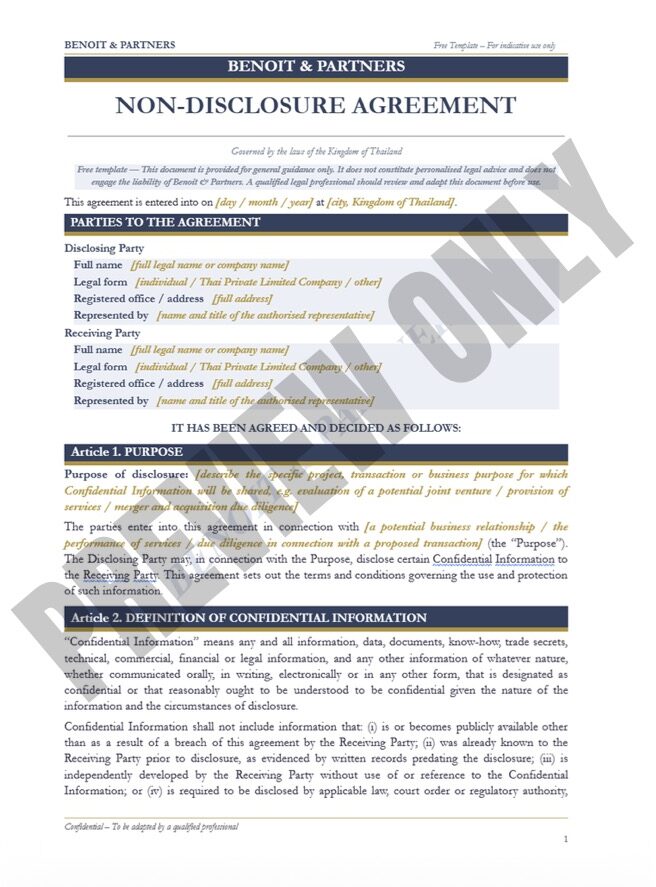
Our Non-Disclosure Agreement in Thailand is drafted and reviewed by experienced lawyers to ensure compliance with Thai law and practical business use. It provides a reliable legal framework for protecting confidential information shared between parties in the context of a commercial relationship, negotiation, or collaborative arrangement in Thailand.
Designed for businesses, entrepreneurs, and individuals seeking to share sensitive information with a counterparty while maintaining legal protection against unauthorised disclosure or use, this template covers key legal aspects such as identification of the parties, the definition of confidential information, the obligations of the receiving party, permitted exceptions, the duration of the confidentiality obligation, and compliance with the Civil and Commercial Code and applicable Thai intellectual property and data protection law.
However, some situations may require additional clauses or tailored structuring depending on the nature of the information being protected, the commercial context in which it is being shared, the relationship between the parties, or the specific risks the disclosing party wishes to guard against. Our legal team can assist clients with customised Non-Disclosure Agreements adapted to their specific situation within a short timeframe.
Disclaimer: This template is provided for general informational purposes only and does not constitute legal advice. While it has been prepared by legal professionals, it may not reflect your specific situation or regulatory constraints. For high-value transactions or situations involving sensitive technical or commercial information, legal advice should be sought to ensure proper structuring and maximum legal protection under Thai law.
Need a Contract Tailored to Your Needs? Get a Free Consultation.
When should you use a Non-Disclosure Agreement in Thailand?
A Non-Disclosure Agreement in Thailand is the appropriate instrument whenever one party needs to share sensitive business information with another party and wishes to ensure that the information is used only for a defined purpose and is not disclosed to unauthorised third parties.
Thai law does not provide a specific statutory framework governing the confidentiality of business information in all commercial contexts, meaning that the parties must rely primarily on the terms of their contractual agreement to protect sensitive information.
The absence of an NDA in situations where sensitive information is being shared creates significant legal and commercial risk. Without a documented confidentiality obligation, the disclosing party may find it difficult to establish that the receiving party was under any duty of confidence, or to quantify and recover the loss resulting from an unauthorised disclosure.
More complex arrangements such as those involving multiple parties, cross-border information sharing, or the disclosure of personal data that is subject to the PDPA require additional provisions that go beyond the scope of a standard bilateral NDA. Our legal team is available to assist with tailored agreements that address these dimensions comprehensively and provide the disclosing party with the strongest possible protection.

1. Identification of the Parties
The agreement should clearly identify the disclosing party and the receiving party by their full legal names and, where applicable, their registered addresses and company registration numbers.
2. Definition of Confidential Information
The agreement should define the scope of confidential information with precision, identifying the categories of information covered whether by reference to subject matter, the form in which it is disclosed, or a specific marking or designation requirement.
3. Obligations of the Receiving Party
The core obligation to maintain the confidentiality of the disclosed information and to use it only for the defined permitted purpose should be set out clearly, together with the standard of care required and any restrictions on access within the receiving party's organisation.
4. Permitted Exceptions
Confidentiality exceptions should be clearly identified and narrowly limited to public information, independently developed information, or disclosures required by law.
5. Duration of the Obligation
The period during which the confidentiality obligation applies should be specified, taking into account the nature of the information and the commercial context.
6. Return or Destruction of Information
The agreement should address the treatment of confidential information at the end of the relationship or the permitted purpose typically requiring the receiving party to return or securely destroy all materials containing confidential information and to certify that this has been done.
Key Clauses and Essential Elements in a Non-Disclosure Agreement
A well-constructed Non-Disclosure Agreement in Thailand gives the disclosing party clear and enforceable protection for its confidential information, while defining the receiving party’s obligations with sufficient precision to be workable in practice. It balances the need for strong legal protection with the commercial reality that the receiving party must be able to use the information for its intended purpose.
The definition of confidential information is the most critical element of any NDA. A definition that is too narrow may fail to protect important categories of sensitive information, while one that is too broad may be unworkable in practice or may be challenged by the receiving party.
This document is relevant across a wide range of commercial relationships and transaction types from bilateral business negotiations to multi-party collaborative projects and the appropriate scope and structure of the agreement will vary depending on the nature of the information being shared and the purpose for which it is disclosed.
Why customise a Non-Disclosure Agreement with a lawyer in Thailand?
A standard Non-Disclosure Agreement in Thailand is adequate for straightforward information-sharing arrangements in routine commercial situations, but a range of circumstances call for a more carefully tailored approach before sensitive information is disclosed.
The nature and sensitivity of the information being shared, the commercial context of the disclosure, and the relationship between the parties all influence what the NDA needs to achieve and how it should be structured.
In certain circumstances, the agreement may also need to address: the treatment of information disclosed orally or visually rather than in writing; the interaction between the NDA and any subsequent commercial agreement between the parties; the specific obligations applicable to subcontractors or advisers of the receiving party who may need access to the information; PDPA considerations where the confidential information includes personal data; the cross-border implications where information is shared between parties in different jurisdictions; or the interaction between the confidentiality obligation and any applicable freedom of information or regulatory disclosure requirements.
Our legal team works with businesses and individuals to prepare Non-Disclosure Agreements that provide genuine and enforceable protection for sensitive information, precisely tailored to the specific nature of the disclosure and the commercial context in which it takes place.
Non-Disclosure Agreement Thailand
Instant Download
Easy to Customize
Ready to Sign
Crafted by Lawyers
FAQ
What is a Non-Disclosure Agreement in Thailand?
A contract through which one or more parties commit to maintaining the confidentiality of information shared between them, using it only for a defined purpose and refraining from disclosing it to unauthorised third parties, in exchange for the opportunity to receive and work with that information.
Is a Non-Disclosure Agreement enforceable in Thailand?
Yes. An NDA that satisfies the general requirements of Thai contract law including offer, acceptance, and consideration — is enforceable through the Thai courts. The disclosing party may seek injunctive relief to prevent or restrain a breach and may claim damages for any loss caused by an unauthorised disclosure.
What is the difference between a unilateral and a mutual NDA in Thailand?
A unilateral NDA imposes confidentiality obligations on one party only typically the recipient of sensitive information. A mutual NDA imposes obligations on both parties, reflecting a situation where both parties are sharing sensitive information with each other. The appropriate structure depends on the nature of the information exchange.
How long should a Non-Disclosure Agreement last in Thailand?
The appropriate duration depends on the nature of the information being protected and the commercial context. Two to five years is common for standard commercial arrangements, while indefinite obligations may be appropriate for genuinely sensitive trade secrets or proprietary technical information that does not lose its value over time.
Can confidential information be protected without a written NDA in Thailand?
In some circumstances, a duty of confidence may arise from the nature of the relationship between the parties for example, in the context of a professional adviser-client relationship. However, relying on implied obligations is considerably less reliable than a written agreement, and a properly documented NDA is strongly advisable whenever sensitive information is shared.
What happens if a party breaches a Non-Disclosure Agreement in Thailand?
The disclosing party may apply to the Thai courts for an urgent injunction to restrain further disclosure or use of the information, and may claim damages for the loss caused by the breach. The availability and quantum of damages will depend on the ability to demonstrate a causal link between the breach and the loss.
Does a Non-Disclosure Agreement protect trade secrets in Thailand?
Yes, to the extent that trade secrets fall within the definition of confidential information in the agreement. Thailand’s Trade Secrets Act B.E. 2545 (2002) provides additional statutory protection for qualifying trade secrets, and an NDA should be structured to complement and reinforce that statutory protection.
How does the PDPA apply to a Non-Disclosure Agreement in Thailand?
Where the confidential information shared under the NDA includes personal data such as customer lists, employee records, or user data both parties must handle that data in accordance with the Personal Data Protection Act B.E. 2562 (2019). The NDA should address the permitted uses of personal data and the obligations of the receiving party regarding its security and eventual return or destruction.