
Notice of Address Change in Thailand
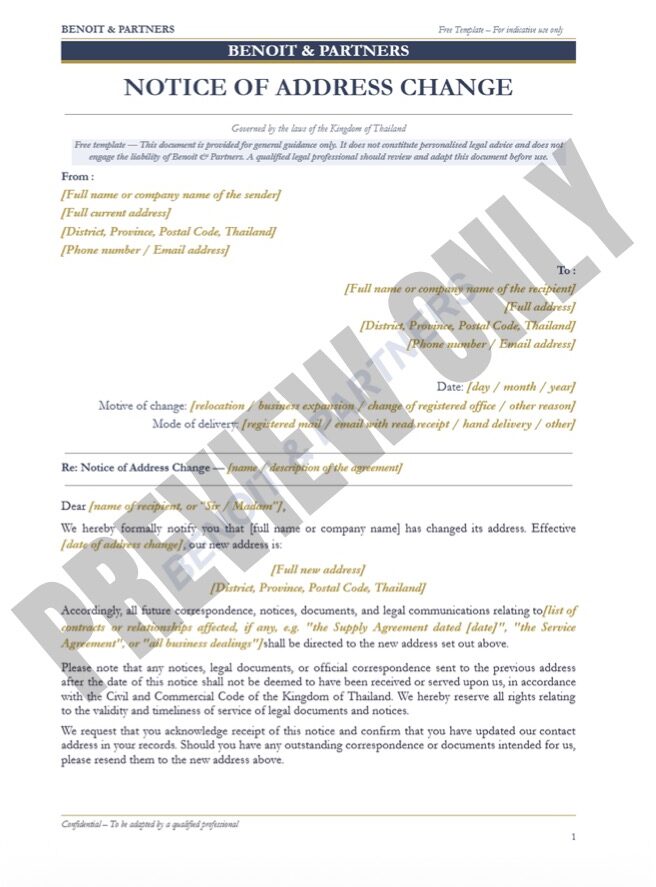
Our Notice of Address Change in Thailand is drafted and reviewed by experienced lawyers to ensure compliance with Thai law and practical business use. It provides a reliable legal framework for formally notifying relevant parties of a change in registered or correspondence address in Thailand.
Designed for individuals, companies, and organisations seeking to formally communicate a change of address to counterparties, public authorities, or regulatory bodies in Thailand, this template covers key legal aspects such as identification of the notifying party, the former and new address details, the effective date of the change, and compliance with applicable Thai civil, commercial, and administrative law requirements.
However, some situations may require additional clauses or tailored structuring depending on the nature of the relationship with the notified party, the type of address being changed, applicable regulatory notification obligations, or the legal consequences that may flow from a failure to notify promptly. Our legal team can assist clients with customised Notices of Address Change adapted to their specific situation within a short timeframe.
Disclaimer: This template is provided for general informational purposes only and does not constitute legal advice. While it has been prepared by legal professionals, it may not reflect your specific situation or regulatory constraints. For complex corporate or regulatory situations where an address change carries legal consequences, legal advice should be sought to ensure proper structuring and compliance under Thai law.
Need a Contract Tailored to Your Needs? Get a Free Consultation.
When should you use a Notice of Address Change in Thailand?
A Notice of Address Change in Thailand is the appropriate instrument when an individual, company, or organisation needs to formally inform one or more parties of a change to their registered or correspondence address in Thailand. Common circumstances include a corporate relocation, a change of registered office for a Thai limited company, a personal address change relevant to ongoing contracts or legal proceedings, or the notification of a new service address to counterparties under existing agreements.
Thai civil and commercial law imposes obligations on both individuals and entities to maintain accurate address records. Under the Civil and Commercial Code, notices delivered to a party’s last known address are generally treated as validly served, meaning that a failure to notify counterparties of an address change can result in a party being bound by communications they never actually received.
For companies registered in Thailand, the Department of Business Development requires that any change of registered address be notified to the competent authority within a prescribed timeframe. Non-compliance can lead to administrative penalties and may affect the company’s regulatory standing.
Formalising the notification in writing creates a dated and documented record of when the change was communicated, protects the notifying party against claims that correspondence sent to the old address was not received, and demonstrates that all applicable notification duties have been properly discharged.
Without a formal written notice, a party relying on informal communications risks being held responsible for correspondence directed to their former address, with potentially significant legal and commercial consequences.

1. Identification of the Notifying Party
The notice should clearly state the full name and, where applicable, the company registration number of the party giving the notice, together with their contact details and the capacity in which the notice is being issued.
2. Former Address
The address previously held on record should be stated precisely, including all relevant details, so that the recipient can verify the change against their existing records and update them without ambiguity.
3. New Address
The replacement address should be set out in full, including any relevant postal code, building name, floor, or unit number, to ensure that future communications are directed correctly from the effective date.
4. Effective Date of the Change
The notice should state the effective date of the new address, as this determines which address applies to communications and any related disputes.
5. Request to Update Records
The notice should request that the recipient update their records and, where appropriate, confirm the change in writing.
6. Scope of the Notification
Where the change applies to a specific relationship, contract, or category of correspondence rather than to all dealings between the parties? this should be stated clearly to avoid confusion about which address applies in which context.
Key Clauses and Essential Elements in a Notice of Address Change
A well-prepared Notice of Address Change Thailand gives the recipient all the information needed to update their records accurately and promptly, while creating a clear and enforceable record of the notification. It sets out the change in unambiguous terms, specifies the date from which the new address takes effect, and confirms any action the recipient is expected to take.
Under Thai law, the address at which a party receives notices and legal communications carries practical and legal significance. A clearly drafted, properly dated notification directed to the right recipient eliminates ambiguity about when the change became effective and ensures that both parties are operating from the same factual basis.
This document is relevant across a wide range of contexts from individual residents and sole traders to large corporations and regulated entities and may be required in connection with contractual relationships, regulatory registrations, court proceedings, or ongoing administrative arrangements.
Why customise a Notice of Address Change with a lawyer in Thailand?
A Notice of Address Change in Thailand is adequate for straightforward address change notifications in routine situations, but a number of circumstances call for a more carefully considered approach before the notice is issued.
The specific context of the change shapes what the notice needs to achieve. A corporate relocation that triggers simultaneous notification obligations to multiple regulatory authorities, a change of address in the context of ongoing litigation, or a notification that must comply with the specific requirements of a contractual notice clause each presents distinct considerations.
Depending on the situation, the notice may need to address the interaction with contractual notice provisions and whether the change requires the counterparty’s consent, the specific format or delivery requirements prescribed by a regulatory authority, PDPA considerations where the notification involves personal data, or the legal consequences of delay in issuing the notice under Thai civil or commercial law.
Our legal team works with individuals and businesses to prepare address change notifications that are accurate, properly targeted, and legally effective. The result is a notice that protects the notifying party, informs the recipient clearly, and satisfies any applicable regulatory or contractual requirements.
Notice of Address Change Thailand
Instant Download
Easy to Customize
Ready to Sign
Crafted by Lawyers
FAQ
What is a Notice of Address Change in Thailand?
A formal written document through which an individual, company, or organisation informs relevant parties of a change to their registered or correspondence address, specifying the new address, the effective date of the change, and any action required of the recipient.
Is there a legal obligation to notify counterparties of an address change in Thailand?
No general statutory obligation applies to all situations, but contractual notice clauses frequently require parties to maintain a current address for service and to notify the other party of any change. For registered companies, the Department of Business Development requires that changes of registered address be filed within a prescribed period.
What happens if a company in Thailand fails to update its registered address?
Failure to notify the Department of Business Development of a registered address change within the required period may result in administrative penalties and can affect the company’s standing with Thai regulatory authorities.
How should a Notice of Address Change be delivered in Thailand?
The appropriate method of delivery depends on the relationship and any applicable contractual requirements. Registered post, email with read receipt, or personal delivery are the most common methods.
Does a change of registered address for a Thai company require court involvement?
No. A change of registered address is an administrative process handled through the Department of Business Development. It does not require court approval, but the relevant filings must be completed within the prescribed timeframe and in the correct format.
Can a Notice of Address Change be issued electronically in Thailand?
Yes, provided the parties have agreed to accept electronic communications or the applicable contractual or regulatory framework permits it. The sender should retain evidence of delivery and receipt in case the notification is later disputed.
How does the PDPA apply to a Notice of Address Change in Thailand?
Where the notice contains personal data — such as the name and new address of an individual — it must be handled in accordance with the Personal Data Protection Act B.E. 2562 (2019). The recipient must use the personal data only for the purpose of updating their records and must store it securely.
What Should You Do After Receiving a Notice of Address Change in Thailand?
The recipient should update their records promptly, confirm receipt to the notifying party where requested, and ensure that all future communications including legal notices are directed to the new address from the effective date stated in the notice.